
Drought Deprives Taiz of Its "Food Basket"… And Women Pay the Price.
In Yemen's Taiz, the climate crisis intersects with conflict impacts, creating a complex situation threatening food and water security and reshaping lives once dependent on land before it dried.
Rania Abdullah
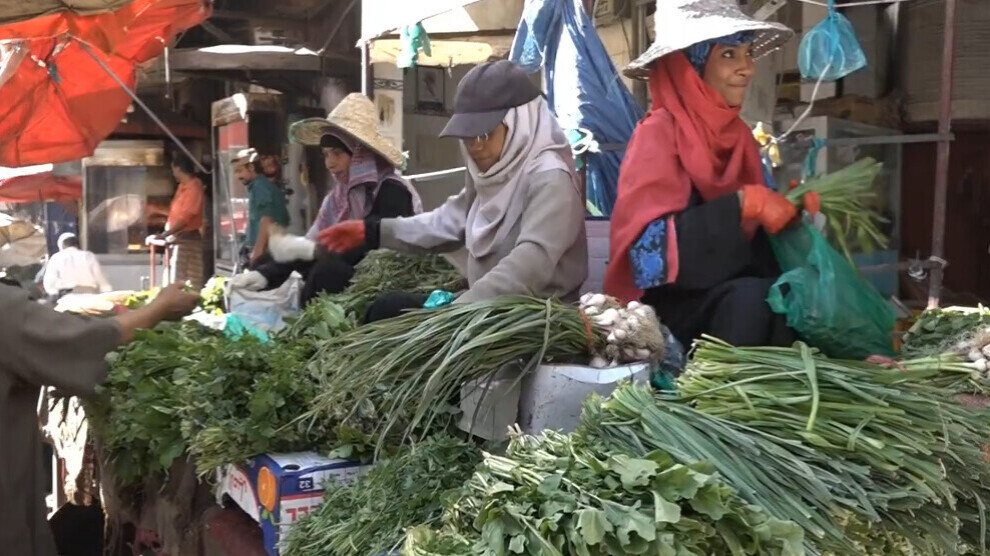
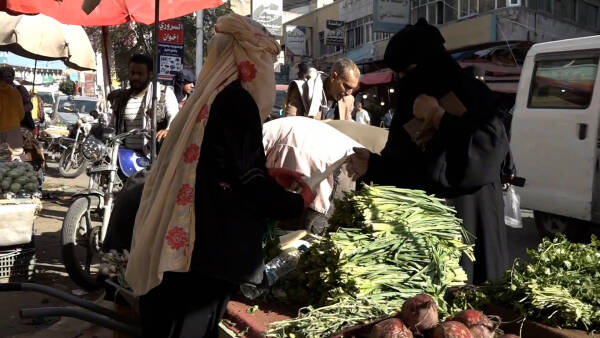
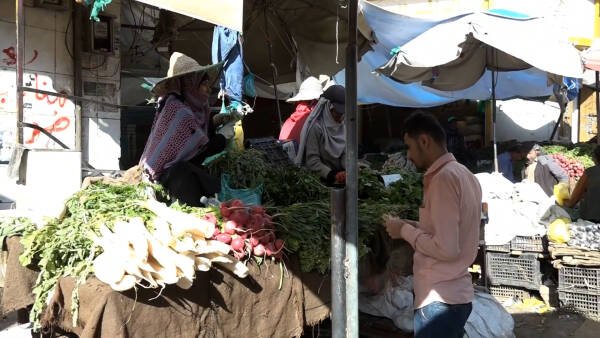
Yemen — Every morning, a group of women make their way through the city of Taiz in southwestern Yemen towards the central vegetable market. They carry what vegetables they can, sitting among piles of leaves and branches, searching for something resembling security for themselves and their children. It is a grueling daily journey, but for them, it is the only option to survive.
For years, Jawhar Ali and her fellow vegetable sellers in the central market were accustomed to bringing produce from Wadi al-Dabab, located about five kilometers from the city center. The valley was a green lung for Taiz and a primary source of vegetables, but this scene has completely changed.
Climate Impact and Neglect
Climate effects have upended the equation. The valley, once teeming with crops, has become arid and dry this year, forcing the sellers to bring vegetables from outside the city. This is an expensive choice that has multiplied their losses due to rising transportation costs and the ongoing siege on the city resulting from the conflict that has persisted for 12 years.
Jawhar Ali says, "We are trying to secure our livelihood from selling vegetables. What we get doesn't cover the medicine my family needs. Now, we are forced to bring vegetables from faraway areas because the farms we used to supply from no longer have crops this year."
For her part, Amira Ali, a vegetable seller who supports her family from this work, explains how a simple trade turned into a losing equation. "We used to buy vegetables from the al-Dabab farm at a suitable price. Now, due to the lack of rain and the drying up of wells, farmers are no longer cultivating. So, we are forced to bring vegetables from distant areas, which costs us extra for transportation. With the siege, the costs double and we lose more. Even the checkpoint levies (taxes) take fees for the vegetables entering the city, and in the end, we barely have enough to cover our expenses."
A Compound Crisis
Behind these testimonies lies a complex crisis that goes beyond the market. A 2023 study published by the World Bank titled "Charting a Course: A Diagnostic of Water Security in Yemen" cites Taiz as a stark example of the overlap between natural scarcity and armed conflict. Water, even before the war, was a cause of 70% to 80% of rural conflicts.
But the situation in Taiz has grown more complicated with the drying up of the Al-Haima wells, intensified competition among well owners, and the refusal of local communities in "Wadi Hudhayr" to cede their water rights to the city. As a result, residents have been forced to buy water at high prices from private tanker trucks, amidst the breakdown of official networks.
This coincides with Yemen being classified as the region's most vulnerable country to the impacts of climate change (ranked 27th globally). Rising temperatures by approximately 0.8 degrees Celsius have increased evaporation and reduced available water quantities, amidst expectations of longer droughts and more severe floods that could push about 70% of farmers to abandon their lands.
Simultaneously, groundwater depletion continues at an alarming rate. Qat cultivation alone consumes 32% of total water withdrawal, amidst the spread of over 100,000 unlicensed wells and the widespread use of solar-powered pumps.
Barren Farms
From amidst the dry farmland, farmer Daliya Muhammad details the agricultural collapse in Wadi al-Dabab. She says the absence of vegetable and fruit crops is due to multiple factors, most notably climate changes, disrupted rainfall patterns, and the emergence of unfamiliar agricultural pests.
However, the most significant reason is the drying up of the valley's water basin, located west of Taiz. This basin was originally designated only as a reserve, but it became the primary water source since the start of the conflict, after water sources east of the city went out of service as they fell under Houthi control.
During the years of conflict, there was intensive reliance on the wells of Wadi al-Dabab to supply the city with water, concurrent with an increase in population, leading to unprecedented rates of water extraction. Daliya Muhammad adds that extraction occurs around the clock, without any regulation or rationing. This has resulted in the drying up of a large number of wells; approximately 25 wells owned by farmers have gone completely out of service. With them, agriculture has nearly ceased, most farms have dried up, and they are now threatened with desertification.
This collapse has not only eliminated a source of income for farmers but has also stripped Taiz of its food basket that it once relied upon. Moreover, these farms used to export their high-quality products to other cities.
The social impact has been clear, particularly on women, as agriculture represented the sole source of income for many families, who found themselves in a deteriorated economic situation this year.
Parallel to this, the crisis is exacerbated by the continued random drilling of wells. Daliya Muhammad points out that interventions by relevant authorities lack clear studies and are often limited to drilling new wells, which depletes what remains of the water basin in the absence of any oversight or regulation.
If the relevant authorities do not expedite finding real solutions, everyone will face a compounded problem. The World Bank has warned that the cost of inaction could reach 15% of the Gross Domestic Product, calling for investment in rainwater harvesting, moving towards seawater desalination for cities like Taiz, in addition to using remote sensing technologies to curb random drilling.
Thus, the drought in Wadi al-Dabab appears not merely as a transient climate crisis, but as an accelerating trajectory towards an entire city losing its resources, and women who continue every morning searching for a livelihood that no longer comes from the land itself.