
Pollution in Lake Van threatens life, prompting calls for permanent rather than temporary solutions
Dredging operations to remove bottom sludge in Lake Van began in April; however, environmental experts stress that this step is merely a temporary measure and does not represent a fundamental solution to the problem.
Mimihan Helbin Zidan
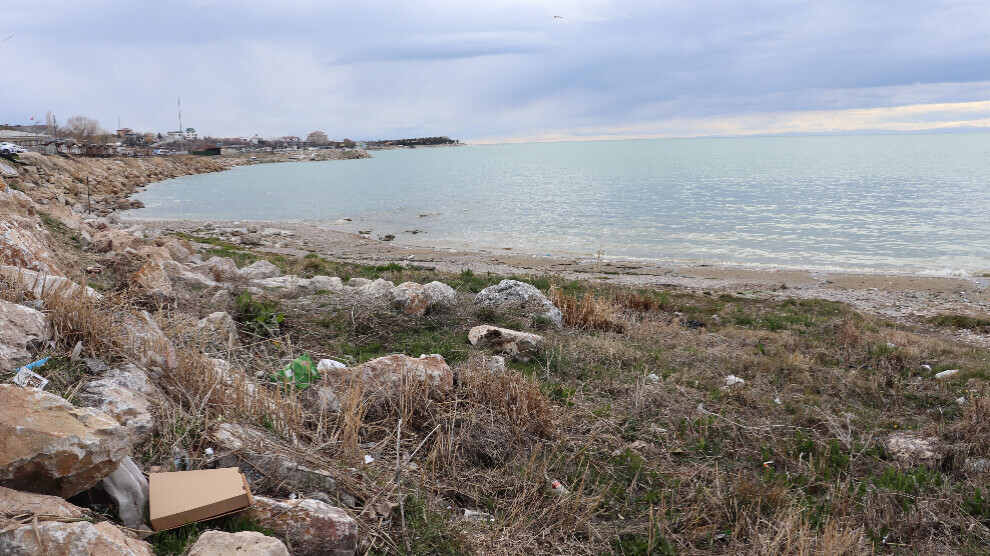
Van — Lake Van is considered an important basin in the region, with a shoreline stretching 450 kilometers and a surface area of 3,570 square kilometers. It is surrounded by one province, six districts, and 136 villages, in addition to industrial facilities. Population growth in the region contributes to increasing pollution in the lake basin.
The mixing of untreated waste with the lake, the lack of sufficient cleaning efforts in and around it, and general neglect toward nature all threaten the lives of living organisms around Lake Van.
In the 1990s and early 2000s, the lake’s water level rose, flooding wastewater treatment plants and sewage systems at the time. As a result, waste mixed directly with the lake water and accumulated along the shores as dense sludge.
Between 2021 and 2024, with the operation of wastewater treatment plants, pollution flowing into the lake decreased by more than 90%. However, sludge accumulated from the past continued to put pressure on the lake’s ability to “self-clean,” which led to a focus on mechanical cleaning.
Between 2025 and 2026, more than two million cubic meters of sludge were removed, helping to improve the coastal ecosystem, including microbialites and the migration routes of the “Inci Kefali” fish. Nevertheless, the risk still remains.

“The cleaning method used is not environmentally friendly,” said Ayşe Ergün, a member of the Van Environmental Association (EKO-DER). She explained that dredging bottom sludge is not an ecological solution but rather a short-term fix, while the long-term solution lies in fully operating wastewater and treatment plants. However, the continued mixing of river water and sewage directly into the lake at the work site further complicates the problem. By April 2026, the lake can be said to have started to “breathe,” but permanent solutions are still needed.
She also noted that 2,086,000 cubic meters of sediment had been removed, stressing the importance of ecological balance. “Until 2021, we were monitoring bird migration routes, and birds had begun to return to the region and reclaim their natural habitats. However, there are unpleasant odors, especially in the Edremit area, where people can no longer sit. This pollution also has serious impacts on human health and may lead in the long term to infectious diseases.”
Ayşe Ergün pointed out that there is a broader infrastructure problem across the country, noting that similar issues are faced in Van. “These problems must be solved. The mixing of sewage with the lake must be prevented, and an appropriate system should be developed. Local administrations bear significant responsibility, and different models—especially in urban planning and infrastructure—can be tested.”
She added that another fundamental issue is mechanical accumulation, as all pollutants carried by rivers return in the form of bottom sludge. “The issue is not cleaning the sludge, but preventing its formation in the first place. Pollution can be reduced at its source, and mechanical rehabilitation can be carried out. Cleaning bottom sludge alone is not enough; the capacity of treatment plants must be increased.”
She explained that before the appointment of a government trustee, there had been more precise and effective efforts aimed at increasing the lake’s capacity, but these later stopped. “To prevent pollution, a ‘zero discharge’ monitoring policy must be implemented. Otherwise, we will continue to burden the lake and rely only on cleaning operations. Water policies must also be managed at the local level, as there are deficiencies in many areas.”
She emphasized the need to implement climate crisis adaptation policies as soon as possible. “Lake Van must be granted a clear legal status, as it is classified as a closed basin, which puts it in a difficult position. The lake relies solely on its own self-cleaning capacity and is already exceeding its limits, while the living organisms there are also under threat. For example, no real measures are being taken to protect the Inci Kefali fish, despite ongoing discussions. This must be ensured through laws and a clear legal framework; otherwise, major shortcomings will persist.”
She stressed the need to reduce pollution entering the lake through rivers at its source and to rehabilitate it, affirming that the only long-term solution lies in wastewater treatment plants, which must also be strictly monitored.
Ayşe Ergün concluded with several recommendations to solve the Lake Van crisis: “There are treatment plant projects, and external support can be utilized in this field. Internationally, we can move forward more easily in environmental advocacy on this issue. The entities responsible for discharging polluted water must be identified. The issue of authority is also very important, as different areas fall under the responsibility of various institutions such as the General Directorate of State Hydraulic Works (DSİ), the Ministry of Environment and Urban Planning, and municipalities. Therefore, these measures must be implemented through coordination between institutions. If such coordination is established, a solution can be found.”