
After a “no harm” ruling… Women in Gabes, Tunisia face pollution that threatens health and life
In Gabes, pollution needs no reports to prove its existence; it is enough to lool at the children’s faces or at test results. Activist Lina Dhahiri asserts:” The court says ‘no harm’… but our bodies say the opposite.”
Zahour Mashreqi
Tunis_ The Tunisiam judiciary brought down the curtain, at the end of last Februray, on one of the most controversial environmental cases in Gabes, after the court of first instance ruled to “dismiss the case for lack of proven harm” in the file concerning the suspension of polluting units belonging to the chemical complex. The decision sparked a wave of widespread discontent among residents and women environmental activists. While the ruling affirms the absence of evidence, the people of Gabes insist that harm is present in the details of their lives- from chronic respiratory diseases to rising rates of caner, infertility, and fetal deformities.
The courtroom wasn’t cold because of the air conditioners, but because seven sessions of pleadings, volumes of technical reports, and the tears of mothers waiting outside the door all ended in four words pronounced by the judge at the end of last Februry:” Dismissal for lack of proven harm.” Only four words, but they were enough to make the air heavier in Gabes’s lungs, where residents have been resisting pollution from the chemical complex for years.
Outside the courthouse, "harm" was waiting in multiple forms: a child breathing with difficulty, a woman carrying test results indicating a new cancer, another struggling with infertility, and a father listing the names of neighbors buried this winter.
In Gabes, harm is not measured by files, but by the number of graves that have expanded, the number of nightmares that turned into medical diagnoses, and the number of wombs that declared failure. For more than 70 years, the chemical complex entered the city under the slogan "development and jobs."
Today, the slogan heard in delivery rooms, in chemotherapy queues, and in schools where children's bones break from the smallest fall is "slow death."
This is not just a report on a judicial ruling, but a testimony from a city that the court deemed "healthy," while the bodies of its women scream daily the opposite. It is the story of "no harm" written in ink, and "harm" written in cancer, infertility, fragility, and suffocation.
From the courtroom to the children's rooms
Seven sessions of pleadings and technical reports ended in one sentence that shocked the women activists of Gabes: "Dismissal for lack of proven harm."
Thus, the court of first instance brought down the curtain, at the end of last February, on the urgent case filed by the bar association to suspend the polluting units, after a judicial process that began on October 23, 2025. The ruling, which was expected to be a "glimmer of hope," turned into a new spark of anger in the city's streets.
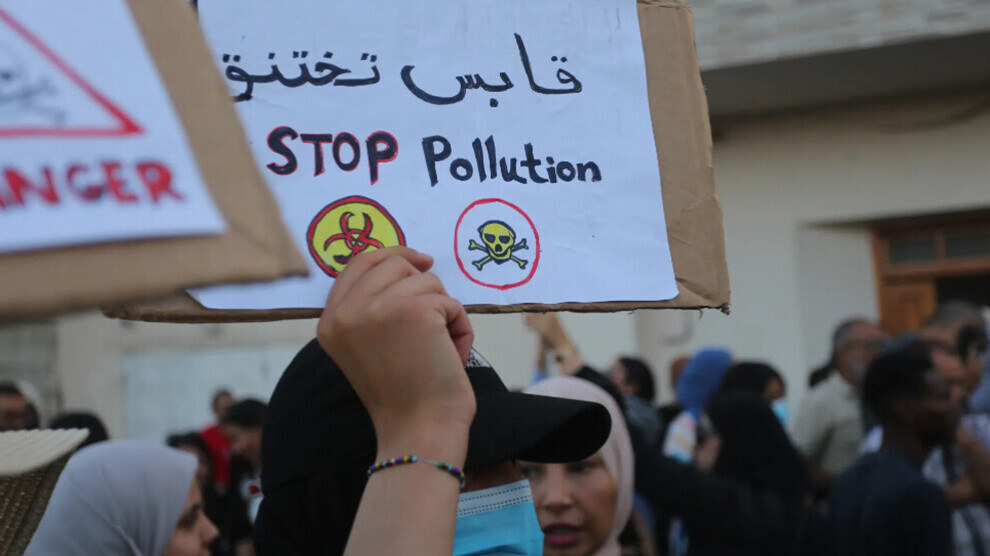
"How can harm not be proven when we bury our dead from cancer every week?" asks Lina Dhahiri, an activist in the "Stop Pollution" campaign. She says: "The court says 'no harm,' but our bodies say the opposite."
To understand this paradox, it is enough to leave the courthouse corridors and enter the homes of Gabes. There, "harm" does not appear in legal documents, but in the details of daily life. "Fatigue, headaches, shortness of breath... have become normal symptoms," according to Lina Dhahiri. "Even our visitors from outside the city wake up exhausted."
Women's bodies… the real record of the disaster
If the judiciary is looking for "proof of harm" in reports, the activists point to their bodies as living evidence. "The most dangerous diseases affect women's reproductive health," says Lina Dhahiri. "We are talking about infertility, about genetic deformities in newborns, about cancer in almost every home." She explains that it does not stop there, pointing to the spread of osteoporosis among children: "My mother is a teacher, and she tells me that barely a month passes without one of the students breaking a bone. This is no longer normal."
She added: "Their faces are pale… this is our new color." The activists accuse the authorities of "possessing the numbers and covering them up," adding: "We do not have statistics, but the state has them. Our patients are in state hospitals, and it knows who died of cancer and who was born with deformities."
Despite that, she points to the absence of a health infrastructure capable of absorbing the scale of the disaster, such as a specialized university hospital.
From promises of employment to accusations of treason
Looking back explains the shock of the ruling. The chemical complex, which entered the city under the slogan of development, gradually changed its features. She explained: "We lost the only marine oasis in the Mediterranean, we lost the sea, we lost the air… and now we are losing each other."
She noted that the crisis is still ongoing, with about 20 cases of suffocation recently recorded, most of them among children, accompanied by neurological symptoms.
She also recalls the wave of protests that lasted from July to December, peaking in the strike of December 11, in which about 160,000 people participated, protesting what the activists describe as the "security approach," which included the use of tear gas, arrests, and accusations of treason.
What after "no harm"?
Today, after the judicial ruling, the women activists of Gabes renew their call: "Our cause is not local, but the cause of all Tunisians." They link Gabes to other areas suffering from pollution, such as the mining basin, Sfax, and Riadh, considering that "any victory here is hope for everyone."
The demand, as they affirm, has not changed since the launch of the "Stop Pollution" campaign in 2012: "Clean air, an unpolluted sea, and drinkable water."
She recalls the statement of President Kais Saied, who described Gabes in 2014 as a "disaster-stricken city," affirming at the end of her speech that "the disaster continues to this day, and the ruling of 'lack of proven harm' does not cancel the harm we live every day… in our bodies, and in the bodies of our children."