
'The trees we planted for leader Apo were watered with the values of the revolution'
Naviya Asaad and Bahiya Murad, speaking about the April 4 celebrations before the revolution, said the trees they planted always grew thanks to the revolution's values, expressing their very deep hope to finally see Öcalan.
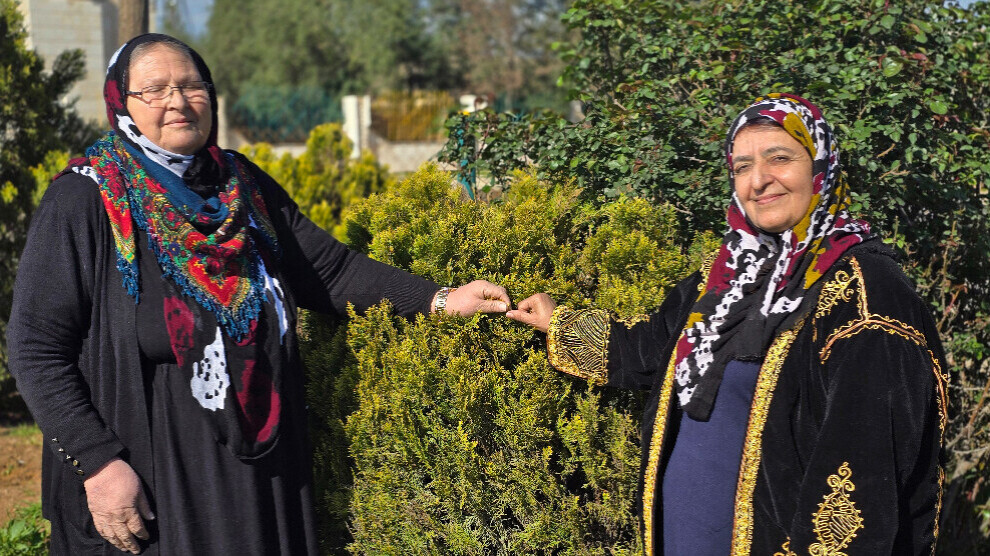
Birtan Mazloum & Nagham Jajan
Qamishlo — Every year on April 4, the birthday of leader Abdullah Öcalan, special events such as planting trees are held in Rojava to celebrate the occasion. Naviya Asaad and Bahiya Murad, two members of "Mala Jinê" (House of Women) from the city of Qamishlo in Rojava, spoke about their memories and previous celebrations of April 4 before the revolution.
Naviya Asaad and Bahiya Murad have dedicated years of their lives to working for the women's revolution in Rojava. They shared their memories while standing in front of the tree planted in honor of leader Abdullah Öcalan.
Naviya Asaad, who had previously met leader Abdullah Öcalan, spoke about her memories with him, expressing her strong desire to see him again.
As for Bahiya Murad, who had tried to go meet leader Abdullah Öcalan but was turned back by the forces of the defunct Baath regime, she said that her only wish in life is to be able to see leader Öcalan.
"Kurdistan is adorned with the flower he sent us"
Naviya Asaad said that 2001 was the first time they celebrated leader Öcalan's birthday, and it was done in complete secrecy. At that time, with the escalating attacks of the Baath regime, several families were forced to gather away from prying eyes. They prepared a cake especially for the occasion and celebrated together, dancing dabke despite the fear and difficult circumstances.
Despite the raids and arrests they faced after those celebrations, she affirmed that they continued every year to gather, plant trees, and light candles in honor of their leader. She added that in 2002 as well, when they again celebrated his birthday and planted trees, they once again faced attacks from the Baath regime.
She pointed out that "Leader Apo did not open the path of freedom only for Kurdish women, but for all women. This year, leader Apo gave us a flower, and today the four parts of Kurdistan are adorned with his flowers."
Memories of her meeting with leader Öcalan
Naviya Asaad recounted to Bahiya Murad her memories of meeting leader Öcalan. She said that in 1990, she went to attend the "August 15 Leap" celebration with leader Öcalan. There, with a large crowd of people, she received training for four days.
She explained that those four days greatly influenced her in terms of thought and philosophy. "After I returned, a man about 70 years old came and kissed my hand. I asked him: Why are you kissing my hand? He said: Your hand touched the Black Stone, you shook the hand of leader Apo. Many women used to bring their sick children and ask leader Apo to place his hand on them so they would heal. He would say to them: I am not a doctor. But one mother said to him: We believe in you, and we believe that our child will heal when your hand touches him."
Naviya Asaad said that her greatest wish is for leader Öcalan to gain his physical freedom. "Leader Apo is not with us physically, but he lives among us through his thought and philosophy. In 1991, I went again to meet leader Apo. When we arrived at the camp, freedom greeted us before our eyes. Leader Apo came to us and spoke with us. We said to him: Our leader, we cannot live without you, and our wish is to always be with you. He left in our hands an education that makes us understand. You are the one who guided women to the path of freedom, and thanks to you, women's existence was established."
She added: "I said to leader Apo: I promise you that when I return, I will work for women. And since 1991 until today, I have been working in the field of women. Although I am now sixty years old, my only wish is to see leader Apo physically free."
Longing of the years
Regarding the policies imposed on leader Öcalan, Bahiya Murad explained that being deprived of any news about him for years was like a deep wound for them. She added that in 1992, she was among the thousands who wished to go see leader Öcalan. Recalling those moments, she said: "Thousands of people were preparing to set out to see leader Apo. My son was two years old, and I insisted on taking him with me because my longing to meet him was so great. After we completed all the preparations, the Baath regime prevented us from crossing. From that day until now, the longing to see the leader has remained in my heart."
She added: "Alongside military work, we had established women's groups. Many delegations come from abroad and ask us: What are you doing for the freedom of leader Apo? Those delegations say they are amazed by the scale of the work done by the women of Rojava. Thanks to the thought and philosophy of leader Apo, we have reached this level of awareness, and we have exerted a great deal of effort and work."
"I used to ask my children to read me the leader's books"
Naviya Asaad said: "Although I am over sixty, if I were given the opportunity today to go to Imrali, I would not hesitate for a moment." She added: "I did not learn to read, but I used to ask my children to read me leader Apo's books. He never worked for his own interest or for his family's interest; he dedicated everything he had for his people. From here to Imrali, we celebrate his birthday. We celebrate it with our comrades in prisons, with the families of martyrs, with fighters on the front lines, and with women's organizations."
She wishes that "next year, leader Apo will be among us, and we will celebrate his birthday with him. It is necessary for us to continue our work and achieve success in the women's struggle."
Bahiya Murad also celebrated the 77th birthday of leader Öcalan and said: "With thousands of precious words and with branches of roses, we offer our congratulations to leader Apo, and we wish him a long life. Our demand is to see leader Apo."
After finishing their conversation, Bahiya Murad and Naviya Asaad watered the tree that was planted in the early years of the revolution on the occasion of April 4. They said that this tree was planted for leader Abdullah Öcalan and has grown thanks to the values of the women's revolution.