
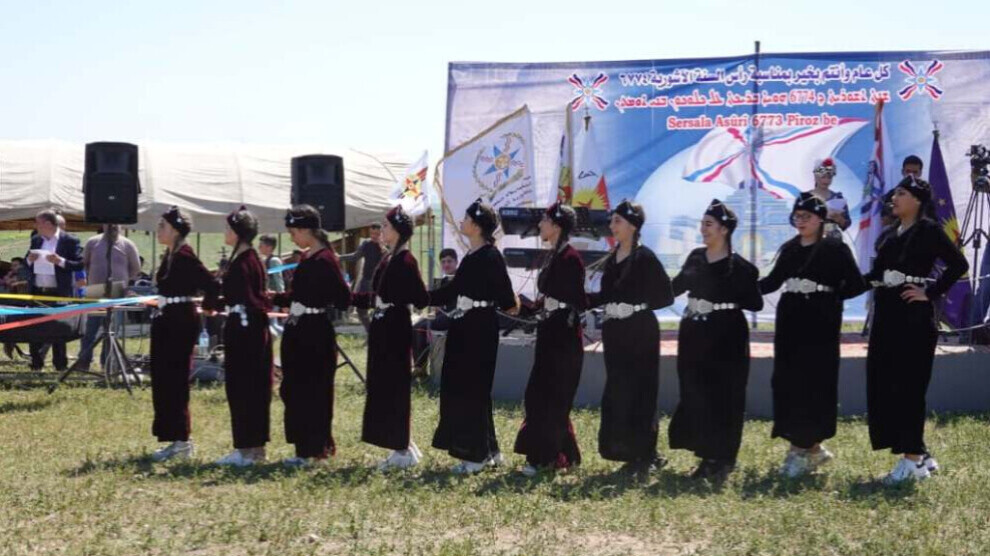
Akitu… a festival that spans thousands of years and embodies the identity of the Syriac and Assyrian peoples.
Throughout the ages, the Syriac, Assyrian, and Chaldean peoples have preserved the Akitu festival, making it today a symbol of cultural identity, unity, and hope, despite the conflicts and challenges the region has endured.
Ronida Haji.
Al-Hasakah — The "Akitu" festival is considered one of the oldest celebrations in the world, with its origins in the fertile lands of Mesopotamia. Over thousands of years, it has been celebrated by various civilizations, reaching us today in its current form.
The Akitu festival—which marks the arrival of spring, the flourishing of nature, and the beginning of a new year—represents an important symbol of cultural identity for the Assyrian, Syriac, and Chaldean peoples.
"Akitu is a symbol of unity and hope"
In this context, Polyana Morris Maliki, President of the Syriac Cultural Association, stated that the Akitu festival is celebrated among all the peoples of Syria, especially within the Christian community, and that it is a festival of renewal and the start of a new life.
She pointed out that for them, this festival is not merely a celebratory occasion, but also a testament to the existence of Syriac, Assyrian, and Babylonian identity and culture. "It is a revival of a deep‑rooted heritage inherited from their ancestors—a heritage that gives them the ability to continue and to build a generation endowed with a rich history, culture, and civilization. For this reason, Akitu for us is a symbol of unity and hope."
According to her explanation, Akitu is one of the oldest festivals in history. "This year, we are celebrating the festival in its 6,767th year. Despite all the attempts aimed at erasing the existence of Christians, denying them, or dispersing them, they remain connected to this festival with a living spirit to this day, and they continue to celebrate it."
She added, "Due to the targeting of holy sites in Syria, we Syriacs have halted all our festivities and replaced them with prayer. Nevertheless, Akitu remains a day that affirms our culture and our existence, and so we celebrate it every year despite the pain and massacres that Syrians in general are suffering."
"Women play a fundamental role in preserving the culture and history of the Syriac people"
Polyana Morris Maliki highlighted the role that Syriac women play in reviving their people's culture and civilization. "Women play an important and essential role in preserving the culture and history of the Syriac people, especially during the celebration of Akitu. Most of the festive preparations—from traditional costumes and folklore troupes to folk songs and theatrical performances—relied heavily on women. Women are the bearers of true history, the holders of cultural creativity, and contributors to the development of civilization. Therefore, they have a fundamental role in reviving this heritage."
She explained that before 2011, the celebration of Akitu existed, but its manifestations were largely limited to prayers and some simple practices, which they were accustomed to. She noted that after the Rojava revolution, the existence of Christian culture and identity was reaffirmed.
She continued, "The Akitu festival in Rojava, especially in areas with a high Syriac and Assyrian presence, carries both cultural and religious connotations. Before the Rojava revolution, under the Ba'ath regime, celebrating the festival took place under strict supervision and was often banned. But after 2012, the Autonomous Administration adopted a project that supports cultural freedom for Syriacs, Kurds, Arabs, and other components. The Syriac and Assyrian community in the region faced historical pressures and displacement, but after the Rojava revolution they gained the opportunity to celebrate their festival freely. Kurds, Arabs, and Turkomans also participated in these celebrations and offered us their support. Thus, Akitu became a festival of fraternity and unity among the components of the region."
Concluding her remarks, Polyana Morris Maliki affirmed that celebrating Akitu is a way to show the true image of the Christian people. "This is our history and our culture. It is not just an occasion; it is an ancient heritage that has lived for thousands of years, and we are ready to protect it.