
"Al-Batoumat" Complex: Agricultural Sustainability and Women's Solidarity in the Face of Climate Change
Women at Tunisia's "Al-Batoumat" complex resist climate change by processing crops, using indigenous seeds, and innovating to cut costs and boost independence.
IKHLAS AL-HAMROUNI
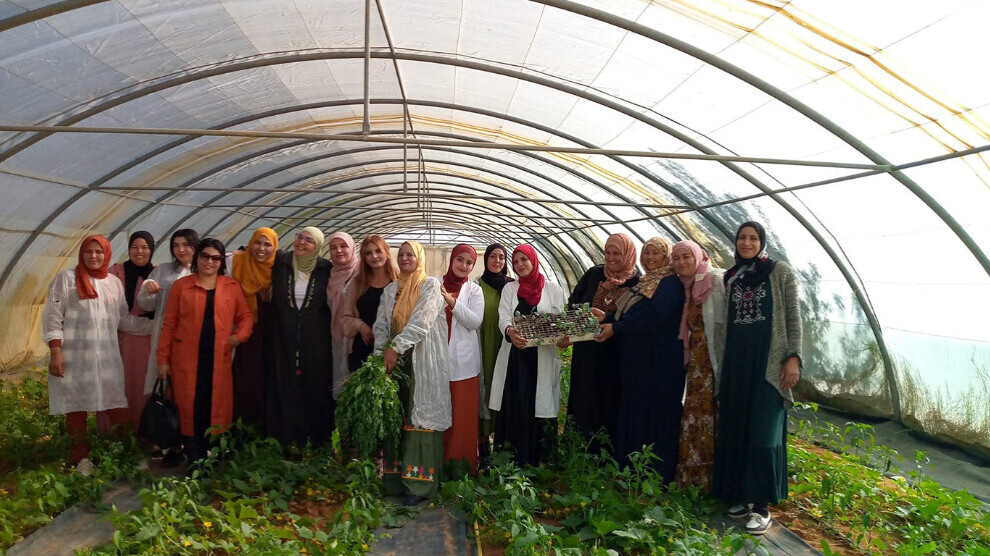
Tunisia — In an agricultural landscape growing increasingly fragile in the face of climate change, fluctuating production, and rising costs, the "Al-Batoumat" women's development complex in the Sidi Bouzid governorate emerges as an integrated production unit. It is a unit led by women who have found in collective work a means to overcome the fragility of the climatic and economic reality through sharing expertise and seeking sustainable local alternatives, most notably indigenous seeds and participatory work.
A Women's Complex at the Heart of Agricultural Transformation
In defining the complex, Sanaa Ammari, President of the Al-Batoumat Agricultural Development Complex, says that the complex includes 47 women and is primarily based on the processing and valorization of agricultural products from Sidi Bouzid, with great diversity in activities including grain processing, cheese making, livestock rearing, poultry farming, and pickle production.
She explains that the work within the complex is based on transforming agricultural materials such as garlic, onions, tomatoes, peppers, and other vegetables into value-added products. She adds that the activity does not stop at production but extends to manufacturing and marketing within an integrated system.
According to her, this productive activity faces increasing pressures due to climate change, which has affected every stage of work—from agricultural production to processing and even poultry farming. She notes that the lack of rainfall and rising prices of raw materials have turned some basic materials such as peppers into rare or high-cost products, which is directly reflected in the prices of final products.
She adds that poultry diseases represent an additional challenge, increasing the scale of losses despite treatment and resistance efforts, making production stability dependent on fluctuating climatic and health factors.
Faced with this reality, Sanaa Ammari explains that the complex did not stop at diagnosis but moved toward seeking practical solutions, the most prominent of which was the experiment with local indigenous seeds in cooperation with a company specialized in the biological field. About three hectares were planted with these seeds, which have proven their ability to resist heat and reduce the need for water, fertilizers, and pesticides.
She says: "This experiment was not merely a temporary solution but the beginning of a strategic transformation. The complex intends to expand it to include tomatoes and then peppers, as part of a plan to adapt to climate change." She stressed the importance of returning to Tunisian indigenous, non-hybrid seeds—such as traditional tomatoes—for their better quality and taste and lower production costs, considering that this option enhances women's independence within the complex and alleviates heavy economic burdens.
Between Climate Pressure and Solution-Making
Based on her professional experience with this complex, Munira Azri—who spends most of her day either cleaning raw materials, drying them, preserving them, grinding them, or sifting them, transforming them into ready-to-use consumer products such as roasted grains and couscous from organic wheat and barley, in addition to molokhiya and red pepper—confirms that climate change has become one of the most prominent factors disrupting agricultural production, due to lack of rainfall, rising temperatures, and winds, making the agricultural cycle unstable.
She explains that "some crops, especially peppers, no longer yield the same results as before, as they are quickly damaged by heat, losing quality or spoiling. The agricultural season has also changed in its timing; harvesting is no longer tied to fixed periods as it was between June and August, but has become irregular and subject to climate fluctuations."
She also points out that water scarcity has contributed to declining production, despite the resilience of some trees such as olives and vines. However, price increases have affected many products, especially figs, which have become rare and expensive. She adds that the spread of insects and pests has further complicated the situation, forcing farmers to use large quantities of pesticides, which raised costs and affected product quality.
A Different Experience
For her part, Fatima Bouazizi presents a different experience within the same system, working in poultry farming through incubation then rearing until sale. She says: "Climate change represents a direct challenge to this activity, as significant rises or drops in temperature lead to the death of chicks or reduced production."
She adds that chicks need a balanced temperature environment, and any imbalance in this balance is directly reflected in results. She has transitioned from traditional methods to using an incubator, which has significantly contributed to improving and increasing production, even though operating this machine requires precise conditions of temperature, cleanliness, and preparation.
She notes that she is sometimes forced to stop work during the summer season—from May 20 to October 3—due to the effect of high temperatures on the hatching rate, considering that climate change has become a decisive factor in organizing production, not just its quality.
In contrast, she affirms that the complex's support enabled her to develop her project by providing the incubator, after previously relying on manual methods with low production, which helped her improve her income and stabilize her activity.
Both Munira Azri and Fatima Bouazizi agree that climate change is no longer merely an external factor but has become part of the daily details of production. What distinguishes this experience, however, is the ability to transform challenge into a collective project based on solidarity, knowledge sharing, and the rehabilitation of indigenous seeds as both a sovereign and environmental choice.