
HANAN HARRAT
MOROCCO— Participants in the forum shed light on the faltering of legislative reforms related to advancing women's rights and strengthening equality in Morocco, and the challenges this poses to translating government commitments into tangible legal and institutional measures.
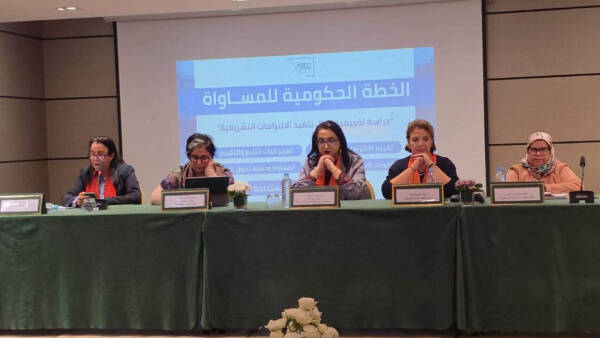
During the second edition of the Institutional Dialogue Forum, organized by the "Challenge for Equality and Citizenship" association in Casablanca, the association presented an evaluation study on the outcome of the legislative commitments contained in the Third Government Plan for Equality (2023-2026), which revealed the faltering implementation of a number of commitments related to reforming the legal system, and the incompleteness of any of the twelve commitments covered by the evaluation.
This plan, whose strategic framework was adopted in March 2023, falls within government orientations aimed at strengthening gender equality and advancing women's rights through programs including economic empowerment, advancing rights, and combating discrimination.
The plan includes 288 procedural measures, with implementation responsibility distributed among a number of government sectors. The study focused on evaluating 12 legislative commitments requiring the creation of new legal texts, the revision of existing provisions, or the integration of a gender approach into legislation.
According to the study's results, none of the twelve commitments recorded legislative completion, while a partial impact was monitored in two commitments, at 16.7 percent, versus ten commitments—83.3 percent—for which no complete, attributable legislative impact was achieved.
Legislative reforms still pending
The study highlights the continued faltering of a number of commitments related to combating violence against women, foremost among them the preparation of a draft amendment to Law No. 103.13, as the document did not monitor the referral of this text to parliament during the period covered by the evaluation.
The workshop related to revising legal provisions on prevention, protection, and judicial follow-up was also not completed, which reopens discussion about the extent of the current arsenal's ability to respond to victims' needs and guarantee their rights.
According to the same source, the faltering extended to other files, including the revision of texts regulating permission for child marriage, alongside measures related to economic empowerment and entrepreneurship, for which no complete legislative impact was recorded throughout the studied period. These results reveal a gap between declared promises and the legal measures that were supposed to translate them, and also raise the question of the fate of incomplete workshops as government responsibility transitions to a new team.
Absence of clear mechanisms
Bouchra Abdo, executive director of the Challenge for Equality and Citizenship association, considered in a special interview with our agency that the study's results highlight the government's failure to fulfill a number of legislative commitments included in the Government Plan for Equality, pointing to the absence of clear mechanisms for identifying bodies responsible for implementation, tracking progress, and measuring impact.
She affirmed that revising Law No. 103.13 remains among the basic demands, alongside the necessity of approving a legal framework that responds to emerging forms of violence, especially digital violence, stressing that confronting violence cannot be limited to legal protection alone but also requires strengthening women's economic and social empowerment in a way that provides them with the conditions of independence and the ability to exit cycles of violence.
Equality requires moving from commitment to obligation
Discussions during the forum extended to examining the institutional and legislative conditions necessary to achieve equality, as participants stressed that approving laws, despite their importance, is not sufficient unless accompanied by an actual commitment from various government sectors to integrate the gender approach into public policies.
One intervention called for moving from the logic of commitment to obligation, through approving a framework law for equality that obliges government sectors to integrate this principle into their programs and interventions, to ensure the continuity of policies aimed at advancing women's rights and their non-linkage to changes in governments or circumstantial priorities.
For her part, another participant demanded the revision of a number of legislative texts, foremost among them the Penal Code, the Family Code, and the Labor Code, to remove provisions that may entrench discrimination, alongside developing the legal arsenal to address various forms of violence, including digital and political.
The remaining interveners addressed the constraints limiting the effectiveness of public programs, including weak coordination between institutions, limited resources, the need to develop services, and the transition from being limited to legal and psychological accompaniment to strengthening women's economic and social empowerment.
In the context of searching for more effective mechanisms to evaluate progress made, proposals were put forward to establish a permanent committee, prepare a "barometer" to measure the extent to which parity is achieved, in addition to strengthening cooperation between public administrations, associations, and women's organizations, and benefiting from the field expertise accumulated by civil society.
Legal gaps requiring revision
For her part, Dr. Nihad Afkir, professor of criminal law at Hassan I University, believes that Law No. 103.13 formed an important step in strengthening criminal protection for women, through criminalizing a number of acts related to violence and approving mechanisms and institutions to care for victims, including cells created at the level of courts.
She added that this system still needs a legislative revision that keeps pace with the transformations that have occurred in forms of assault, in light of technological development and the emergence of new practices in digital space. She explained that the Moroccan legislator addressed acts falling in this field, such as capturing, recording, or publishing data and images affecting private life, but did not set, according to her reading, explicit and comprehensive provisions providing prevention from various forms of digital violence.
She pointed out that difficulties of proof remain among the most prominent problems impeding the achievement of the desired goal, especially in cases of psychological and economic abuse, which requires reconsidering the relevant legal texts to ensure greater effectiveness. She called for updating Law No. 103.13 and the Penal Code, alongside the Family Code, to align the legislative framework with societal transformations and provide actual protection for women.