
Algerian Women Facing the 2026 Test… Why Does Political Participation Stall?
Political activist Fatima Maskour asserts that Algerian women’s political presence remains far below expectations, with electoral abstention and weak media support hindering their shift from numerical representation to decision-making roles.
RABAA ALKALIS
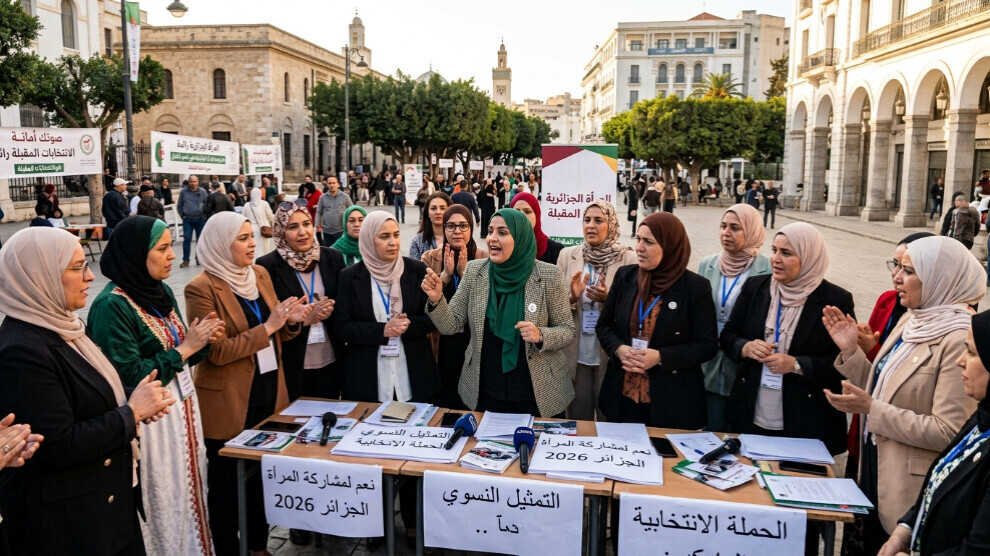
Algiers_ Algerian women have established a remarkable presence across various domains, particularly in science, employment, and civil society. However, this presence has not been reflected to the same degree in political decision-making positions and local governance. While women assert themselves powerfully in associative and field-based spaces, their presence within elected institutions—especially in leadership roles—remains below aspirations.
With the approach of local elections scheduled for November 28, 2026, the issue of women's political empowerment returns to the forefront of discussion—not merely from the perspective of their numerical representation on electoral lists, but regarding their capacity to transition from mere numerical presence to substantive influence and the assumption of leadership responsibilities.
In this context, political activist and President of the "Rahaf" Association, Fatima Maskour, raises a series of questions concerning the persistence of this gap and the factors that prevent the translation of growing women's competence into qualitative political presence within state institutions.
Maskour asserts that "Algerian women have proven their ability to excel across all vital fields, and the political sphere has not been an exception to this dynamic; however, it falls far short of the desired level," considering that the significant women's turnout for parliamentary and local elections has not, despite this, translated into a "qualitative leap in decision-making centers."
Civil Society as a Factory for Women's Leadership
Maskour points to a notable paradox: the substantial disparity between women's presence in civil society and their modest presence in the partisan political and institutional landscape.
She explained that civil society "constitutes a vital space for cultivating women leaders, exchanging expertise, and providing training in leadership and advocacy," citing active and influential platforms such as the "Joussour" Forum of Algerian Feminist Associations, where women have established a prominent field and media presence.
However, according to her diagnosis, this presence does not find its natural extension within local governance institutions. Women's presence in municipal and provincial people's assemblies remains modest, while the presidency of municipalities and assumption of leadership positions in local administration—including the position of Wali (provincial governor)—remain limited and rare compared to the scale of women's competencies present in society.
"Phobia" of Local Administration
In attempting to explain this gap, Maskour identifies a series of obstacles that curb women's ambitions to reach positions of responsibility, foremost among them the absence of specialized theoretical and field-based training that accompanies women before assuming office and during their tenure.
She emphasized that this training deficit "directly leads to the emergence of real fears and anxieties among women regarding the risks of managing municipalities," given that local administration has become, in her estimation, "a complex and highly sensitive arena requiring extensive legal and field expertise."
Maskour considers that these fears are linked to the nature of the legal and penal responsibilities imposed by the presidency of the Municipal People's Assembly, within a complex local governance system, a dense legal and administrative framework, and stringent oversight by supervisory authorities, in addition to daily engagement with citizens' concerns. This burden is exacerbated, according to her, by the absence of partisan or governmental framing and support. The fear of administrative error and legal accountability thus becomes a factor that drives some women with leadership potential to retreat from leadership aspirations. She emphasizes that the problem lies not in the absence of competence but rather in the "absence of a system that prepares competence to exercise power and responsibility."
Electoral Abstention as a Double Burden on Women's Participation
The obstacles do not stop at training and experience. Maskour draws attention to another equally impactful factor: electoral abstention and declining political participation. She considers that the contraction of electoral participation "has cast its heavy shadow on women's competencies in a compounded manner."
The results of recent electoral contests reveal a clear decline in participation rates, reflecting a widening gap in trust and interest in electoral affairs. The participation rate in the 2021 local elections reached approximately 36.58% for Municipal People's Assemblies and 34.76% for Provincial People's Assemblies, while the legislative elections of the same year recorded a national participation rate of 30.20%.
This downward trend continued in subsequent legislative elections, reaching the July 2026 legislative elections, in which the domestic participation rate did not exceed 21.24%.
This decline means that women do not enter political competition in a normal electoral environment; rather, they face a dual challenge: first, convincing voters to participate, and second, persuading them to cast their votes for women. This makes weak electoral turnout an additional obstacle to the emergence and rise of women's competencies to positions of responsibility.
The 2026 Elections as a Genuine Test for the Political Class
Against this backdrop, the upcoming electoral contests assume importance that transcends their nature as a periodic electoral date, transforming into a genuine test of the ability of the political class and the associative and feminist movement to rebuild trust in political participation and present women's models capable of managing public affairs with competence and capability.
Maskour situates this milestone as a "genuine test," affirming that the challenge lies not merely in mobilizing votes or ensuring women's presence on electoral lists, but rather in the capacity of the associative and feminist movement to present qualified competencies—academically and practically—capable of establishing themselves as a credible governance alternative.
This requires, in her view, overcoming what might be termed the "phobia of local administration," generated by legal and administrative complexities and previous experiences. This is to be achieved through investment in training, qualification, and accompaniment, rather than contenting oneself with inviting women to run for office without providing the essential tools for their success in exercising responsibility.
The Media... The Missing Link in the Empowerment Equation
Maskour identifies the absence of media support as among the most prominent factors limiting the consolidation of women's political presence. She criticizes the insufficient spotlight on active women's models, despite the importance of highlighting successful experiences in encouraging a new generation to engage in political work and in changing stereotypical perceptions regarding women's capacity to bear responsibility and make decisions.
Conclusion
Ultimately, she considers that the empowerment challenge is no longer linked merely to increasing the number of women on lists and in elected councils, but rather to transforming this presence into actual influence and leadership positions. With the approach of the November 28 elections, the challenge facing the political class and the associative movement lies in presenting qualified women's competencies capable of managing local affairs. Will this milestone succeed in breaking the cycle of abstention and fragile representation, or will women's presence remain stronger in the civic sphere than within decision-making circles?