
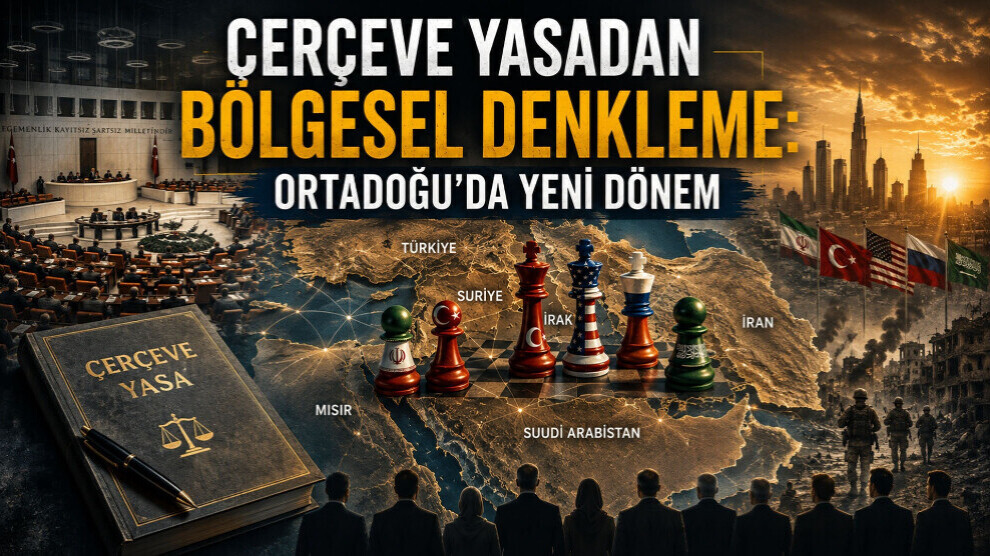
From Framework Law to Regional Equation: A New Phase in the Middle East
With Turkey's framework law, the Kurdish issue intersects with regional power shifts. Arzu Yılmaz warns that Kurds have yet to see equal gains from this evolving alliance.
ELIF AKGÖL
News Center — The framework law passed by the Turkish parliament has created a legal foundation for the path to resolving the Kurdish issue and democratization in Turkey. Its impact is not limited to the domestic trajectory; it also opens the door to a new phase regarding the Kurdish issue and regional power balances in the Middle East, particularly in Syria, Iraq, and Iran.
Speaking about the framework law and the Middle East entering a new phase, political science specialist Arzu Yılmaz stated that the law's impact in the Middle East cannot be assessed solely from the perspective of Turkey-Kurdish relations, noting that the alliance Turkey has established with Kurds has strengthened its position in the regional power struggle.
She added that the reactions of regional powers, foremost among them Iran and Israel, to Turkey's rapprochement with Kurds demonstrate that the matter is not merely about peace.
According to Arzu Yılmaz, the path has strengthened Turkey's image as a "stable state" in the region, but has not achieved the same gains for Kurds. She pointed out that the integration of the Syrian Democratic Forces (SDF), the establishment of a political party in Rojava, and the attacks facing Erbil reveal that the process is unfolding unevenly for Kurds. The next phase will be determined by whether Turkey fulfills the requirements of the alliance it has established with Kurds.
"Iran and Israel Are Unhappy with Turkey's Growing Power"
In her assessment of the attack targeting the residence of the Prime Minister in Erbil, Kurdistan Region, and the Israeli attack on Idlib in Syria just before the law's approval, Yılmaz said these developments must be read within the framework of the impact that Turkey's alliance with Kurds will have on regional power balances. She noted that all these events show that Iran and Israel are dissatisfied.
She added: "This path began long before the framework law was issued—about a year and a half to two years ago. Therefore, these reactions have appeared over time. Initially, we must acknowledge that when this path first emerged, it created a general sense of satisfaction from China to the United States. Although there was no clear regional reaction at first, as the path progressed, reactions became particularly directed toward Kurds."
She noted that according to statements by AK Party spokesperson Ömer Çelik, the issue goes beyond mere reconciliation between Kurds and Turks, concerning Turkey's positioning as a dominant power in the region. "Given the intense power struggle in the region, it was not expected that other regional powers would remain without reaction to Kurds aligning with Turkey and Turkey aligning with Kurds."
"Gulf States Are Currently Following a Wait-and-See Policy"
Arzu Yılmaz also addressed the position of Arab states in her assessment: "It is important to pause at the Arab states, because the geography that Ömer Çelik referred to—Lebanon, Iraq, and Syria—it can be expected that Turkey's display of power in these countries through its partnership with Kurds, or in other words, its emergence as a dominant force, could also provoke potential reactions from Arab states."
She explained that "we can assume that Saudi Arabia is currently facing a serious security problem, a state of concern and weakness, and even at a time when it has established a partnership with Turkey and Pakistan, it has not yet raised any clear objection or reaction, if it has such an objection."
Given the close relationship the UAE has established with Israel, as she explains, it represents a clear reaction, and it follows a "wait-and-see" policy that extends over time.
"A Factor Strengthening Turkey's Position"
Arzu Yılmaz also stated: "There is no doubt that whether Turkey will ultimately become a dominant power in the region remains a matter of debate, but its alliance with Kurds in the Middle East today, and Kurds aligning with Turkey, undoubtedly constitutes a factor that significantly strengthens Turkey's position."
It is possible, according to her, "to bring the Gulf states into the picture, as a region that is likely to be disturbed by Turkey's growing influence through its alliance with Kurds, at a time when Iran and Israel are waging struggles for their interests in the region."
"Turkey's Peace Discourse Does Not Align with the Region's Demographic Realities"
Regarding the framework law's repercussions in the Middle East, as well as Nationalist Movement Party leader Devlet Bahçeli's description of what includes Syria, Iraq, and Lebanon as "Turkish peace," Arzu Yılmaz said his discourse on "centrality" is not a new approach, explaining that the expression "Turkish peace" he used is also linked to the regional role designated for Turkey by the United States, noting that she approaches the description of current conditions as a peace phase with caution.
She noted that what is currently happening in Syria and Iraq indicates that the region is still at the heart of a struggle, not a peace phase. "It is enough to say that the partnership Turkey has entered into with Pakistan and Saudi Arabia is called a 'defense pact.' Therefore, we must take into account that states are positioning themselves in a war phase, not a peace phase."
She added that Turkey's description of its position in the Middle East as a position of peace, after recently signing a defense pact, may be true in the future, but she sees it as a very advanced interpretation at present.
"The Kurdish-Arab-Turkish Alliance"
Arzu Yılmaz said that the path in Turkey is directly linked to the situation of Kurds in Syria and the position of the Kurdistan Region, considering Kurdistan Region President Nechirvan Barzani's visit to Damascus, according to President Erdoğan's expression, as an indicator of the Kurdish-Arab-Turkish alliance.
However, she noted that this alliance has not yet been reflected on Kurds to the same extent, explaining that the integration of the Syrian Democratic Forces (SDF), the exclusion of the Women's Protection Units (YPJ) from the process, the legal and political obstacles to establishing a political party in Rojava, and the developments in Ras al-Ayn/Serê Kaniyê constitute serious problems for Kurds.
She added: "The ceasefire lasting a year and a half, the continued alliance with Turks—even if faltering—then the image captured in Damascus, and finally the issuance of the framework law, all contributed to strengthening the position of 'Turkey as a stable state' in the region, which also supports the Turkish peace stance that Bahçeli speaks of."
Arzu Yılmaz expressed dissatisfaction with the peace process's progress for Kurds. "When we look at the Kurdish side and ask what Kurds have gained so far from this path, whose outcomes have turned into gains for Turkey, we can say there is a state of imbalance. Rather, we can say Kurds have been victims of the developments the path has witnessed so far."
Even in the integration process in Syria, as she explains, there is a large gap between what Turkish media conveys about developments in Syria and what is happening on the ground in Rojava and Syria. "On one hand, it is said that the integration process is complete, and that the SDF will dissolve itself or a political party will be established, and the media speaks of a near timeline for that." However, in the current Syrian political system, there are no legal arrangements allowing for the establishment of a party, according to her.
She believes that "even if a party is established, there are no free, equal, and transparent elections, and the method of forming parliament is known." She added: "On the other hand, there are attacks in Serê Kaniyê during the return."
"The Final Picture of the Kurdish-Arab-Turkish Alliance"
She said the same situation applies to the Kurdistan Region. "Nechirvan Barzani's visit to Damascus was described as the final picture of the Kurdish-Arab-Turkish alliance that Erdoğan spoke of. But if this is an alliance, the attacks facing Erbil today, as well as the attacks on residents returning to Serê Kaniyê—which lie at the heart of the requirements of the January 29 agreement and are part of the integration process—raise a question about the stance Turkey will take."
She continued: "After the framework law, I believe it is time to see how Turkey will provide the required support under this alliance. This includes how Turkey will handle problems related to the stalled integration process in Rojava, as well as issues still threatening Kurdish lives in the context of return processes, in addition to its stance on the attack targeting Erbil, which reached the Prime Minister's building."
Arzu Yılmaz concluded her assessments by affirming: "At the stage we have reached, if there is indeed a picture of an alliance, it will be possible to follow how the requirements of this alliance are implemented, and thus whether it will ultimately turn into peace, more clearly through the positions Turkey will take in the next phase.