
Female Farmers in Tunisia: Awareness of Rights and Challenges in Accessing Protection
Activist Shaima Qasimi said women in Tunisia's agricultural sector, despite knowing their rights and food-security role, face exploitation, harassment, and weak access to information, services, and protective structures.
IKHLAS AL-HAMROUNI
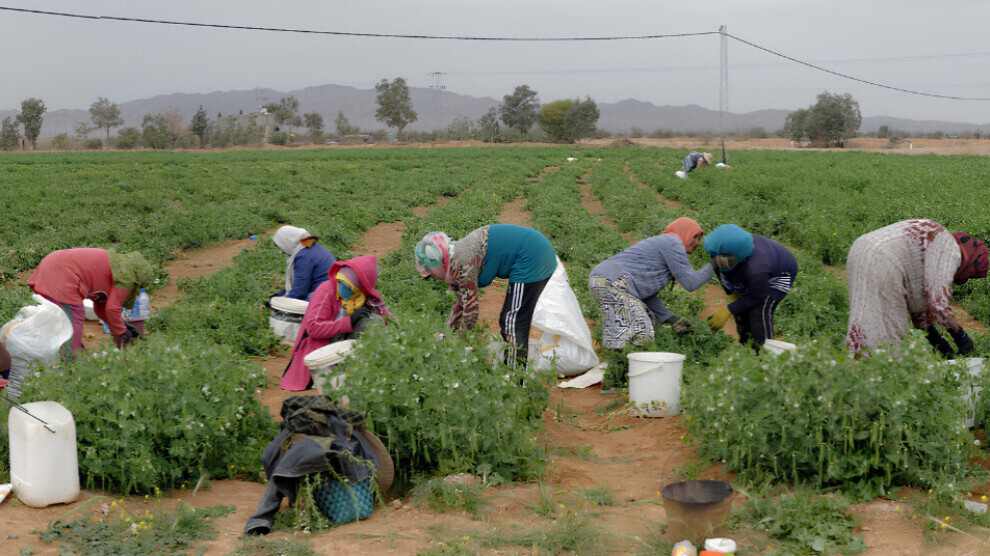
TUNISIA– In the heart of remote fields, where agricultural lands extend far from cities and the eyes of institutions, thousands of women work in the agricultural sector, carrying on their shoulders the responsibility of the country's food security, while facing economic exploitation, harassment, and multiple forms of mistreatment.
Their ignorance of the laws is not the primary reason that deepens their suffering; rather, it is the weak access to information and services on the one hand, and on the other hand, the difficulty of reaching protection mechanisms, in isolated work environments lacking the minimum requirements of safety.
Between the Role of Food Security and the Fragility of Reality
Shaima Qasimi, a civil society activist working on the file of female agricultural workers, confirmed that female workers have a major role in preserving food security, as they represent the active majority in this sector and bear the largest part of it.
She explained that female workers in isolated places face greater risks of harassment and assault, in light of weak protection and the spread of verbal insults, noting that divorced and widowed women may be more exposed to these violations.
During women's work in the fields, harassment is not limited to the sexual aspect, as they are subjected to other forms of harassment in terms of the exploitation of their money and resources. Shaima Qasimi added that women are more exposed to economic and material exploitation by the farmer or the intermediary, who exploits certain services they provide to him for meager compensation.
She explained that in the summer, when temperatures rise, food usually spoils, so women remain hungry. Even if the intermediary or farmer provides a quantity of food, it is in exchange for money. She also addressed the absence of health treatment, because when she gets sick, the woman goes for treatment with her own money.
She said: "In many cases, a woman contracts diseases as a result of excessive use of insecticides when treating vegetables or trees, which leads to her being dismissed." She explained that these conditions reveal a vicious circle of exploitation that begins with working conditions and ends only with the loss of the ability to work itself.
A Deficit in Access
At the level of access to rights and services, Shaima Qasimi said that the laws existing in Tunisia and the services available for women are "deficient" and access to them is limited. "A woman sometimes has information about a certain service or law, but faces difficulty, for example, in moving around. Most of them live in rural areas and work there, so it is difficult to find transportation, and therefore their chances of enjoying the services available for them decrease."
She explained that the relevant authority talks a lot about eliminating violence against women, whether in reporting or other procedures, and also about the financing opportunities that some institutions provide to such women. However, there is difficulty in implementation because of the unfair conditions, especially regarding benefiting from financing opportunities.
She addressed the condition of real estate ownership of land and the existence of a water source or groundwater well, and other conditions that may be difficult for women working in agriculture to provide, in order to start small projects that could be an incentive for them, or a source of self-stability and economic empowerment, naturally.
Regarding the exchange of information, she explained that female agricultural workers rely on direct communication among themselves to exchange news and information about available opportunities, which constitutes an informal support network that contributes to compensating for the lack of institutional support.
She noted that civil society organizations are making efforts to communicate with women in various regions and provide them with the necessary information, but these initiatives are still insufficient, in light of the need to intensify efforts and develop additional recommendations and measures to ensure the protection of women working in the agricultural sector.
Legislative Gains Awaiting Implementation
Regarding legislative gains, Shaima Qasimi explained that Decree No. 4 (a decree related to the social protection system for female agricultural workers), which was issued in 2024 after the multiplicity of incidents during that period that claimed the lives of many women, is one of the most important gains. "Unfortunately, the regulatory texts organizing this decree have not yet been issued, for several reasons, including structural reasons related to relevant institutions such as social security institutions and labor inspection, among others."
She explained that the agricultural sector needs deep sectoral structuring, given the overlap of many institutions in it on the one hand, and the fragility of the situation of workers in it on the other hand.
She noted that there are sectoral agreements specific to all fields, including the agricultural sector, but they remain unspecified according to specialization. She added that this situation requires only organizing them in order to determine the nature of work, working hours, accidents, and diseases.
She stressed the necessity of doing more work to support the agricultural sector, as it is a vital and very important sector economically. It is also necessary to pay attention to female agricultural workers because they represent a fragile category whose conditions have become difficult. "We must invest more in the agricultural sector, as we today live under different climatic and geopolitical changes. Therefore, public and vital sectors must be protected and supported, foremost among them the agricultural sector."
At the end of her interview, Shaima Qasimi explained that this goal will not be achieved without the cooperation of the various concerned parties, including institutions, departments, economic actors, activists, farmers, intermediaries, and others.