
From Tunis to Rojava, the struggle is one in the battle for equality and existence
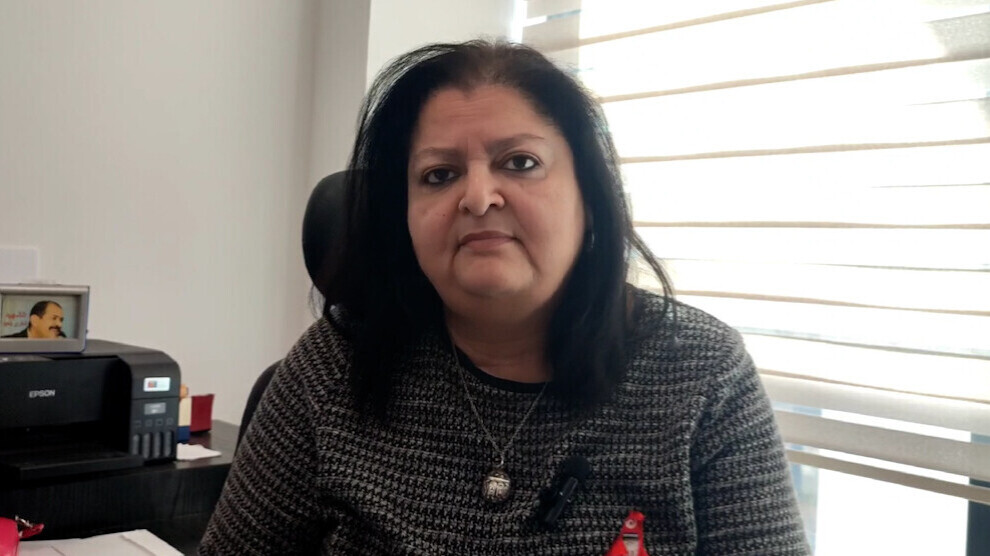
Tunisian activist Raja Al-Dahmani declared her solidarity with YPJ, affirming her support for campaigns aimed at establishing women’s rights, protecting their bodies, and ensuring their full participation in Professional and political life.
Zahour Al‑Mashrqi
Tunis – The Tunisian experience in the field of women's rights is considered a pioneering model in the region, as it has succeeded in shaping a solid legal and human rights framework that goes beyond mere slogans to deeply rooted institutional practices.
This human rights legacy, led by well‑established organizations such as the Tunisian Association of Democratic Women, fundamentally aligns with other struggle experiences in the region, even if the tools and circumstances differ – such as the experience of the Women's Protection Units (YPJ).
While women in Tunisia lead the battle of civil solidarity to establish full equality and consolidate human rights against social and political obstacles, the YPJ embodies solidarity in its field form as a tool for liberation and existential protection.
This emotional and struggle‑based connection affirms that women's issues share a "single cause" – breaking the chains of marginalization and building societies based on genuine equality, making cross‑border solidarity not an option but a necessity to preserve and protect these gains.
From the capital Tunis, where the Tunisian Association of Democratic Women raises its historic slogan "We live by your solidarity," this resonance extends to meet unique struggle experiences such as the YPJ, affirming that the battle for rights is one battle, regardless of geography.
Within a women's movement that has escalated over decades, human rights activist Raja Al‑Dahmani, president of the Tunisian Association of Democratic Women, affirmed that the battle to establish women's rights is no longer limited to slogans but has moved to the stage of imposing presence in all professional fields without exception.
She explained that women today are breaking into all fields that were previously considered exclusive to men, pointing out that the government and society must guarantee this access without discrimination. "Women today work in all fields without exception – whether in defense, interior, public service, or the public and private sectors. Any field a woman wishes to work in is available to her as long as discrimination in access to the labor market is absent."
She did not limit herself to highlighting local affairs but declared cross‑border solidarity, specifically addressing women in neighboring countries and the Arab region, particularly in Rojava, expressing her support for campaigns led by women there to expand women's rights, protect their bodies, and ensure their full participation in professional and political life.
Rejecting exclusion on the pretext of "gender"
She sent a message against attempts to marginalize women, affirming that female identity is not an obstacle but a source of strength. "As feminists, we reject any exclusion or marginalization of women on the pretext that she is a woman. There is no profession she is incapable of doing, and it is illogical to close doors to her ambitions."
She stressed that women's solidarity will continue until all the demands that women aspire to in the Arab region and the world are achieved, reaching a reality free from systematic discrimination.
She affirmed that solidarity is not just a moral value but a "fundamental issue" and an essential pillar for defending women's issues in North Africa and the Middle East. She noted that this vision directly intersects with the philosophy on which the YPJ was built in conflict zones, where solidarity and networking become the only guarantee for survival and social change.
Raja Al‑Dahmani stressed that the "shared cause" and diverse equality issues require collective resilience, pointing out that continuity depends on the strength of cross‑border, solidarity‑based feminist fronts. "Women's human rights are only established through mutual recognition and cooperation between civil and field movements."