
Political Activist: Advancing Women’s Freedom of Expression Is Part of a Broader Struggle for Democracy.
Political activist Sanaa Fawzi warned that repeated prosecutions over expression in Morocco may harm public participation, stressing democracy requires both institutions and rights-respecting public space.
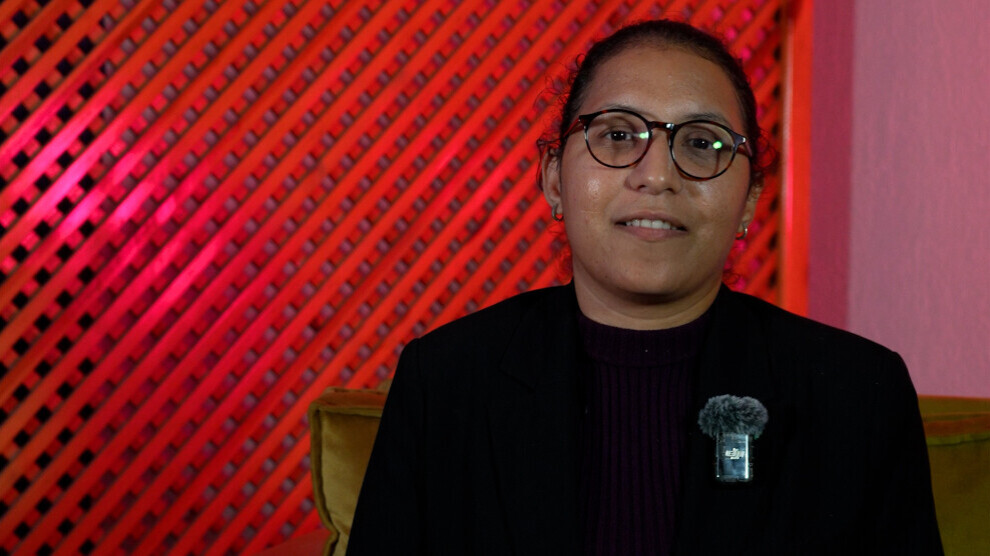
Hanan Hart
Morocco — In recent times, debates have intensified over the prosecution of a number of women in Morocco for expressing their opinions, raising human rights and political questions about the limits of freedom of expression and the position of women in the public sphere.
In an interview with our agency, Sanaa Fawzi, president of the Women of the Democratic Left Federation organization, affirmed that these prosecutions should be understood within the context of the transformations taking place in public discourse in Morocco, where women’s presence is increasingly growing in both civil society and digital spaces.
How do you interpret the increasing prosecution of women activists in cases related to freedom of expression at this stage? What are the political implications?
At the Women of the Democratic Left Federation organization, we believe that prosecuting women for expressing their opinions cannot be understood as isolated incidents. Rather, it should be examined within the broader transformations taking place in Morocco’s public sphere, where spaces for expression are expanding and demands for full and equal citizenship are increasing.
In recent years, women have had a notable presence in public debate—whether through civil society work, digital spaces, or political engagement. This presence does not only reflect an expansion of social participation, but also signals a gradual shift from symbolic representation of women to direct political agency. Women are no longer merely subjects of public discourse; they have become active contributors to it and participants in holding power accountable.
This transformation is linked to what can be described as a “culture of recognition”—the demand to acknowledge women as full political actors with equal rights within the public sphere. However, redistributing recognition within any society does not always occur smoothly, as it challenges traditional structures of power and representation, and raises questions about who has the right to speak and who defines the limits of public debate.
From this perspective, the emergence of critical female voices reshapes power dynamics within the public sphere. This may create political and cultural tensions that reflect a struggle between the logic of expanding freedoms and the logic of maintaining existing balances.
Understanding these prosecutions also requires recalling Morocco’s political memory, where the struggle over freedom of expression has long been part of a broader debate about the limits of criticism and dissent in the public sphere.
Politically, this phenomenon reveals a paradox between official discourse that encourages women’s participation in public life and the reality of prosecutions that raise questions about the limits of this openness. On the one hand, women’s presence in the public sphere is expanding in unprecedented ways; on the other hand, this presence faces resistance when it takes the form of independent critical discourse.
Therefore, we affirm that democracy should not be measured solely by official rhetoric, but by the extent of actual freedoms within society and the ability of the public sphere to accommodate new voices advocating for freedom, equality, and social justice.
To what extent do these prosecutions carry a deterrent effect aimed at women? And how might this affect their future participation?
Even when prosecutions take place within a legal framework, their impact often goes beyond individual cases to influence the broader climate of political and social participation.
In many contexts, repeated prosecutions related to expression create a climate of caution within the public sphere, where individuals become more inclined to moderate their speech or practice self-censorship. This effect may be particularly pronounced among groups whose presence in political spaces is still emerging, including women.
Women’s participation in the public sphere is not merely a matter of numerical representation; it is part of a broader struggle over the distribution of symbolic power within society. The more women raise their voices in public debate—especially on political and social issues—the more they contribute to reshaping influence within society.
From this perspective, any environment that limits freedom of expression affects not only individuals but also the vitality of democratic debate. Democracy depends not only on institutions, but also on an open public sphere that allows for the exchange of ideas and differences.
At the organization, we do not start from the assumption that there is a systematic intent to deter. However, we stress that repeated prosecutions in opinion-related cases may produce an indirect political and cultural effect, reducing the boldness of expression among some women—particularly younger generations entering the public sphere for the first time.
Does the use of criminal law in these cases conflict with constitutional guarantees and human rights?
The debate over the use of criminal law in expression-related cases is fundamentally a discussion about the balance between authority and freedom within society.
In modern democratic systems, freedom of expression is one of the essential pillars of political life, as it enables society to hold power accountable, debate public policies, and generate intellectual and political alternatives.
Morocco, through its constitution and international commitments, has affirmed the importance of protecting fundamental rights and freedoms, including freedom of expression. However, the key issue is not only the existence of these guarantees in legal texts, but also how they are implemented in legal and political practice.
Contemporary democratic experiences tend to expand freedoms and reduce reliance on criminal penalties in matters of expression, because a vibrant public sphere fundamentally depends on the freedom of criticism and dissent.
From this standpoint, we believe that the strength of the rule of law is measured by its ability to balance the protection of public order with the preservation of a space of freedom that allows society to evolve.
For us, expanding freedom of expression—especially for women—is not only a human rights demand, but also part of a broader struggle to build a democratic society based on freedom, equality, and dignity.