
The Struggle Journey of an Upper Egyptian Woman Between Pottery Making and Difficult Working Conditions
In a daily journey combining the hardship of manual work and family responsibilities, Sabah Hassan Abdel Hamid undergoes an experience of struggle in pottery making, amid physical challenges and difficult working conditions.
EMAN SAMIR ALI
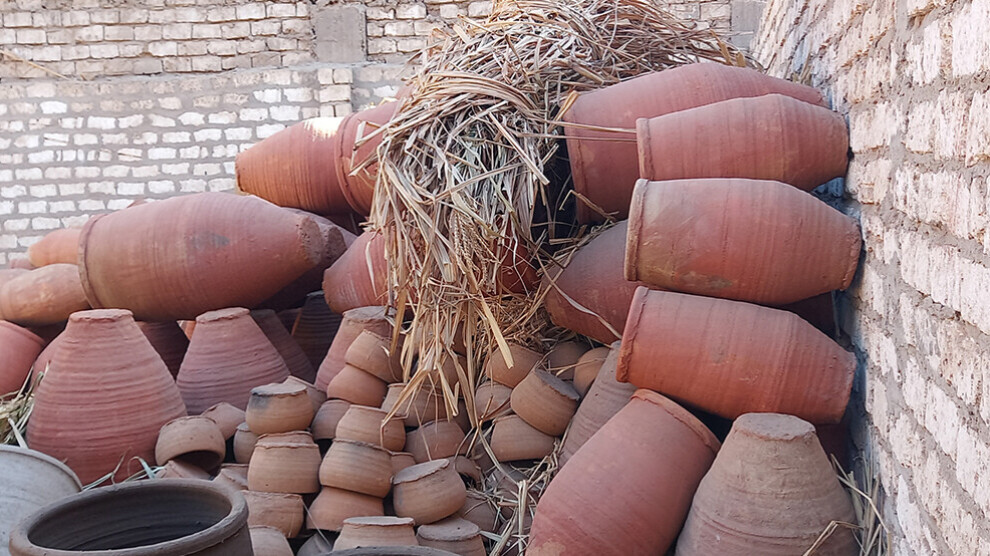
EGYPT_ Sabah Hassan Abdel Hamid works in handmade pottery, a profession that requires patience, physical effort, and the ability to endure harsh working conditions. For years, she has become an essential part of the stages of producing pottery vessels, in a journey that does not end with the end of working hours, but extends to include her daily responsibilities inside the home.
Sabah Hassan Abdel Hamid has been married for 16 years, in the village of Dairut Al-Sharif in Assiut city in Egypt. She began working about 10 years ago in pottery making, with the aim of providing for her family's needs. Since then, she has participated in the details of the profession and its various stages, starting from preparing the pottery pieces, passing through exposing them to the sun to dry, and reaching preparing them for firing in the kilns.
These stages require continuous care, as leaving the pottery pieces under strong sunlight for a long time may lead to their damage. Therefore, work is organized according to temperatures, and the vessels are constantly monitored to avoid losing the effort exerted in manufacturing them, as she explained.
Working hours do not follow a fixed schedule, according to Sabah Hassan Abdel Hamid, but change according to the season and weather conditions. In winter, she works for a period of about an hour, then rests until noon, before returning to work in the evening, within intermittent work periods that may reach about three times a day. As for times of extreme heat, the need to divide work and monitor the pottery pieces carefully increases, to protect them from damage.
Between the Workshop and Household Responsibilities
Sabah Hassan Abdel Hamid's responsibilities are not limited to work in pottery making, as the workshop is located next to her house, which allows her to move between the two places to follow up on production and complete household tasks.
After finishing one of the work stages, she returns home to do household chores, then returns to the work site to complete her tasks and follow up on the vessels that need continuous care before the sun's heat causes them to be damaged.
These details embody an aspect of the multiple burdens that many women working in manual professions bear; paid or productive work is not separate from care responsibilities and housework, which doubles daily effort and limits opportunities for adequate rest periods.
Pottery Prices and the Challenges of Hard Work
The products made vary between large and small jars, qasariya, bottles, and other pottery tools whose prices differ according to the size and type of the piece.
These prices indicate the diversity of products, but the price of a single piece alone does not reflect the amount of effort exerted in manufacturing, drying, and preparing it for firing, in addition to the time needed to complete the various production stages.
Sabah Hassan Abdel Hamid confirms that standing for long periods and continuing manual work are among the most prominent difficulties she faces, as accumulated fatigue is sometimes reflected in her back and body, especially with the repeated operations of lifting, transporting, and monitoring pottery pieces.
Despite this hardship, she continues working to provide a living and bear family responsibilities, as stopping work is not an easy option in light of daily needs that require continuous income, which pushes her to continue despite the fatigue.
Sabah Hassan Abdel Hamid's experience reveals a reality lived by women working in handicraft professions, where manual skills intertwine with physical effort, and household responsibilities that do not stop with the end of work in the workshop are added to this.