
Displacement Robs Women of Sweida of Their Privacy and Doubles Life's Burdens
Displaced women's suffering extends beyond material losses to losing independence, comfort, and security, forcing them to manage family affairs in environments lacking life's most basic necessities.
ROCHELLE JUNIOR
AS_SWIEDA — Leaving home for displaced women was not merely a move to another place, but the beginning of a journey of daily suffering that touched every detail of their lives — from the loss of privacy and the difficulty of securing basic needs, to mounting household burdens, psychological stress, and anxiety over their children's future. Between the loss of homes and sources of livelihood, women are trying to rebuild their lives under conditions unlike what they were accustomed to, as winter approaches and needs increase.
Sahar Al-Yousef recounts the suffering of women who took refuge in hosting centers after leaving their homes, where in the first days large numbers of families stayed in shared rooms lacking basic necessities and privacy.
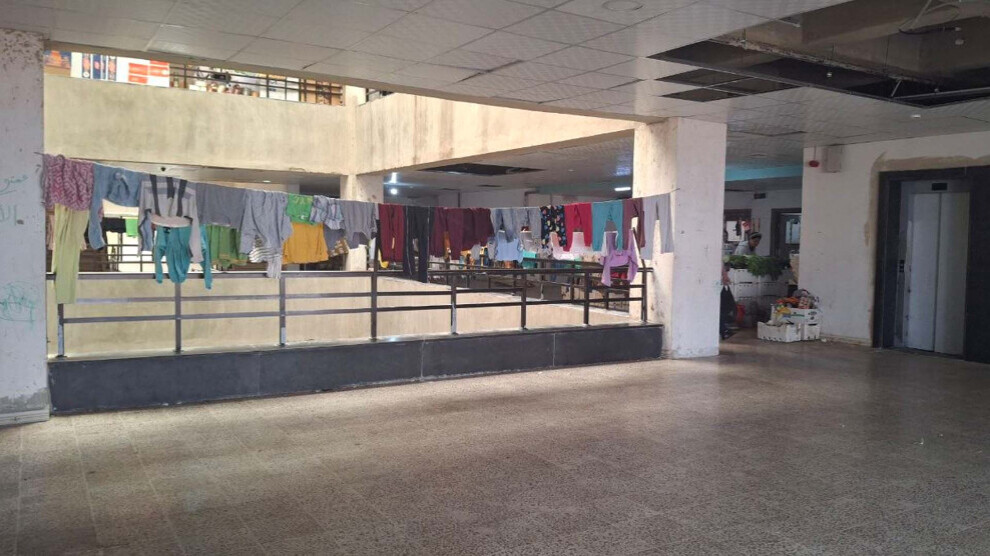
She explains that having several families in one room made sleeping, changing and washing clothes, and preparing food arduous tasks, especially with bathrooms far from the living areas and a shortage of hygiene and cleaning supplies.
She points out that the difficult living conditions raised concerns about hygiene and the transmission of diseases and infections, as well as psychological pressures that were reflected in the women's lives and their relationships with their children, as some became less able to bear daily responsibilities and deal with their children as a result of psychological exhaustion.
She affirms that a woman who used to live in her own home and manage her family's affairs independently suddenly found herself facing a different reality, in which she is forced to share with others the simplest details of her life, amid a shortage of the tools and supplies she relied on daily.
"We lost our homes and livelihoods and started from scratch"
Rasha Al-Shoufi, displaced from the village of "Umm Haratain" in the northern countryside of Sweida, recounts that families were forced to leave at the start of the attack; women and children went out, while young men stayed to resist until the final stages. She explains that the residents did not leave their villages easily, but the difficulty of the confrontations pushed them to displace.
She says that her family was unable to take most of their belongings or identity documents, and carried only a few things, including her daughter's books, as she was preparing for the 2025 general secondary certificate exams.
After displacement, the family found itself facing a new life that they started from scratch, having lost their home, possessions, and sources of livelihood, and were forced to rely on the help of relatives and friends to secure basic needs.
She stresses that material losses cannot be compared to the loss of lives, recalling the suffering of families who lost their children, including her nephew who was killed on July 16, 2025, affirming that the pain of a mother who loses her son and the suffering of a child who loses his father are greater than any material loss.
Doubled household burdens after displacement
The difficulties are not limited to economic losses and household burdens; they extend to searching for job opportunities that help the family regain its ability to depend on itself. Rasha Al-Shoufi explains that she is seeking a job opportunity that suits her qualifications and experience in the field of education, but finding work that matches her knowledge and specialization is a challenge under current conditions.
She explained that the suffering was not limited to material losses, but extended to the painful psychological impact of need and the family's forced reliance on others after self-sufficiency. Despite the spirit being broken by some forms of assistance that carried a tone of pity or coldness due to the exhaustion of displacement, the solidarity of the people of Sweida and their provision of suitable housing restored to the family its lost privacy and stability.
Even the simplest personal needs have become difficult
Nawal Nasr, displaced from Najran, recounts that she left her home in the clothes she was wearing, before moving with her family between multiple places of residence.
She says that the family stayed in her sister's house in Shahba for about 29 days, with nearly thirty people, then moved to a school where they stayed for about three months, before moving again to a shelter center. She explains that the current housing conditions do not provide her with the necessary privacy, as she lives in a building comprising about ten rooms, and a hanging curtain separates her from others, providing no safe space for daily life.
The conditions of displacement turn the simplest personal needs into a source of anxiety and embarrassment, depriving the family of its former privacy. Under the pressure of reality, Nawal Nasr was forced to buy a washing machine with a sum of money she received to wash clothes, preferring it over food and basic necessities, especially after her young son was injured by a landmine explosion.