
Displaced Women of Kre Sipi... Between a Harsh Displacement Journey and the Hope of Return
On the seventh anniversary of the occupation of Kre Sipi/Tal Abyad city in the Hasakah countryside by the Turkish state and its mercenaries, the women of the city demand a guarantee of safe return to their homes and lands.
NORSHAN ABDI
KOBANI_ The ninth of October marks the seventh anniversary of the Turkish attack on Kre Sipi/Tal Abyad and Sari Kani/Ras al-Ain in 2019 in the countryside of Hasakah governorate, which led to the occupation of the two cities and the displacement of thousands of residents, amid violations against civilians and their loss of homes and property.
The journey of displacement of civilians to the "Tal Al-Saman" camp in the countryside of Raqqa, which was established on 22 November 2019 to shelter the displaced from Kre Sipi city, continued. On 6 January, the attacks on Raqqa, Tabqa, and the "Tal Al-Saman" camp pushed residents to displace again toward Kobani city.
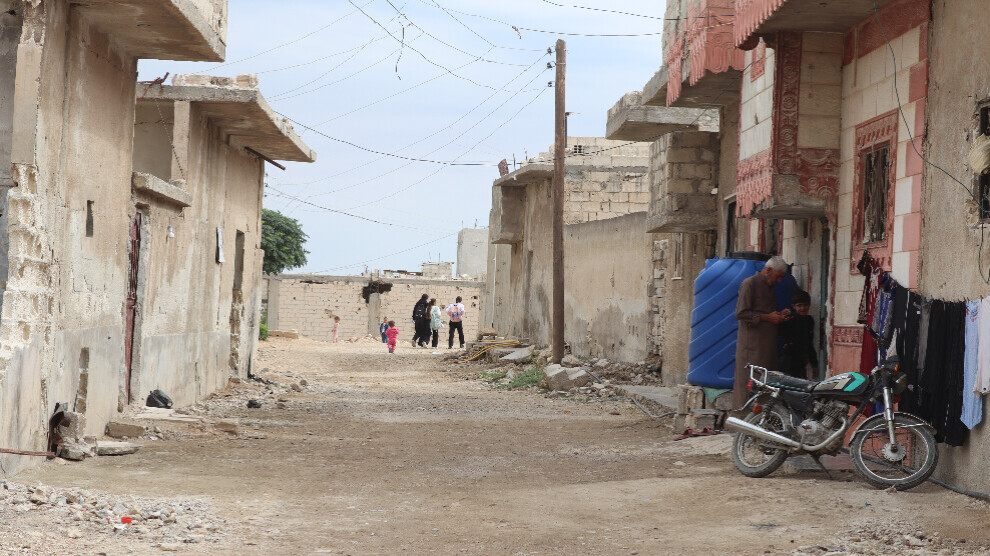
Our agency monitored scenes of the suffering of the people and women of Kre Sipi city, displaced to the "Museum of Resistance" in Kobani city, where they were forced to live amid the rubble and destruction and take it as a shelter for themselves and their children. Despite the harshness of the displacement conditions, they are still holding on to their land and homeland, and living in hope of a safe return to their homes.
"We Lived Long Years as Displaced Persons Waiting to Return"
A displaced woman from Kre Sipi city, Alia Mohammed Ali (60 years old), said that her displacement journey began seven years ago following the attacks on her city. She recalled the entry of about 200 military vehicles into her village "Al-Shu'ba," carrying Turkish flags and the flags of mercenaries. She added that this coincided with arrests and violations against civilians, which raised fear among the residents and pushed them to leave their homes and displace from their city.
Regarding the stations of her displacement, she noted that her family initially headed to villages in the Kobani countryside, and moved between them for about two years, before moving to the "Tal Al-Saman" camp, where she spent about five years hoping to return to her home and live in safety. She added that the attacks on Raqqa and its countryside forced them to displace again toward Kobani, where they faced harsh conditions of cold and snow, and were forced to stay for about two months with her husband's relatives, as about 30 people lived in one room, including children. She noted that their suffering has continued since leaving their homes until today.
She said that her family currently resides in the "Museum of Resistance" in Kobani city, where she found a partially damaged house, which she worked on restoring and securing doors, sanitation, electricity, and water to make it habitable. She noted that the house still lacks the necessities of life, as rainwater leaks into it during the winter season.
At the end of her interview, Alia Mohammed Ali confirmed that the displacement journey was full of pain and suffering, but she and her family are still holding on to their right to a safe return to their city and homes, despite their knowledge that their home was completely destroyed. She demanded enabling the displaced to return to their land and homes.
"Our Children Live a Childhood Exhausted by the Tragedy of Displacement"
For her part, a displaced woman from the village of "Al-Shu'ba" affiliated with Kre Sipi city, Amina Qader, said that on the night of 9 October 2019, the family heard the sounds of bombardment and gunfire, before she saw at dawn military columns accompanied by Turkish planes, according to her account.
She noted that the bombardment hit the village and led to the injury of two of her husband's brothers and their relatives before their eyes, while her husband's two brothers are still missing until today, which pushed the family to leave the village for fear for their children. She added that her husband, who was at his work at the time, was injured and disappeared for about a month, before being transferred to Kobani and then Tabqa to receive treatment, where the family was later able to communicate with him and confirm that he was still alive.
Amina Qader recounts that her family left the village at dawn amid the sounds of planes and bombardment, in a state of fear and confusion, and was forced to leave without supplies, leaving their home and property behind, with the aim of protecting them.
She explained that the displacement journey began by heading to the village of "Al-Jalbiya" in the eastern Kobani countryside, then the village of "Mila," where the family moved between villages and was forced to sleep on roads and in schools, before moving months later to the Tal Al-Saman camp. She added that life in the camp was harsh, as the family suffered from rain and cold in winter and the heat of summer, while the children's future remained unknown, despite the availability of a degree of safety and stability compared to the area from which they were displaced.
After about six years in the camp, the family was forced to displace again following the attacks on Raqqa and its countryside, so they headed to Kobani city, where they stayed for several months in schools.
At the end of her interview, Amina Qader said: "Life in schools is extremely difficult, especially for children. Therefore, we came to the Kobani museum and restored a house so that we could live in it. The pain of displacement is enough for the people of the occupied areas, and today we demand to return to our home. Our children need a safe life and stability in housing. Our children, as a result of years of refuge, suffer from psychological complexes from moving from one home to another and from one village to another. A safe return must be secured for the people of Tal Abyad so that they can return to their land and homes."
Alongside Kre Sipi, Turkey occupied the cities of Afrin and Sari Kani. Under the agreement of 29 January between the interim government and the Syrian Democratic Forces, which stipulated guaranteeing the return of displaced persons to their areas, the return of the people of Afrin began, and arrangements for the return of the people of Sari Kani are currently being completed. In contrast, the file of the return of the people of Kre Sipi is still under discussion, without reaching clear guarantees and mechanisms that allow their safe return to their city.
https://www.youtube.com/watch?v=0TsJoXyHTP4