
University Life in Iran…. Rising Costs and Dreams Threatened with Interruption
University life in Iran has turned into a growing burden due to the rising costs of living and studying, which has pushed some young men and women to suspend their education or abandon it permanently, and give up their dreams of a better future.
ZILAN ATMANI
URMIA _ University life in Iran was never easy or free of challenges, but continuing higher education in recent years has turned into a heavy financial burden, not only for students coming from outside their university cities, but even for students residing in the cities where they study.
High costs of housing, food, and transportation, alongside other expenses such as buying books and paying tuition fees, have forced some students in Iran to face difficult choices between continuing their studies or leaving university.
Housing: A Costly and Dilapidated Obsession
The costs of university life depend on several factors, including the city where one will study, the type of university, the availability of university housing, and the situation related to tuition fees. In this context, housing is considered the most prominent factor in the financial pressures faced by students coming from outside the city.
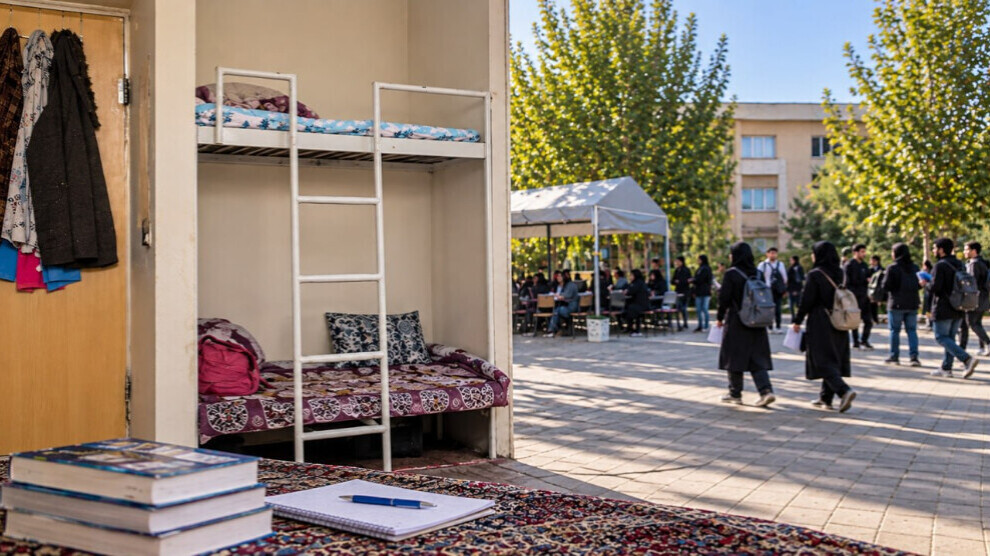
Alongside the costs, the conditions of many university residences are described as unsuitable and in need of rehabilitation; many small rooms house between four and ten people on average. The rules regulating life inside university housing are in some cases stricter, especially for female students.
(Maria. A), a student at Urmia University, says: "There are restrictions on entry and exit times, and if we return to the residence in the evening after a specific hour, we are not allowed to enter. Some rules, such as preventing presence in the corridors without hijab, make the female student feel restricted and uncomfortable."
According to her, some students, despite a month having passed since the beginning of the academic year, are still without beds in their rooms and are forced to sleep on the floor.
Food: From Reducing Quantities to Eliminating Meals
University meals are offered to students in public universities and medical sciences universities at subsidized prices. However, food expenses are not limited to prepaid university restaurant meals, as the rise in food prices also affects daily purchases and meals students eat outside the university.
(Kani. M), a student at a public university, describes the university restaurant meals as insufficient and of low quality, noting that their quantities decrease year after year, while their price remains linked to the number of years the student has spent studying.
She explains: "An undergraduate student who does not finish their studies within eight semesters must pay 300,000 tomans for a meal whose price is 30,000 tomans. Even this meal's quantity and additional components decrease year after year."
She noted that food items such as fruit and meat are rarely available in students' refrigerators, and that food packages, aid, and ration coupons allocated for breakfast meals no longer meet previous needs in light of rising prices.
As for students of private universities, this problem has led to eliminating some meals. (Sharmin. K), a student residing in the city at Azad University, says: "With these prices, we prefer not to buy food, and content ourselves with eating a piece of chocolate and drinking tea until the next meal we eat at home."
Inevitable and Hidden Expenses
Travel and transportation costs have also not been spared from the wave of high prices. Students residing in the city where their universities are located feel the weight of these expenses more, while they are usually lower for those residing in university housing near the university. However, many of these students postpone returning to their homes and original cities for longer periods.
The rise in book prices has also been added to the list of student expenses. (Dilaram. M), a nursing student, describes the prices of reference books as astronomical, saying: "High prices have led most of us to rely on PDF book files and study handouts, unless we are forced to buy references, which are often very expensive."
In this context, many students consider personal hygiene and health supplies, the internet, and the purchase of tools such as laptops as essential needs whose provision has become difficult or impossible, or requires changing one's lifestyle.
Dropping Out of Education and the Absence of a Clear Future Horizon
Significant increases in university fees, alongside the difficulties of student life, have pushed some students toward withdrawing from university or taking academic leave for a semester or more; in some majors, a student is required upon withdrawal to pay a fine much greater than the value of tuition fees for one semester. This matter pushes some of those wishing to enroll in university, especially in medical specialties, to reverse their decision before starting their studies.
(Kaziweh. J), a doctoral student, believes that there is no longer much hope in the future, and that a student can no longer continue studying under these difficult conditions. "In the past, a student at a public university was reassured that their family would provide at least the minimum requirements of life, and that they would be able to reach a good position thanks to their degree. Today, a doctoral student, who in other countries receives a salary as a researcher, is worried about the end of the permitted period to complete their studies, and even at this stage is no longer able to envision a future for themselves."
She noted that these conditions are more difficult for women, due to family responsibilities and social restrictions, expecting that the repercussions of this problem will manifest more widely in the future, especially among women, which may lead to depriving larger numbers of them of continuing university education and reaching higher academic stages.