
An octogenarian recounts the bitterness of displacement between two Nakbas and a key still in hand
Between the 1948 Nakba and the 2023 war, octogenarian Bahia Al-Bayk endures displacement twice—from a child carried from Jaffa to a grandmother clutching her destroyed Gaza home's key, witnessing an unhealing wound.
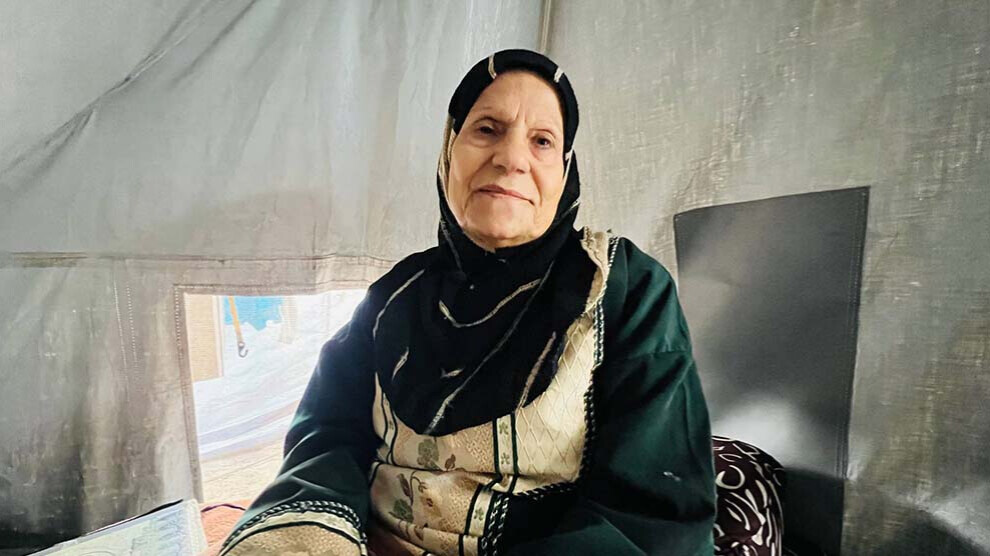
RAFIF ESLIM
PALESTINE— Bahia Al-Bayk lived through the Palestinian Nakba twice. The first time, she was expelled from her home in the city of Jaffa, one of the Palestinian lands occupied in 1948. The second time, she was expelled from her home in the Gaza Strip, which now lies beyond the Yellow Line and was destroyed by Israeli forces during the 2023 war. Yet she still keeps the two keys, hoping to return to her two homes after ending up as a displaced person living in a tent that neither shields from summer heat nor winter cold.
Bahia Al-Bayk, 83 years old, does not remember the details of her displacement in 1948, because she was a child of four when her father carried her on his shoulder and left with her to the city of Gaza, after hearing of the massacres committed, especially against women and children. Fearing for his family, he displaced from Jaffa and stayed in refugee camps.
She recounts from her mother's account that they did not stay in the camp long, as her father was able to buy a plot of land in their place of displacement and built a new house. But in that period, they were not forcibly starved for months and years, nor pelted with tons of rockets and explosives, nor displaced dozens of times on foot. At that time, they were able to buy what they needed and recovered some of what they had lost during displacement, whereas during the 2023 war, the displaced person could not buy what he needed because of Israeli restrictions preventing goods from entering.
She still holds in her hands the key to her home beyond the Yellow Line
Bahia Al-Bayk grew up, married, and traveled to Kuwait, where she raised a family. But when her children reached university, she was forced to return to Gaza City because of the exorbitant cost of foreigners' education in the Gulf states. She pointed out that she lived in the Shuja'iyya area east of Gaza City and built an apartment building there for herself and her children, whom she educated and married off one after another, and she took the edges of the house as land to cultivate — all she had dreamed of until the war broke out.
She spoke about the period of the forced displacement order during the 2023 war, and recalled, like a refugee, the first departure from the country, and she had a fit of crying over whom she would leave her house to. So she stayed in the northern areas of the Gaza Strip, moving from a house to a school to a hospital, until it came to the point where her children pitched a tent next to their tents, but she still holds in her hands the key to her home beyond the Yellow Line.
Bahia Al-Bayk sees that what she witnessed in 2023 represents "the real Nakba." While in the first Nakba she did not experience hunger for long years, during her displacement in Gaza she lived through a famine that extended for a year and a half. During that harsh period, she was forced to grind barley, beans, and lentils, and it even reached the point where she ground animal feed to make bread. Even when the Israeli forces allowed flour to enter after months, vegetables and meat remained forbidden, leaving her in a circle of hunger and deprivation, lacking food, clean water, and the minimum necessities of life.
The choking pain of the dream of return
What saddens her most are the memories of displacement, when an evacuation order would be issued for an area she was displacing to and she could not walk, so her children would rush to carry her and the luggage, which made her feel that she was an additional burden on them instead of helping them. She added that throughout the war period, she could not find her medicine and was buying it at doubled prices, especially when her condition worsened, as being a chronic patient, she cannot stop the medication.
Bahia Al-Bayk affirms that the Palestinian did not sell his land or his house as some rumors promote, but left the homeland with tears filling his eyes, seeking survival for himself and his family.
She recalls with sorrow the departure of her parents, who passed away with the choking pain of the dream of return and seeing their home, even for one last time, in their hearts. Although she is a daughter of the city of Jaffa, "the bride of the sea," as Palestinian historians described it, she affirms that if she were given the choice today between returning to her home in Jaffa or her house in Gaza, she would choose Gaza without hesitation, for it is the land that embraced her childhood and youth, where she married and gave birth, making it the storehouse of her memories and the bridge linking her past to her present.