
One year since the "Baraq" ambush... from university tensions to the widening circle of violence in Syria
Over a turbulent year, Syria saw escalating events from university tensions to Damascus countryside and Sweida, turning into wide violence leaving dozens dead and a sense of collapsing security.
Rochel Junior
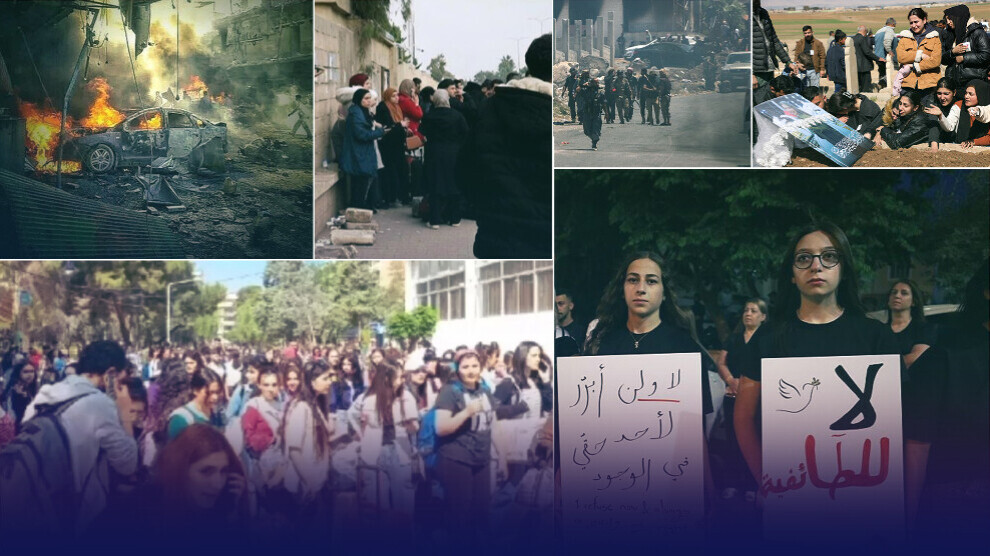
As-Sweida_ in the spring of 2025, following the spread of an audio recording attributed to one of the sheikhs of the Syrian city of Sweida, which contained religious insults and was later found to have been fabricated by jihadists of Hay’at Tahrir al-Sham, its widespread dissemination via social media led to a state of tension and anger that clearly reflected inside university housing.
During that period, incidents of tension were recorded within university cities, including verbal altercations and physical and verbal assaults targeting Druze students from Sweida, according to student testimonies speaking of being beaten and insulted. Student accounts indicate that the atmosphere inside some university facilities witnessed rapid escalation, punctuated by individual assault incidents, including the stabbing of one student and the injury of others.
Against the backdrop of these attacks, students from Sweida left university housing amid escalating tension. Student testimonies indicate that the departure came as a result of a growing sense of insecurity and fear for their safety, in light of repeated assault incidents and tensions within the university environment.
In a related context, the tension moved several days later to the Damascus countryside areas inhabited by Druze, including Jaramana, Ashrafiyat Sahnaya, and Sahnaya, where an atmosphere of resentment prevailed and rumors increased, accompanied by sporadic acts of violence and security tensions.
In the subsequent period, the areas of Ashrafiyat Sahnaya, Sahnaya, and Jaramana witnessed a series of violent incidents that led to a number of victims, estimated between 50 and 100 dead, in addition to sporadic physical assaults. As tension continued, groups of young men from Sweida headed toward the friction zones that had witnessed tension between Druze in the Damascus countryside, responding to "al‑Faza'a" (solidarity call). However, this group was ambushed by HTS jihadists on the Baraq road, located between Damascus and Sweida, resulting in the killing of 47 young men.
The solidarity call that turned into a tragedy
Raqiya Al‑Sha'er, a political activist in Sweida, said that on this day last year, young men from Sweida were targeted after they answered the "Faza'a" call to defend their people in Ashrafiyat Sahnaya, Sahnaya, and Jaramana, which, according to her description, were being attacked by HTS jihadists and so‑called internal security forces.
She adds that the ambush that took place on April 30, 2025, resulted in the killing of 47 young men from Sweida while they were carrying out their duty to defend their people. She notes that the victims were not only young men from Sweida but also civilians from Sahnaya, Ashrafiyat Sahnaya, and Jaramana – women, children, and elderly – in addition to the young men who rushed to defend their land and dignity, bringing the total number of victims in those massacres to more than one hundred.
She points out that the moment HTS took power on December 8, 2024, was in her view the beginning of the collapse of the new Syria, after years of collapse under the previous regime. Since that date, she says, the "cascade of blood" began from the Syrian coast, where numerous massacres took place, the number of victims of which is still unknown due to their continuation and media blackout. Then these events extended to Sweida in July 2025, where, according to her account, more than five thousand people were killed, without the possibility of documenting the numbers accurately due to the inability to reach all the bodies because of jihadist control.
She notes that this authority came "through a political deal, and since then the bleeding in Syria has not stopped," considering that the ideology carried by this authority is exclusionary, based on violence against anyone who differs from it in sect or creed.
"The person who fabricated the recording is still free"
Raqiya Al‑Sha'er returns to the cause of the events, saying that everything that happened began with a "fabricated audio recording," whose owner later admitted it was not real. Despite that, this recording led to a wide campaign of incitement against members of the Druze sect, starting from university students, through the events in Jaramana and Sahnaya, to the Sweida massacre. She adds, "The person who published the recording is still free, living in Turkey. He even visited Syria and took photos with figures from the authority, including the Minister of Culture."
Raqiya Al‑Sha'er concludes her speech by saying that the interim government talks about development and economic projects, but the reality "witnesses increasing queues, shortages of basic materials, and absence of services, while the only achievement remains the continuation of killing and bloodshed, to the point that Syrian land has become unable to absorb more blood being spilled daily."
The facts that Syria has witnessed in recent years show that blood was shed in more than one area on the basis of identity and affiliation – from the coastal massacres that targeted members of the Alawite sect, to the Sweida massacres that targeted the Druze, through the events of the Ashrafiya and Sheikh Maqsoud neighborhoods that targeted Kurds, to the bombings that struck churches, such as the bombing of the Dweil'a Church.
These events are part of a record of violations attributed to the interim Syrian government, which they consider responsible for the continuation of the cycle of violence and division in the country.