
A shelter under a bus sums up the collapse of humanity in Gaza
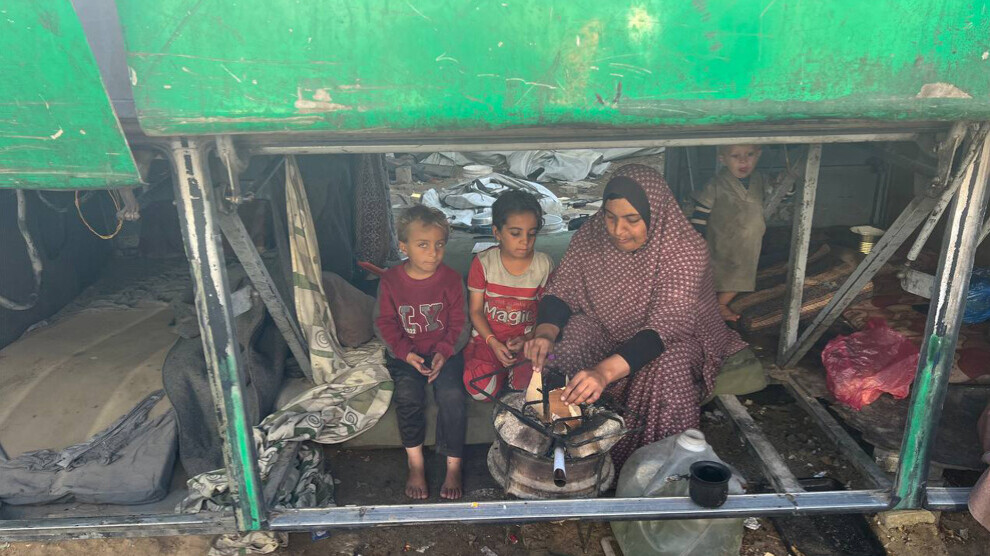
Under the chassis of an abandoned bus, a mother and her children sleep between the wheels, in a scene that sums up how war can drive people to live in a place never meant for life.
Nagham Karaja
Gaza – Israa Junaid, one of thousands of women who found themselves alone facing the harshness of war days, lives a long journey of homelessness, hunger, and loss of security. Her days have turned into a constant struggle for survival in the absence of shelter, income, and protection, making the details of her daily life an unrelenting open battle.
Israa Junaid says, recalling the details of her harsh journey: "I feel that I am facing multiple wars, not just one war… War is not only in the shelling; war is in hunger, in displacement, in being a mother with no support, and in sleeping without a roof to protect your children." These words summarize the features of a whole life she lives between overcrowded displacement sites and continuous attempts to find a safe corner to shelter her three children.
After being displaced from the north of the Gaza Strip to the south, Israa Junaid found herself facing a harsher reality than she expected. There was no place to shelter her, no tent available, not even a small space on a crowded sidewalk. She adds: "I arrived and found nothing… no tent, no room, not even a corner to put my children. I felt invisible." After many attempts, she was forced to sleep for two consecutive days on the ground in front of an educational college, in a scene that sums up the scale of the humanitarian collapse in displacement sites.
Later, the administration of one of the shelters suggested she sleep under a parked bus. The means of transport turned into a temporary shelter. She says: "They told me, sleep under the bus. They didn't even give me a single cover for the children. My ceiling is a metal frame. At night we are afraid of the cold, insects, and suffocation." In this cramped space, she would close the lower openings of the bus at night to prevent insects from creeping in, but at the same time, she and her children were trapped in suffocating air between the vehicle's wheels and the heavy smells of the place.
Israa Junaid describes the details of the nights there with clear bitterness: "Sometimes we suffocated. Not enough air, no space to move. Insects never leave the place, and my children cry all night. I asked myself: Is it conceivable that a human being lives under a bus? How can a mother explain this to her children?" Amid these conditions, she had no tools for protection, heating, or even the minimum means of living.
Despite all this, she receives no stable support or sponsorship for her orphaned children. "I am alone. No one asks, no one helps," she says in a voice mixing exhaustion with suppressed anger.
She starts her day early, lighting a small fire to cook whatever is available; sometimes she finds nothing to cook at all, so she sits with her children around the fire in heavy silence. "Sometimes I light the fire and there is nothing to cook. Just to make them feel that the day has started."
The three children also live today deprived of education, childhood, and stability, as the mother cannot provide stationery or school supplies, so school remains a deferred dream.
The family also suffers from a severe shortage of clothing; the children sometimes wear summer clothes in winter and winter clothes in summer due to the inability to provide the minimum needs. In the temporary accommodation, the mother's suffering increases with rodents and insects that invade the place, while she stands helpless to confront them alone, fearing for her young children who cannot protect themselves.
In a broader context, Israa Junaid's story reflects the reality of thousands of women in the Gaza Strip who have borne the burdens of war doubly, amid a wide economic and humanitarian collapse.
Women in displacement centers face not only food and shelter shortages but also an enormous psychological burden of protecting children from hunger, fear, and disease in an environment lacking the most basic elements of safety. Many of them are forced to redefine their daily roles between motherhood, searching for food, and caring for children in inhuman conditions, making their experience one of the harshest manifestations of resilience in this war.
International organizations concerned with human rights and women affirm that displaced and widowed women in Gaza bear a disproportionate burden in armed conflicts, as they are considered among the most vulnerable groups under international humanitarian law. Protection principles indicate the need to urgently provide shelter, food, healthcare, and psychological support to civilians, especially women and children.
International law also obliges warring parties to ensure that civilian infrastructure and shelters are not targeted and to secure the basic needs of displaced persons – something that UN reports confirm remains a major challenge.
At the end of her speech, Israa Junaid returns to summarize her daily scene with simple yet heavy words: "Every day I say tomorrow will be easier. But every day is harder than the one before. I want nothing but a safe place for my children, a roof that does not frighten them, and a night in which we do not suffocate." Between this simple wish and the harsh reality, her life remains suspended between survival and staying alive in a war that has left her only one choice: to remain a mother resisting alone.