
BARJIM JUODI
KOBANI — Coinciding with the International Day for the Elimination of Violence against Women, women from the city of Kobani affirmed that combating violence should not be limited to one day but should turn all days of the year into days of struggle and resistance, stressing the need to enhance women's role in decision-making positions and community management, and to build a democratic Syria that guarantees women's rights and freedom.
At a time when the world is witnessing accelerating scientific and technological developments, rates of violence against women are alarmingly increasing, and its forms and methods are multiplying. Women no longer confine their struggle against violence to November 25 alone but affirm the necessity of turning all days of the year into stations of struggle and uprising against various forms of violence.
In this context, our agency met with a number of women from the city of Kobani in Rojava and surveyed their opinions and messages, where they stressed the need to continue the struggle to end violence and achieve equality and justice.
"Women's reality has witnessed tangible changes"
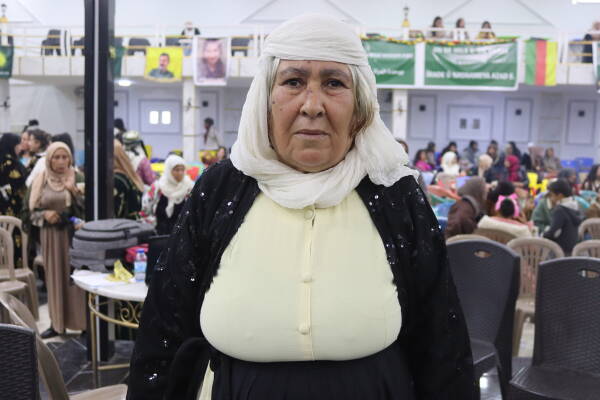
Shams Mohammed spoke about the transformations she witnessed over the past five decades, noting that she is currently 70 years old, and recalled the features of women's reality in her youth. "Women lived under the weight of great oppression, as their role was limited to work inside the home, doing household chores, and raising children."
She added: "But with the July 19 revolution in Rojava, these concepts that confined women to the home framework witnessed a major transformation in our society. Thanks to Leader Öcalan's thought and his philosophy based on women's freedom, we realized that we have rights, and that women also have their existence, role, and status in society."
"Choosing effective methods to confront violence"
Shams Mohammed directed a message to women, calling on them to make struggle a fundamental approach to confronting violence and discrimination, affirming that the changes achieved have not ended women's suffering, as many of them are still subjected to violence, stressing that women have the right to a dignified life free of violence.
She added: "I call on women to liberate themselves from dependency and demand their rights. Instead of surrendering to violence or resorting to self-harm and suicide, they should continue the struggle and work to change society."
"Violence is not merely individual practices"
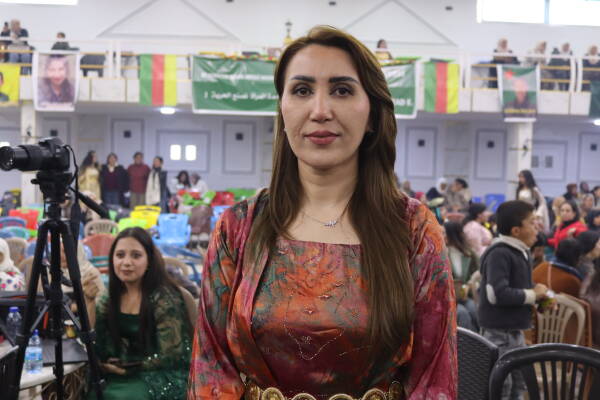
For her part, Berivan Hassan shed light on the political and social dimensions of violence against women, considering that violence is not merely individual practices but is linked to the nature of the prevailing system.
She pointed out that the prevailing global system is based on violence and places women in the circle of targeting in various areas of life, explaining that women in Syria and the world are still absent from effective participation in building systems, amid deliberate practices aimed at excluding them from decision-making positions.
Berivan Hassan directed a message to Syrian women calling on them to strengthen will and strength and continue the struggle against patriarchal mentality. "We must have will and strength and continue our struggle. If we want to build a sound society free of violence, women must take a leading role in managing it."
"Strong and struggling women are a target of extremist forces"
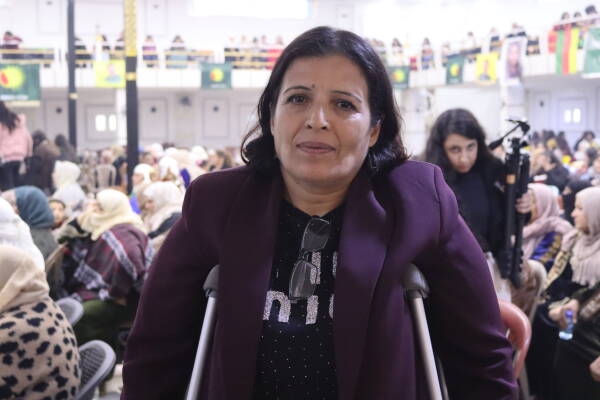
As for Halima Othman, one of the wounded of the women's revolution, she said: "Our tongue and mind are still capable of struggle," affirming that violence will not be able to silence women's voice or stop their struggle.
She condemned all forms of violence against women. "We must make this year a year of uprising against all forms of violence. Great powers fear women's will; the Turkish state has targeted hundreds of women with the aim of stopping our work and struggle. Even if I no longer have a hand or a foot, I still have my tongue and my mind to continue my struggle."
She affirmed that the Syrian interim government seeks to marginalize women's role and exclude them from positions of influence and decision-making, stressing the rejection of this mentality and all practices that deny women's existence and rights. "Guaranteeing women's rights, identity, and participation in shaping Syria's future must top the priorities of the struggle in the coming phase," affirming that society's freedom remains hostage to women's liberation and their attainment of their full rights.