
Delishan Ibesh… Nine Years Since the Departure of the Unforgettable Voice of Truth
Over six years, Delishan Ibesh devoted her media career to conveying society's truth and suffering, documenting Rojava's women's revolution, becoming truth's eye and every woman's voice.
NORSHAN ABDI
KOBANI– The twelfth of October marks the ninth anniversary of the martyrdom of media professional Delishan Ibesh, who devoted six years of her life to journalistic work, and made her camera a means of conveying the truth of societies and shedding light on their suffering and tragedies, especially women who lived through the horrors of wars and conflicts. For her, the camera was not just a tool for documenting events, but was her window for conveying the voices of the marginalized and oppressed to the world, and revealing the truths that the war tried to erase.
Six Years of Work and Journalistic Struggle
Delishan Ibesh was born in 1992 in Kobani city in Rojava, into a patriotic family known for its love for its homeland and its connection to the Kurdish cause. The launch of the 19 July 2012 revolution constituted an important turning point in her life, as she chose to engage in the path of the revolution. In 2013, she began her journey in the media field, through her work as a presenter at "Voice of Kobani" radio, of which she was among the founders.
With the beginning of ISIS's attacks on Kobani in 2014, she participated in covering the resistance and conveying events. However, the difficult field conditions forced her to leave the city, and during her journey she was subjected to arrest by the Turkish state, where she spent 18 days in prison alongside a number of her media colleagues.
After her release, she moved to Qamishli, where she continued her media work at "Voice of Joudi" radio. With the liberation of Kobani in 2015, she returned to her city and resumed her work at "Voice of Kobani" radio, before working for two months at Ronahi Satellite, then moving in 2016 to Hawar News Agency, through which she continued covering field events and documenting the reality of society under war.
During her career, Delishan Ibesh participated in covering the military campaigns launched by the Syrian Democratic Forces against ISIS in Sarrin, Manbij, Tabqa, and Raqqa, leading to the Al-Jazeera Storm campaign in Deir ez-Zor, which was her last station. On 12 October 2017, Delishan Ibesh was martyred alongside her two colleagues Hawkar Mohammed and Rizgar Deniz, while covering the Deir ez-Zor liberation campaign.
"Through Her Work, Delishan Became the Voice and Eye of Truth"
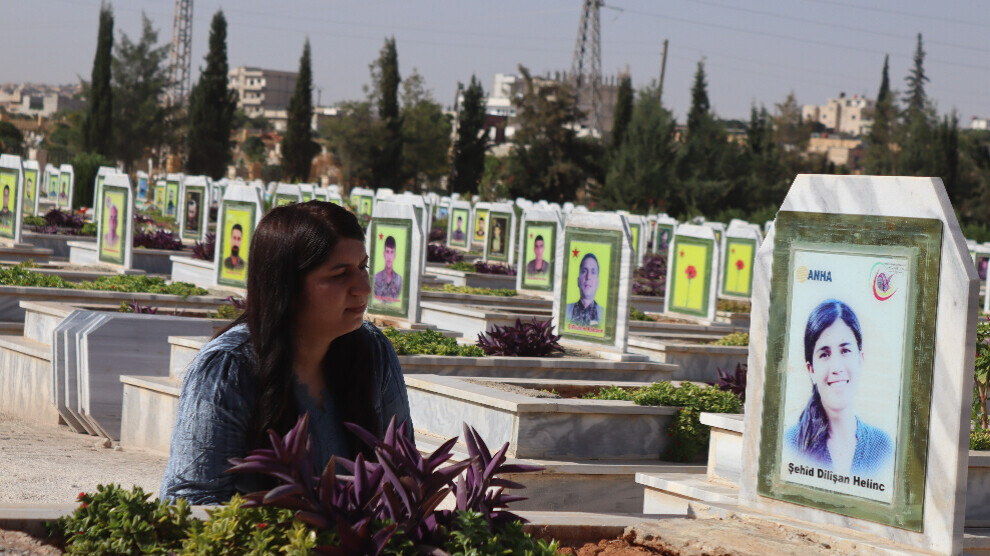
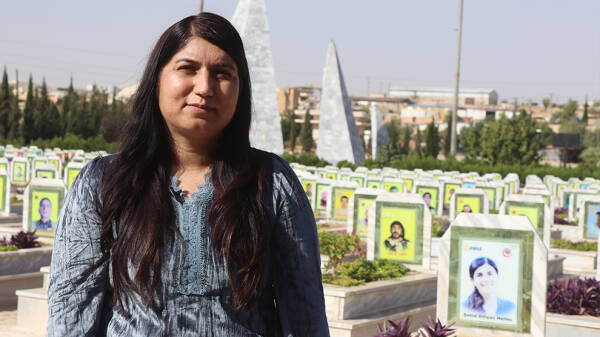
On the Ninth Anniversary of the Martyrdom of Delishan Ibesh, Shilan Mohammed, correspondent for JN TV Women's Satellite in Kobani, spoke about Delishan's professional journey, her personality, and the journalistic and humanitarian legacy she left behind.
She said: "We are today in the Martyr Dijle Cemetery in Kobani, a place that holds special meaning and status for the people of this city. Every female and male martyr in this cemetery has a story and a painful epic, among them Delishan, who made a great effort and work to introduce the reality of society to the world."
She explained that Delishan, as a young woman from Kobani, wanted to be an essential part of the revolution, so she chose journalistic work and devoted her capabilities to conveying the reality of her society, confirming that her influential personality and continuous work contributed to leaving a clear mark and an important legacy in the media.
She said that Delishan dealt with her colleagues in the spirit of a teacher, based on her belief in the importance of "Voice of Kobani" radio and its role in the revolution, especially as it was one of the pioneering media institutions in the region. Therefore, she made great efforts to develop media work and enhance the capabilities of those working in it, believing that building strong media begins with preparing cadres capable of performing their mission with professionalism and responsibility.
Regarding Delishan's personality and the memories she shared with her, Shilan Mohammed recalled her permanent smile and positive spirit, saying that the place where she was would be filled with happiness and joy. She was a person with a cheerful face and a strong personality, and she gave those around her morale and self-confidence.
A Camera That Documents Suffering and Gives Hope
Delishan Ibesh's role was not limited to work inside media institutions; she was a field journalist present in many military campaigns witnessed in the areas of northern and eastern Syria, and she documented the conditions of residents and displaced women and their suffering under conflicts.
About Delishan's role in the field, Shilan Mohammed noted that her personal strength was reflected on her colleagues and the fighters around her, as she tried to spread morale in the most difficult circumstances, and did not allow fear to limit her ability to perform her duty.
She noted that Delishan played an important role in developing media work, especially women's media, through her insistence on conveying the reality of women and their suffering, and highlighting their role in resistance and building society, so that her camera became a tool for documenting events, and a means of defending the truth and conveying women's voices to the world.
She confirmed that "the month of October carries the memory of a number of media martyrs who sacrificed their lives for the sake of conveying the truth, among them Delishan Ibesh," stressing that preserving their legacy is a responsibility falling on the media professionals who continue to work in this field.
At the end of her interview, Shilan Mohammed said that commemorating Delishan is not limited to reviving the memory of her martyrdom, but is also represented in continuing her media mission, conveying the voice of society to the world, and shedding light on women's issues in Rojava and their role in the revolution and building society.
Nine years after her martyrdom, Delishan Ibesh is still present in the memory of her colleagues, with the positions, memories, and professional and humanitarian experience she left behind. She departed while carrying her camera in the field of work, but she left behind a legacy that reminds that journalism is not just conveying events, but a responsibility toward society, a testimony to people's suffering, and a permanent attempt to give the truth a voice and an image that do not disappear with the absence of their owners.