
An awareness session in Baghdad highlights Resolution 1325 to enhance women’s leadership
The National Team for Iraqi Women Organized an awareness session on UN Security Council Resolutio 1325 on Women, Peace and Security.
RAJAA HAMID RASHID
BAGHDAD_Baghdad witnessed an awareness session that shed light on recent files that have become an essential part of the women, security and peace agenda, foremost among them digital security and climate security, and the importance of enhancing women’s role as an active partner in finding solutions to environmental crises.
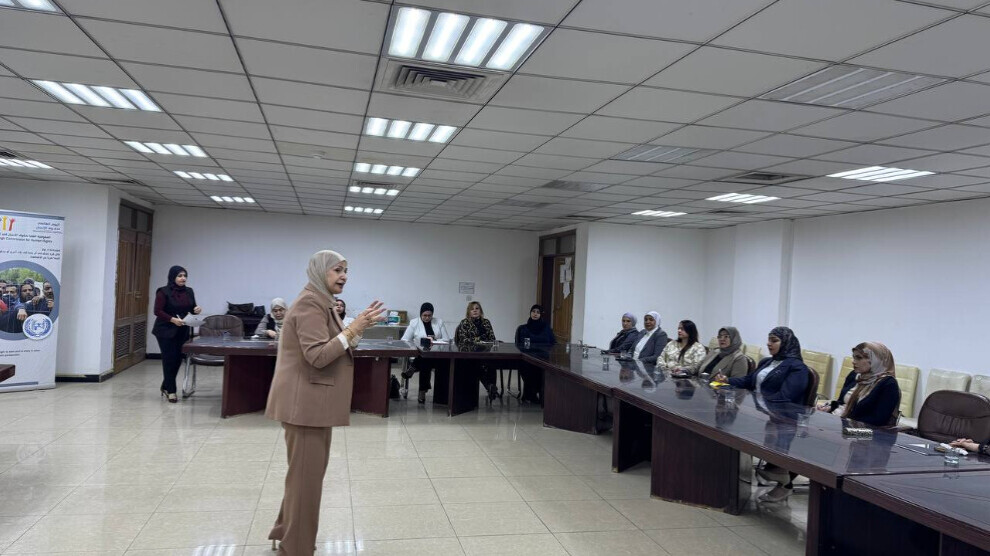
Under the umbrella of the program for empowering and leading women in political participation and peacemaking, the National Team for Iraqi Women, in cooperation with the High Commission for Human Rights, held an awareness session on UN Security Council Resolution 1325 on Women, Peace and Security, yesterday, Thursday, November 12, in the hall of the National Center for Human Rights in Baghdad. The session was lectured by the High Commission for Human Rights' Nisreen Abdel-Aali, with the participation of a number of members of the National Team for Women and activists from government institutions and civil society organizations.
The session, held on the occasion of the 26th anniversary of the issuance of the resolution, addressed the most prominent contents of UN Security Council Resolution 1325, which the UN Security Council adopted in October 2000, based on a number of international references, foremost among them the Convention on the Elimination of All Forms of Discrimination against Women (CEDAW), the Beijing Declaration and Platform for Action, especially the axis related to women and armed conflicts, in addition to Security Council resolutions 1265 of 1999 and 1296 of 2000, related to the protection of civilians during armed conflicts.
The resolution is considered a pivotal document, as it is the first official document in which the Security Council recognizes the impact of armed conflicts on women and girls, and affirms the importance of women's participation in efforts to establish peace, in addition to enhancing their role in conflict prevention and protecting their rights during and after conflicts.
The first national plan (2014–2019): the emergency and confrontation phase
Lecturer at the High Commission for Human Rights Nisreen Abdel-Aali affirmed that Iraq was the first country in the Middle East and North Africa region to launch a national action plan to implement Resolution 1325, but its launch coincided with the attack of the ISIS terrorist organization, which made it focus exceptionally on emergency humanitarian response.
She also reviewed the first pillar of the resolution, which is participation, explaining that the concept of participation is not limited to the numerical representation of women, but includes ensuring their effective presence in political and security decision-making and peace negotiations. This pillar was embodied in Iraq through the constitutional quota system, stipulated in paragraph (Fourth) of Article (49) of the Iraqi Constitution, which guaranteed women's representation of no less than 25% in the House of Representatives, in addition to enhancing their presence in local councils, higher administrations, and law enforcement institutions.
The second national plan (2021–2024): the recovery and revitalization phase
Nisreen Abdel-Aali addressed the recovery and revitalization phase, which focused on taking into account the needs of women during and after crises, especially after the liberation of cities and the beginning of the stabilization phase, where work moved to reintegrating survivors and displaced women into society, activating local reconciliation committees, rebuilding infrastructure, and enhancing the protection of women and girls from gender-based violence and sexual violence during and after armed conflicts.
She also reviewed the most prominent national policies and measures taken in this field, including the Yazidi Survivors Law No. (8) of 2021, and the measures implemented by relevant government institutions to provide protection and safety for women and the most vulnerable groups, especially women and children, by providing psychological support, compensation, job opportunities, supporting small projects, and granting loans and the necessary facilities to implement them.
In this context, lecturer Nisreen Abdel-Aali pointed to the importance of verbal and psychological support in enhancing survivors' self-confidence, by adopting the term "survivors of violence" instead of "victims," which contributes to highlighting their strength and ability to overcome the effects of violations and improve their reality.
The session also addressed the efforts of relevant institutions in enhancing protection, including the formation of family and child protection directorates in the Ministry of Interior, activating community policing, combating domestic violence and violent extremism, rejecting hatred and enhancing peaceful coexistence, in addition to programs for building community peace and preventive awareness.
It also addressed the importance of digital security and confronting electronic blackmail that women are subjected to, especially election candidates, and the defamation, distortion, and smear campaigns they face aimed at influencing their political participation.
The third national plan (2025–2030): the empowerment and institutional integration phase
Regarding the third national plan, the lecturer reviewed the work contexts within the current phase, and the steps achieved so far toward moving from individual initiatives to institutionalizing the pillars of the resolution within ministries and government institutions, and including its objectives in the state's general plans and budgets.
Lecturer at the High Commission for Human Rights Nisreen Abdel-Aali also shed light on the recent files that have become an essential part of the women, security, and peace agenda, foremost among them digital security and climate security, and the importance of enhancing women's role as an active partner in finding solutions to environmental crises, especially the drought and water scarcity crisis, instead of being the first victim of its repercussions.
She affirmed that the third national plan and the coming years present new challenges that were not present when the resolution was issued in 2000, which requires focusing on two main tracks:
Digital security and peace: by protecting women, activists, and actors in the political and societal fields from blackmail and cyberbullying, and ensuring their safe and free participation in the digital space.
Climate and environmental security: by addressing the challenges of water scarcity, drought, and climate displacement, and supporting rural women as an essential partner in resource management and adaptation to environmental and climate changes.
At the conclusion of the session, the seminar witnessed a number of interventions and discussions that enriched its axes with information and the personal, professional, and scientific experiences of the participants, and contributed to the exchange of visions regarding enhancing Iraqi women's participation in decision-making and consolidating their role in building peace and achieving security and stability.