
“Women of Sophocles”: Greek tales on the Sweida stage mirroring women’s reslience
Participants in Sweida’s “Women of Sophocles” performance affirmed women remain the first voive against injustice and marginalization, able to create, resist and drive change, inspired by Greek rebellion tales.
ROCHELLE JUNIOR
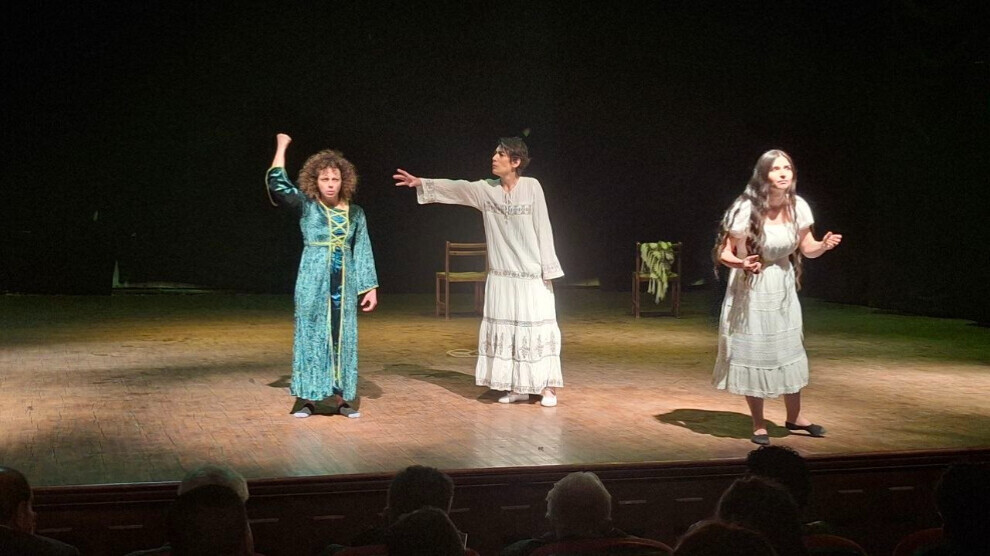
AS-SWEIDA— The Education Theater in Sweida witnessed a theatrical performance, prepared and directed by Ziad Karbaj, a work that brings together five plays in a single performance and sheds light on women's suffering and their resistance to injustice and tyranny, evoking female models from Greek times and linking them to contemporary reality and the burdens and challenges women carry today.
The theatrical performance, titled "Women of Sophocles," was presented yesterday, Wednesday, November 11, and offered the tales of women who, despite belonging to the palace and the court, stood against power and domination and turned into resistance figures seeking to bring about change and raise the voice of truth. The work also addresses the marginalization and violations women were subjected to during massacres and wars, especially violations that were often passed over in silence and shame, in an attempt to break this silence, highlight women's suffering, and shed light on their ability to confront and resist.
"Women are capable of creativity"
Speaking about her participation in the performance, actress Ruba Snayh — who has worked in theater since she was nine years old and is now 38, alongside her work as a sports and physical fitness trainer — explained that women's presence in artistic events, especially theater, gives society greater value and importance. She pointed out that women, with the household responsibilities and life pressures they carry, possess the ability to create and give, and combine in their personality strength, tenderness, and the capacity for endurance.
She affirmed that women are capable of creativity in various fields, and that their presence in the artistic and cultural space reflects their potential and active role in society, far from confining them to traditional roles.
Contemporary women's role is not small
For her part, actress Kholoud Al-Masfi spoke about the content of the "Women of Sophocles" performance, explaining that it addresses women from Greek times who were in a state of resistance to power despite fundamentally belonging to the palace and the court. She pointed out that the work presents the image of the resisting woman who, after stages of dictatorial rule, massacres, and domination, can lead a revolution and be part of a state of change.
She added that the performance presents three actresses embodying five female characters whose stories intersect at women's suffering and marginalization, even in the violations they were subjected to during massacres.
She noted that, by virtue of her previous work in bodies concerned with women's rights, she sometimes feels that women in Greek texts appear stronger and more capable of confrontation than what we see in the reality of women today. She explained that the role of contemporary women is not small, but it remains below the level that would enable them to have real influence on decisions, lead a revolution, or declare a protest position that enjoys support and rallying around it.
She pointed out that the female characters presented in the performance are daughters of the court who were subjected to a great deal of cruelty and oppression before they rebelled and became resisting women, wondering about the extent of the suffering women face in the present day, as they bear burdens, responsibilities, and pressures that accompany them at various stages of their lives.
"Women have been throughout history the first voice"
For her part, actress Layal Al-Muhaithawi, who has practiced theater work for four years, explained that the performance sheds light on women's role in demanding justice and defending rights, affirming that women have been throughout history the first voice in confronting injustice, and continue in this role to this day.
She said that the idea of the work is based on merging the past with the present, to show that women have always been present in the march of resistance and the demand for rights, but their voice has become clearer today with the growth of societal awareness. She called on the audience to pay greater attention to theater and take interest in it as an essential space for expression and change.
She affirmed that women constitute an essential part of the history of theater and ancient civilizations, and that theater is capable of portraying humanitarian issues and conveying cries that may be stronger than reality itself, by shedding light on them and placing them before the audience. She stressed the importance of the role theater plays in conveying the voices of women who suffer injustice and repression in various times and places.