
Protests in Tunisia against Declining Freedoms and Worsening Living Conditions
Protesters demanded the removal of the ruling system, citing a dangerous turning point caused by deteriorating economic, social, and political conditions, alongside the severe shortage of basic life necessities.
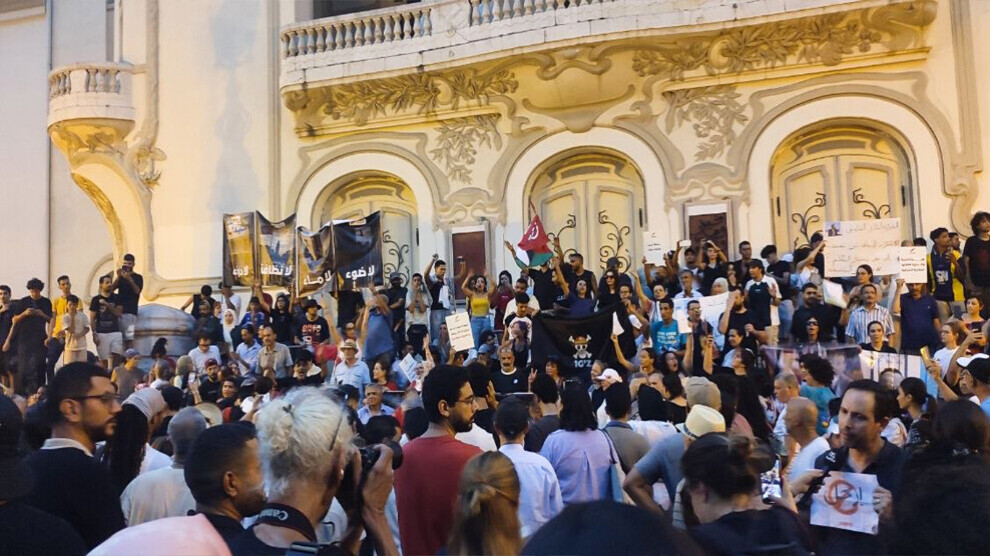
Tunis — The Tunisian capital witnessed a large-scale protest movement and mass march on Saturday, July 25, coinciding with Republic Day celebrations. Organized by the "Nafass" movement and opposition forces, the event saw widespread participation from the nation's youth and civil society components.
These demonstrations served as a stark expression of public frustration and a direct denunciation of the political, social, and economic trajectory the country has taken six years after current President Kais Saied assumed power.
The protests were not limited to the political sphere alone; they extended to touch the daily lives of exhausted Tunisian citizens. Demonstrators strongly condemned recurring water and electricity crises, the soaring cost of living, and the harsh daily realities faced by Tunisians. The tone of the slogans raised reflected a deep sense of despair and anger, with protesters describing Tunisia’s current reality in harsh terms, likening the country to a "grave" or an "open prison."
From the "Cradle of the Revolution" to a Station of Disillusionment
Today’s protest landscape cannot be read in isolation from modern Tunisia’s historical legacy. For the Arab region, the country was not merely a geographical territory; in 2011, it was a beacon that illuminated the path of change, inspired millions, and offered a profound lesson that freedom and peaceful change are possible when a people unite and organize their ranks.
In the years following the revolution, Tunisia took broad strides along the path of democratic transition. Its citizens enjoyed expansive spaces for freedom of expression and the press, elevating the country to advanced regional rankings—a status crowned when the Tunisian National Dialogue Quartet was awarded the Nobel Peace Prize. However, this hope collided with the 2019 elections, when a wide segment of youth placed their trust in constitutional law professor Kais Saied, believing he would be the guarantor of the nation's constitution. Yet, hope gradually turned into deep disappointment as the country entered its most difficult and harshest phase since independence.
Service Collapse and Tragic Testimonies
The decline was not confined to the political arena; it struck the very core of daily life, generating living crises manifested in water and electricity cutoffs and hyperinflation. The humanitarian situation reached catastrophic levels documented by professional reports. The Young Doctors Organization noted that between 150 and 200 people died inside public hospitals and clinics, alongside silent deaths occurring at home due to power outages, the failure of vital equipment, and the complete collapse of the health system.
Feminist and human rights activist Nejet Arâari emphasized that their presence in the march coincided with the sixty-ninth anniversary of Republic Day, pointing out that Tunisia is enduring one disaster after another.
She explained that this is not merely about elections or ballot boxes, but rather a value system whose foremost requirement is preserving the citizen’s dignity, protecting their rights, freedoms, and decent living, alongside achieving equality, social justice, and socio-economic rights.
Arâari stressed that these values are entirely absent in Tunisia today, where citizens live in darkness, thirst, poverty, vulnerability, and deprivation across various regions. She noted that people now speak of high unemployment and poverty rates, and of citizens dying in hospitals due to a lack of medicine, alongside burned-out and degraded public services.
For her part, a citizen named Aziza expressed fierce anger over the deteriorating living conditions, questioning the role of officials in the face of soaring prices that have forced parents to pull their children out of school. With deep sorrow, she recounted the plight of a 71-year-old elderly woman who has no one to accompany her to the hospital or provide her with even a single medicine.
She stressed that hunger, exhaustion, and thirst have become harsh daily realities, asking how anyone earning meager wages can survive or meet basic needs. She explained that many have become barefoot and hungry, sometimes scavenging from trash cans or collecting plastic bottles and bags, while patients find no medicine for their chronic illnesses in hospitals.
She concluded by emphasizing that the youth—supposedly the pillar of the nation—suffer from unemployment, poverty, and homelessness, underscoring the scale of injustice endured by ordinary citizens who can no longer even afford their daily bread or medicine.
The Lack of Basic Necessities
Zineb Mraihi, the wife of a political prisoner, recounted her daily suffering, affirming that she is a first-class Tunisian citizen living exactly as ordinary Tunisians do, noting that her husband is a political prisoner currently held in Tunisian jails.
She stated that she took to the streets alongside fellow citizens to express the severe suffocation felt by the public, explaining that people can no longer breathe or bear the worsening conditions, and that their catastrophic situation lacks the most basic elements of life, such as water and electricity.
She emphasized that conditions inside Tunisian prisons are extremely poor and tragic; detainees suffer from severe suffocation, a lack of ventilation, and intense heat. Furthermore, drinking water is frequently cut off, forcing them to bring drinking water from outside the prison walls amid water scarcity, a lack of adequate care, and record high temperatures.
Since July 25, 2021, freedoms in Tunisia have declined significantly. The country ranked 129th out of 180 in the 2025 Press Freedom Index, with 167 assaults recorded against journalists, at least 4 journalists still detained, and the closure of the Access to Information Authority in August 2024, further tightening restrictions on journalistic work.
Citizens continue to suffer from high prices despite inflation slowing to 5% in September 2025. The 2026 budget relies on taxes for over 75% of its revenue while targeting a sluggish growth rate of 3.3%.
Unemployment rates remain high, exceeding 16% overall and 38% among higher education graduates, coupled with a sharp decline in purchasing power.
Regarding women's rights, feminist organizations have noted a setback following the abolition of the principle of parity in the 2022 constitution and an increase in judicial harassment against female activists and human rights defenders.