
Women of Kobani: We will not accept the erasure of our language and culture
Women in Kobani affirm that Syrian interim government measures target Kurdish language and threaten the cultural identity of the population, stressing that school name changes directly target the Kurdish existence.
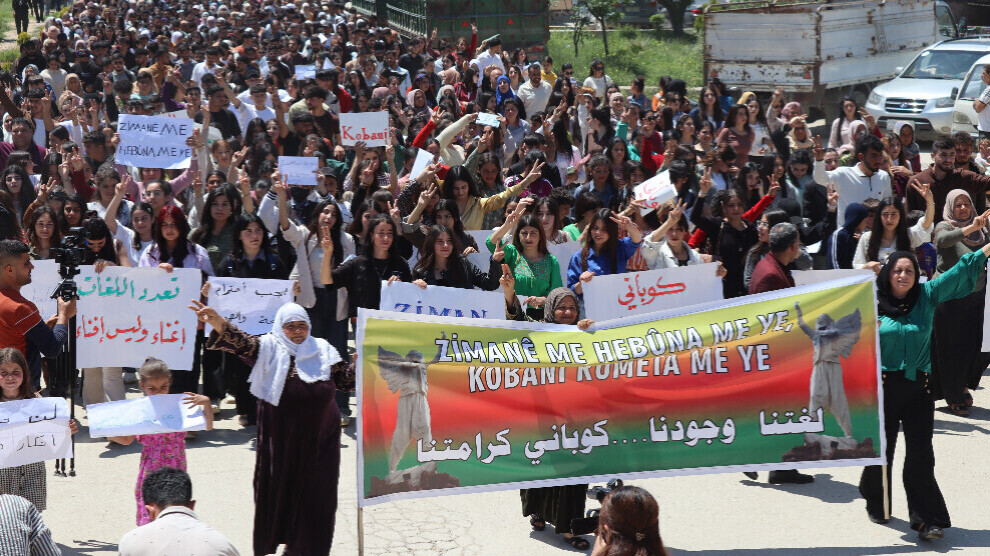
Kobani – Rojava regions, especially the city of Kobani, are witnessing escalating protests led by women and residents, rejecting the policies of the Syrian interim government that include changing the names of schools and towns and removing Kurdish signs.
The interim government's failure to officially recognize the Kurdish language in the Syrian constitution, along with its adoption of tendencies described as inconsistent with the principles of integration, has sparked a wide wave of concern in western Rojava. Fears have increased recently following measures related to restricting the right to education in Kurdish, and attempts to remove Kurdish signs and change school names in several Kurdish‑majority cities.
The interim government is also working to change the names of villages and towns in the cities of Kobani and the Jazira region, which has provoked angry reactions and widespread discontent among residents who consider these steps an attack on their cultural identity.
Rojava regions are witnessing movements and protests rejecting policies that residents accuse of undermining their linguistic and cultural specificity, considering that they contradict their demands to preserve their identity within an inclusive national framework. In Kobani, residents are organizing protest vigils and demonstrations against the measures the interim government is trying to impose, amid growing popular discontent.
Women of Kobani in particular express their rejection of these steps, participating in protests and showing wide anger at what they describe as "an assault on identity." Several women spoke to our agency, affirming that these policies affect their cultural rights and target the Kurdish existence in the region.
"The autonomy of Kurdish regions is fading away"
Klestan Iti affirmed that the city has a deep‑rooted Kurdish identity, language, and culture, and that what is happening represents a policy targeting the Kurdish language and culture, considering that these steps reproduce the genocide mentality that the Kurdish people have faced throughout their history.
Regarding attempts to change the names of the city, neighborhoods, and schools, she affirmed that they do not reflect Kobani's reality nor represent its society, stressing that residents categorically reject these changes. "The people of Kobani, after years of struggle and sacrifices, will not accept policies that they see as targeting their identity and cultural existence."
She stressed that the fundamental demand of Kobani's residents is to live in their original language, pointing out that the will of the people is clear in defending their language and identity after many years of work and sacrifice. "Kobani will continue to protect its self‑autonomy and its language." She considered that the ongoing attempts to deny the Kurdish language and replace it with other languages contradict previous promises to protect the specificity of Kurdish regions.
She added that the Kurdish people in Kobani insist on preserving their language and cultural identity, noting that Syria is a country rich in linguistic, religious, and belief diversity, and that respecting this diversity is the foundation of stability and coexistence.
"We have offered 14,000 martyrs to secure our existence and our language"
Hevin Ismail highlighted the heavy price the Kurdish people have paid for their language and identity, saying: "We have sacrificed more than 14,000 martyrs to secure our existence, identity, and language. Is it easy for us today to accept such measures? Since the beginning of the revolution, we have worked in the spirit of the democratic nation, affirming the need to recognize every component living in Syria and respect its language, culture, and religion. But we see that the interim government, on the contrary, imposes on us the concept of a nation‑state based on one language, one nation, and one religion, and we will not accept this under any circumstances."
The Hope Organization called on the Syrian interim government to respect linguistic, cultural, and religious diversity in Syria, affirming its rejection of measures it sees as targeting the Kurdish language. The organization said in a statement: "We clearly declare our rejection of practices being carried out against our language and our existence. We will not accept the denial of our language, nor will we remain silent in the face of these assaults. Just as we respect other languages, the interim government must respect our language as well, not ignore it. We will continue to work and struggle for this goal, and we will not abandon our identity and language."
"I do not agree to change the name of my school"
Rubin Ma'mo, a student at Martyr Beritan School, expressed her anger at the measures that she says target the Kurdish language and students' right to learn in their mother tongue. She said: "The interim government is working to deny our language, our education, and our identity." She affirmed that students who have been studying in their language for years reject any step aimed at erasing linguistic identity. She asked: "How can they change the names of schools where we have been studying for many years?"
She expressed her refusal to change her school's name, saying that Martyr Beritan School holds special symbolism for students. "Thanks to the sacrifices of martyrs, we are able today to live in our language and culture and preserve our identity as a people. Attempts to change the school's name are unacceptable in any form," considering that they affect the cultural symbols that form part of the community's memory.
"We will not bow down for the future of our language"
Student Rohlat Ali expressed her rejection of measures targeting the Kurdish language and the new generation's right to learn in their mother tongue. "Previous generations were not given the opportunity to study in their original language or receive education according to their culture, while the current generation considers itself lucky to have started their education in Kurdish from the first grade."
She affirmed that students will not remain silent in the face of attempts to weaken linguistic identity, adding that they dream of continuing their university education in their mother tongue, and of becoming academics, teachers, and doctors, stressing that no force will be able to deter them from achieving their dreams. "Protecting the Kurdish language represents for them an essential part of cultural struggle and a rejection of what they describe as attempts at linguistic genocide."