
Freedom Movement: Leader Öcalan is the primary interlocutor in any political solution
On PKK dissolution’s first anniversary, Freedom Movement leadership reassessed the peace process, affirming progress requires legal steps and Öcalan's political status to guarantee his role leading the next phase.
News Center – On the first anniversary of the dissolution of the Kurdistan Workers' Party (PKK), this occasion emerged as a striking political event that re‑highlighted the transformations in the Kurdish arena over the past year. The decision to dissolve marked a turning point in the Kurdish movement and opened the door to wide‑ranging discussions about the future of the political process.
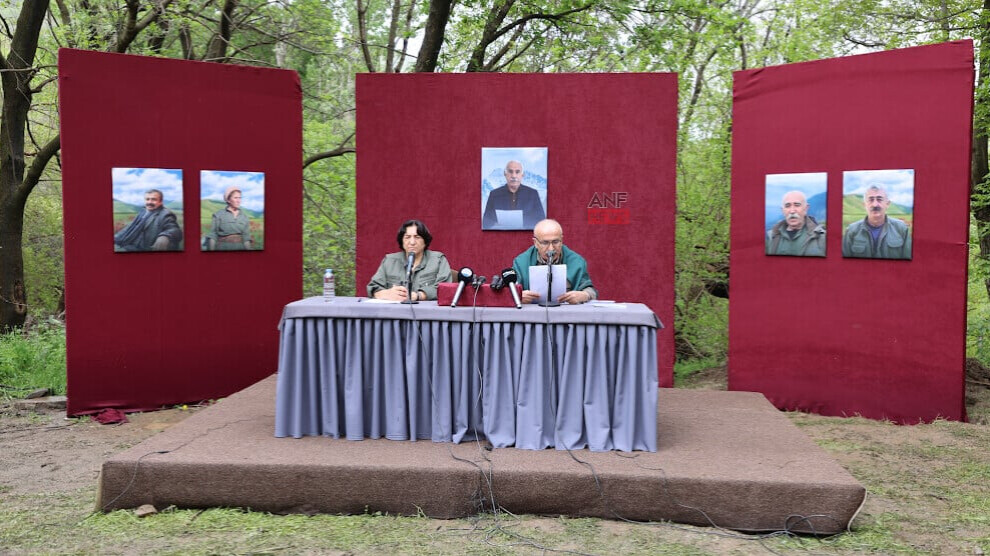
The leadership of the Azadi Movement held a press conference today, Tuesday, May 5, in the legitimate defense zones, marking one year since the congress that dissolved the PKK's organizational structure. During the conference, the leadership reviewed the latest developments concerning the peace process and the building of a democratic society. The press conference was attended by Mustafa Karasu, a member of the Executive Council of the Kurdistan Communities Union (KCK), and Sozdar Avesta, a member of the Presidential Council of the KCK.
The movement issued a statement read by Sozdar Avesta, member of the General Presidential Council, in Kurdish: "We are holding this press conference in the days between May 5 and 7, i.e., on the anniversary of the 12th Congress of the Kurdistan Liberation Movement. It has been one year since our decision to dissolve the movement's organizational structure and end the armed struggle. Therefore, we will conduct a comprehensive review of what has happened in the context of the peace process and the building of a democratic society, and what the liberation movement has done compared to what the Turkish state has done, in order to provide answers to the questions that concern public opinion at this stage."
The statement explained that leader Abdullah Öcalan, in his call issued on February 27, 2025, addressed the circumstances that led to the emergence of the Kurdistan liberation movement and explained the reasons for its development over past decades. Based on a comprehensive assessment of the movement's trajectory over fifty years, leader Öcalan called for the dissolution of the movement and an end to armed struggle against Turkey. Following this call, the movement declared a unilateral ceasefire on March 1, 2025, a step described as part of a new path aimed at supporting the peace process.
The statement indicated that after this call, some circles and individuals believed that the Kurdistan liberation movement would not comply, but the movement continued on the path of leader Abdullah Öcalan and held its congress in a short period. The movement translated Öcalan's call into practical steps without hesitation, taking the decision to dissolve the party's organizational structure and end the armed struggle against Turkey. It added that leader Öcalan is the only one capable of implementing these decisions on the ground and of leading the peace process and building a democratic society as the chief negotiator.
The statement noted that from 1993 to the present, leader Öcalan has declared unilateral ceasefires more than once to pave the way for a democratic solution to the Kurdish issue, and has put forward multiple proposals for a solution, dealing with them rationally in an approach rarely seen globally. However, Turkey did not have a political solution at that time, leading to the failure of those efforts. On October 22, 2024, Devlet Bahçeli, the leader of the Nationalist Movement Party (MHP) and current coalition partner, made an appeal to which leader Öcalan responded positively, sensing that a genuine will for a solution might emerge from within the state's corridors.
The leadership affirmed in its statement that the movement, based on its confidence in Öcalan's ability to find a solution, took decisive decisions such as dissolving the PKK's organizational structure and ending the armed struggle, believing that such major steps alone can open the way for a democratic solution. "Through these decisions, we wanted to demonstrate our will and determination." It noted that on July 11, 2025, Besê Hozat, co‑chair of the Executive Council of the KCK, together with 30 fighters, destroyed their weapons by fire – a step that the movement saw as evidence that if the appropriate political conditions are created and necessary laws are enacted, thousands of other fighters will also lay down their weapons.
The statement pointed out that Devlet Bahçeli had made a statement at that time, considering that those who destroyed their weapons should return to Turkey through appropriate legal legislation, thus presenting a vision for a return mechanism. "We, as the liberation movement, and in order to end the armed struggle and enable the expression of our will for a political‑democratic solution, have withdrawn our forces from within Turkey's borders to outside, and have also evacuated some of our positions in the legitimate defense zones to avoid any potential clashes. We also handed over some members of the Turkish intelligence service whom we had captured in 2017."
According to the statement: "We have taken all these steps so far to move forward with the political and legal steps that could lead to a political‑democratic solution. Within the framework of this process, some meetings were held in İmralı with leader Öcalan, and the bodies of some of our martyrs were received in the legitimate defense zones. Apart from these issues, no other concrete steps have yet been taken on this path."
The statement explained: "We have always worked to prepare Kurdish public opinion for a political‑democratic solution, to send positive messages to the peoples of Turkey, and to adopt a sensitive approach on this matter. However, some spokespersons of the authority and media close to them have not contributed to preparing public opinion; on the contrary, they have worked to create negative feelings and ideas and to put forward opposite positions. Moreover, the negative approach towards the opposition has prevented the process from receiving social support to some extent."
The statement added: "We have seen that the committee formed in parliament is a positive thing, but the report‑writing process took too long, and public opinion was not well prepared. Although the primary interlocutor is leader Öcalan and he is the party of the solution, the parliamentary committee held only one meeting with him during this process. In the end, the committee prepared a report, and despite its shortcomings, this report could have positive effects on the ground, but its content and proposals have not yet been implemented. This shows that the authority is not approaching the peace and democratic society process seriously or sincerely."
The statement noted that leader Öcalan launched this process through the "Peace and Democratic Society Call" and increased its pace. He seeks to end a century of conflict and violence between Turkey and the Kurdish people and to build a democratic republic in which the Kurdish issue is resolved through democratic integration. Efforts are being made in this framework. However, for leader Öcalan to play his role in achieving this goal, he must be recognized as an official interlocutor. Then it will become clear whether the state has a genuine will to resolve the Kurdish issue. A real resolution process cannot begin except with the recognition of Öcalan's legal status and the determination of that status.
According to the statement, leader Öcalan has repeatedly affirmed that meetings held and statements made will have no meaning or results unless his legal status is clarified. If his legal and political status is determined, and he is able to hold meetings on that basis with various parties, then he can play his role effectively. Intermittent meetings with delegations do not allow him to play his fundamental role; indeed, that is impossible under such conditions.
The statement affirmed that the Kurdish issue is the most fundamental issue in Turkey, and leader Öcalan is the primary interlocutor. "The current approach towards him shows that this century‑old issue is not being resolved properly. Despite this reality, statements by the Speaker of Parliament and AKP officials that the process is ongoing do not reflect the actual situation. Only when Öcalan's status is determined and he is allowed to work freely can we speak of progress. Only then will the Kurdish people and public opinion believe in its progress, and support will quickly increase."
The leadership's statement indicated that for the peace and democratic society process to advance, Öcalan's status must be determined by a political decision, and legal steps must be taken to ensure the free progress of democratic politics. Disarming and fully engaging in democratic politics are linked to taking legal steps. This fact has been known to all parties from the beginning of the process until now. Therefore, the discussion revolves around legal steps and the legal system. In the end, statements linking legal steps to "verification and confirmation of disarmament" do not reflect reality; rather, they increase public confusion. On one hand, it is said that laws have been enacted to advance democratic politics freely and guarantee freedom of expression and assembly; on the other hand, it is said, "We will not lay down weapons, we will not come." On the contrary, leader Öcalan from the beginning called for preparing a legal ground to accelerate the process. Officials announced that legal steps would be taken after the holiday, but to date the necessary measures for the process's advancement have not been taken.
The leadership of the Azadi Movement concluded its statement by affirming that the Kurdistan liberation movement, in the congress where the dissolution of the PKK's organizational structure and the end of armed struggle against Turkey were announced, decided that the peace process and the building of a democratic society should be led by leader Öcalan as the chief negotiator and the central figure in this process. It stressed the need to determine Öcalan's political status as the primary interlocutor and to enable him to work in free conditions, as this is the only way to manage the process correctly and achieve concrete results. "The movement has done what was necessary in the past phase, even though many did not expect steps of this level. To achieve real progress, Öcalan's status must be determined and the necessary legal measures taken. This demand is not only the movement's but also reflects the aspirations of the people and democratic forces."