
Dersim… the lost girls and the confrontation that never materialized
The stories of women and girls targeted in Dersim massacre remain partly untold. While lost girls' fate stays obscure, women's memory keeps demand for justice and confrontation alive.
Sarya Deniz
News Center – Although many years have passed since the Dersim massacre, women still bear the heaviest burden of this historical tragedy. In this immense destruction that goes beyond official records, the losses were not limited to lives alone, but also included lives that were uprooted, children who were exiled, and women whose traces policies tried to erase, all buried in deep silence.
In particular, the fate of the women known as the "lost girls" remains unknown to this day, despite decades having passed, clearly revealing the absence of a genuine confrontation with this past.
What happened in Dersim was not just a massacre; it was also a multidimensional rupture that sought to erase women from memory. Women at that time were a direct target of violence, and at the same time they were silenced as bearers of collective memory. Yet, it was women themselves who transmitted what happened from generation to generation, preserving the language of grief and resistance. Every testimony told today, every elegy, every act of remembrance affirms that this silence was never complete.
Women as carriers of life and memory
The women of Dersim are not only witnesses but also fundamental actors in the continuation of resistance, faith, and identity. According to beliefs, woman is the carrier of life, and she performed this role in that historical period as well, being among the main forces that preserved collective memory.
Amid war, exile, and denial, these women managed to preserve their existence, and today they are considered a key not only to confronting the past but also to rebuilding the future.
An unparalleled massacre
In Dersim, which was known as one of the cities that the authorities could not subdue despite repeated military campaigns, one of the largest massacres in Turkey's history took place during 1937–1938: the Dersim massacre, known as "Tertele."
All Dersim tribes were ordered to surrender their weapons to the state. Then, on December 25, 1935, Law No. 2884, known as the "Tunceli Province Administration Law," was issued, under which "disciplinary" and "punitive" operations were launched, and the province's name was officially changed to Tunceli.
Under a Council of Ministers decision dated May 4, 1937, according to official records, about 13,000 people were killed, while unofficial estimates suggest the number may reach up to 70,000. This massacre was recorded as one of the bloodiest and most brutal events in the republic's history, considered an attempt at genocide targeting ethnic and religious identity.
According to official data, 11,818 people were exiled to the west of the country, while some sources indicate the real number was higher.
Targeting women and girls
According to beliefs, women hold a central and sacred place in various areas of life. They play the role of protector and guardian, are considered equal to men, and their status is not reduced to motherhood alone; rather, they are carriers of reason, conscience, and collective memory, contributing to the transmission of values and knowledge from generation to generation, alongside the role of "Dede" (religious guide). For this very reason, women and girls were among the direct targets of this massacre.
The violence was not limited to ethnic and religious policies; it also took a gender‑based dimension. Women were subjected to horrific forms of violence, including torture, sexual abuse, and even mutilation of corpses. These crimes have been described as "inhuman" and "brutal" by all standards.
The girls who were torn away
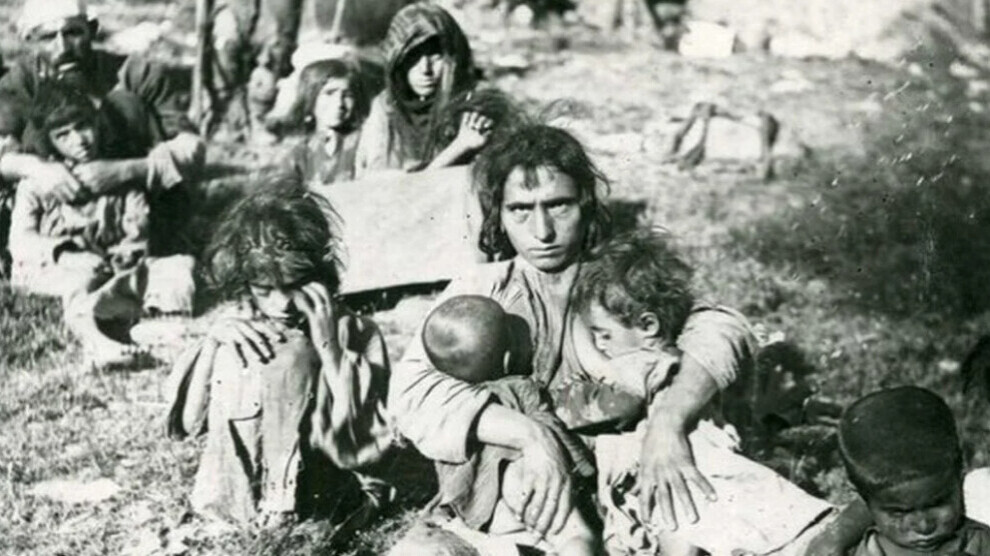
With the Dersim massacre, the reality of girls separated from their families emerged – an issue that continued to be spoken of for decades. After "Tertele," many girls were forcibly torn from their families and handed over to soldiers, while some were sent to boarding schools. Thus, girls were uprooted and pushed into a harsh and systematic assimilation process.
Families' attempts to search for and find their children continued through successive generations, making "Dersim's lost girls" a symbol of unending grief. Narratives that have come down from that period to this day have revealed many truths.
"Let those who remain alive stand up"
The massacre witness, İşehe Cega (died 2023), testifies: "They gathered people in the harvest square, and there was a machine gun. People started screaming, and some fled. Some families hid their children and survived. They separated men from women and said they would take us to the mountain to take pictures. We were children, crying and asking for bread and water. Some soldiers cried as they passed, others secretly gave us water and bread. My mother placed me between her legs and hid me and my brother, but a spear hit my back. When evening came, a young woman said: 'Let those who remain alive stand up.'"
"Children's screams are still in my ears"
Ekhe Neni (Emine Kulahci), who was a child during the massacre, recounts: "They gathered the Dimnan and Haydaran tribes and brought them to our village. Then they said, separate the Alan tribe. They took them to the Kirte Mazgir area, and there they were all killed. The screams of children are still in my ears to this day."
"The village square was like a field of corpses"
Fatma Birikdar says: "Forty soldiers came to our village and collected weapons. After days, they began gathering people. In Demirkapu, they gathered hundreds of villagers. We children and women fled to the forests. Those who did not flee were executed with machine guns. The village square was like a field of corpses."
She adds about the story of the two girls, Naciye and Hatun, daughters of a tribal leader: "An officer told them to choose one of them to marry him so that he would pardon them, but they refused, saying: 'You killed our family; we prefer our blood to mix with our relatives' blood rather than agree.' So he executed them."
A page of history that does not close
Today, despite decades passing, the traces of what happened in Dersim remain present. The memory carried by women is not just past pain; it is also the foundation for demands for justice, truth, and accountability.
As long as the fate of the "lost girls" remains undisclosed, and as long as gender‑based violence goes without genuine confrontation, this history does not close. Women's struggles continue today not only to remember the past but to make truth visible and ensure such tragedies are not repeated. For this reason, women in this land continue their resistance without pause.