
Najiba Qara Daghi: Democratic integration ends sectarian bigotry and women’s subordination
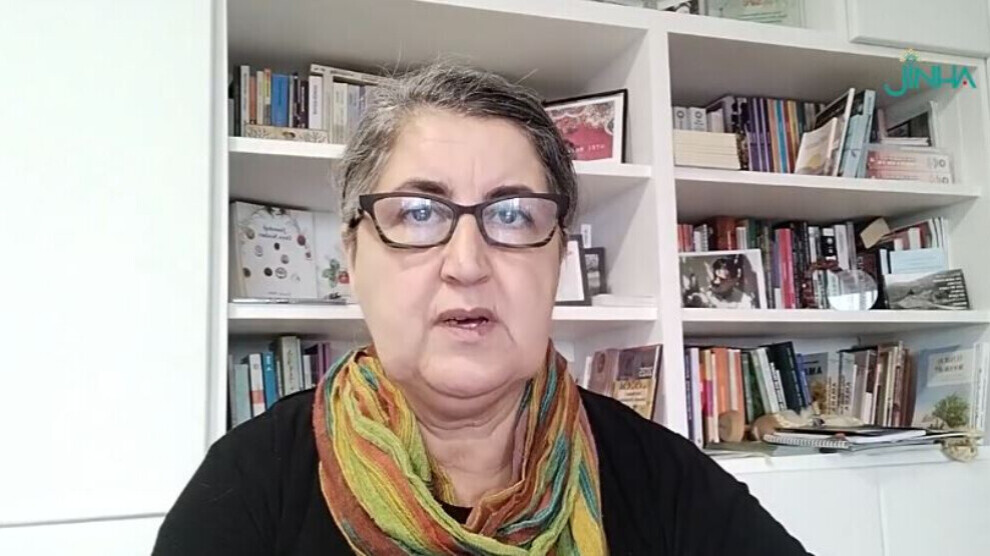
Najiba Qara Daghi of Jinology Academy: What’s happening is not mere negotiatios but an existential transformation forcing the Kurdish presence upon Turkey: the struggle has imposed an unavoidable new reality.
Hevi Salah
Sulaymaniyah – Democratic integration stands out as the foundation and main pillar for organizing society and modern, global politics, emphasizing the active participation of all diverse components without losing their own identities. This process is not merely formal unity but represents a philosophical deepening of the concept of free citizenship and the enhancement of the position of women and marginalized groups at the center of decision‑making.
Women's leadership in the process of democratic integration will lead to a radical change in the male‑dominated and authoritarian mentality, contribute to ending religious and sectarian bigotry, and address the deep crises in the Middle East.
"Democratic integration is a project of radical change and breaking the impossible"
Najiba Qara Daghi, a member of the Jinology Academy in the city of Sulaymaniyah in the Kurdistan Region, said in her discussion of the concept of integration and democratic integration that during the past period, especially after February 27, 2025, discussions about the issue of integration and democratic integration have escalated. She pointed out that there is a big difference between the two concepts. Integration in the context of countries receiving immigrants is used to address refugee issues to help them adapt to those countries' laws, whereas the process that began after the Peace and Democratic Society call launched by leader Öcalan on February 27 is fundamentally different from the traditional concept of integration.
The stage of existence and self‑awareness
She noted that democratic integration comes in the context of the Kurdistan freedom movement after a hundred years of struggle against denial, genocide, and marginalization, which "has brought the existence of the Kurdish people to a stage where the state can no longer deny it." She described this as an "existential" stage of great importance.
Likewise, the past fifty years, according to Najiba Qara Daghi, have witnessed "a revolutionary reconstruction process within the Kurdistan liberation movement, which established self‑awareness and knowledge of identity within Kurdish society. This struggle, on national, gender, and class levels, has highlighted the issue and forced the state to gradually move from its negative definition of the issue to the stage of negotiation."
Radical change in mentality
She affirmed: "We are not talking about negotiations in which the state accepted all the conditions of the Kurdistan liberation movement, but rather a very important step to begin a stage of radical change at the level of the state and the nation. In the context of the Middle East, especially in the countries where Kurdistan was divided, talking about democracy and changing the mentality is extremely difficult and sometimes seems impossible. But under the leadership of the struggle of the Kurdistan freedom movement, and with the philosophy of democratic modernity and the slogan 'Woman, Life, Freedom,' this impossibility has been broken."
Radical democracy and ecology
Najiba Qara Daghi stressed that "the proposed modernity is based on the foundations of radical democracy, women's freedom, and ecology, which has made the process not only about the rights of the Kurdish people but about a project of mental and structural change in the countries where Kurdistan was divided."
She said that these transformations certainly require a strategy and a strategic mind. "Talking about democratic integration means creating a fait accompli that forces the state to provide a democratic legal and political ground for the Kurdish people."
Reconstruction and the free citizen
In another part of her speech, she noted that "democratic integration is part of the self‑reconstruction process; that is, society, without waiting for the state's steps, works to consolidate democracy, build its institutions, and develop its linguistic, cultural, social, economic, and political needs. This is not a short‑term process but requires mutual patience and democratic laws. The concept of women's freedom, recognition of women and youth as the real actors in this process, is extremely important."
Regional and global impacts
Our speaker explained that democratic integration is a national issue, and on the other hand, a global and internal process. For Kurds, "it is related to the national unity of the Kurdish people in all its parts, but it is not just a national project; it requires a democratic mentality."
According to her assessment, this process "requires amending the constitutions of the countries where Kurdistan was divided, and these laws will not include only Kurds but will give all marginalized components and peoples space to represent themselves."
The role of society and the Amedspor model
She also pointed to the need to unleash the energies that have been shackled by the male‑dominated mentality, affirming that society must organize itself around its daily needs such as education, health, and the economy.
She added: "When Abdullah Öcalan began organizing the movement, he pointed out that a society that is not democratic from within and is dominated by a male‑dominated mentality cannot achieve a democratic revolution or build a free identity. So he started from the smallest social unit, the family, to build a communalist socialist identity."
She also said that one of the most important foundations is the "free citizen" capable of self‑management through communes and councils. "In this process, intellectuals, legal professionals, and even athletes play an important role." She cited the example of the Amedspor football team, which, through its promotion to the top league, managed to break the wall of racism built between Kurds and Turks.
In conclusion, Najiba Qara Daghi said that democratic integration represents the radical solution to crises and to reducing religious and sectarian bigotry, as it provides a "third ground" away from racism and discrimination against women. Recognition of women's will as active actors creates leadership that changes the mentality of men and society as a whole. She considered that this process will prevent the state and dominant powers from manipulating the will of peoples and provoking conflicts, affirming that democratic integration is the only solution to national, sectarian, and gender discrimination issues in the Middle East.