
Tunisian women are frustrated by continued restrictions on civil and independent media space
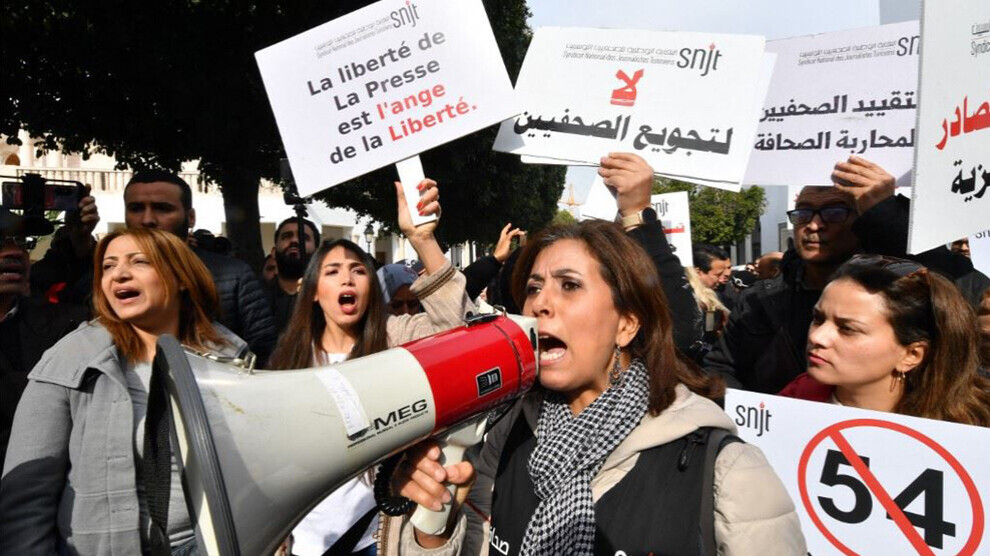
Activists and human rights defenders have expressed their frustration over the continued restrictions on civil and independent media work, especially for women, and have expressed their unconditional solidarity with "every free soul."
Naziha Bousaidy
Tunis – Legal prosecutions and harassment continue under Decree No. 54. Journalist Yathreb Al‑Mouchirhi, owner of the website "Tunisia24," was interrogated by the judicial police squad at Bab Bhar in the capital on Wednesday, April 22. The public prosecutor decided to keep her at large.
According to a statement by the Journalists' Union, journalist Yathreb Al‑Mouchirhi was surprised by her arrest while filming a report on Habib Bourguiba Avenue in the capital. Despite her insistence on postponing the interrogation due to the absence of a lawyer and because she had not received an official summons guaranteeing her right to defense, the squad insisted on hearing her. The statement noted that she had previously been heard in the same case due to published articles on the website, in addition to matters related to the financial management of the institution.
The union expressed its full solidarity with her and with all independent journalists who have recently sought to establish their own media institutions, affirming its complete rejection of prosecuting journalists outside the framework of the law regulating their profession, considering it an assault on freedom of expression and press freedom.
The Journalists' Union considered this episode a new link in an escalating chain of restrictions on civil and independent media space in Tunisia, especially after the arrest and imprisonment of journalist Ziad Al‑Hani, the sentencing of media professional Sana Dahmani to a year and a half in prison, and the continued imprisonment of Mourad Al‑Zoghidi and Borhan Bsis.
Prosecutions and harassment targeting civil work continue. After the arrest of activists from the "Steadfastness Convoy," their interrogation, and the release of Sana Masahli and Jawhara Chenna, the Tunisian Human Rights League was suspended for a month. The "Khatt" Association was also notified of legal proceedings aimed at its dissolution, which will be considered by the Tunis Court of First Instance on May 11.
Accusations used to defame activists
In a related context, feminist activist Mariam Al‑Zoghidi said that her brother, Mourad Al‑Zoghidi, is in prison, along with several journalists and civil society activists, affirming that "every dissenting voice today is either in prison or under investigation."
She added that this "bleeding" must stop, stressing the need to unite efforts to stop it, because it is unworthy of post‑revolution Tunisia, especially regarding freedom of expression, which she called "the only gain we have achieved." She indicated that this gain "we will not retreat from, nor will we abandon it; we will struggle for it with all our might."
She noted that when the authorities are unable to bring a clear charge against a journalist or a political or human rights activist, they resort to defamation through fabricated accusations, such as money laundering, in order to deprive them of solidarity and popular support – as happened with Mourad, who was charged with an accusation usually leveled only at businessmen.
Targeting the "Steadfastness Convoy"
Civil society activist and member of the Joint Action Coordination for Palestine, Randa Fahoula, believes that the interrogation of members of the "Steadfastness Convoy" falls within an international and regional political framework, and within a general context of restrictions imposed by the Tunisian authorities on all meaningful civil activity.
She pointed out the paradox: the authorities themselves had supported the convoy at its inception, before their position gradually shifted to preventing its activity and imprisoning its members.
She added that targeting the Steadfastness Convoy has a clear political dimension, stemming from the fear that it might turn into an effective pressure force leading to the enactment of a law criminalizing normalization, or that it might issue a stance condemning the attack on Iran – which could embarrass the authorities that have been unable to take a position supporting Iran and opposing the United States.
Randa Fahoula considered that the arrest and interrogation of the convoy activists lacks any legitimacy, especially since the Tunisian people who donated to the Palestinians have not filed any complaint against them. "We stand for public and individual freedoms achieved through the struggles of martyrs, but today we are living a dangerous regression because of Decree No. 54, which has restricted these freedoms, especially press freedom."
She affirmed that the coordination calls for the repeal of this decree and for a fair trial for civil society activists, with the need for them to be investigated while at large.
Women are more exposed to restrictions
Amena Ben Khalifa, head of the research and documentation unit of the "Takatof" Association, said that the association has observed a notable increase in the pace of prosecutions targeting women in various forms, especially women activists in the public and civil spheres, whether political or civil in nature.
She explained that targeting women often uses methods different from those used against men. Women are subjected to defamation campaigns on social media, slander, attacks on their honor, in addition to intrusions into their private lives through cases given a moral facade – citing the judge who was falsely accused of adultery.
She added that attacks against women are linked to the fragility of their position within society, where they are viewed within a narrow framework defined by society, not by their own will. When a woman dares to step into the public space, she becomes vulnerable to targeting. The social imagination portrays any woman who steps beyond this framework as a "loose woman" or a "liberated woman" trying to monopolize the public space.
She explained that women involved in political and civil work who face judicial prosecutions also suffer violations of their basic rights, even those concerning seeing their children or receiving a "food basket" during visits, making the punishment double. She cited the example of Sharifa Al‑Riahi, who was prevented from breastfeeding her daughter, considering that the punishment was not limited to her civil activity but extended to her very existence in the space in which she struggles.
Amena Ben Khalifa concluded by saying that active women have no choice but to double their resolve and seize their places, because these positions are not given but fought for, affirming that "just as previous women struggled for our rights, we too must struggle for the rights of those who will come after us."