
Silent layoffs & boundless exploitation… women workers are the first victims of the economic collapse
With the escalation of the economic crisis and the repercussions of war in Iran, women workers in Kermanshah face more that other cases of layoffs, delayed wages, job discrimination, and security pressures.
Sara Bourkhezri
Kermanshah- Every year during March, a struggle repeats itself between representatives of employers, workers, and the government in the Supreme Labor Council over setting the minimum wage. A struggle that appears on the surface to defend workers’ rights, but often ends up in favor of the government and employers.
Last March, in the same week the war broke out, the Supreme Labor Council hastily approved a 60% wage increase for workers for the new year. At first glance, this decision seemed like an indicator of support for the working calss, but reality soon revealed another face.
Simultaneously with the announcement of this increase, inflation rates jumped at an unprecedented pace. The prices of basic commodities, food, rent, and even the simplest daily necessities doubled within a few weeks. Under such circumstances, the 60% wage increase did not improve workers' purchasing power; rather, it practically turned into a pretext to justify the exorbitant wave of price hikes.
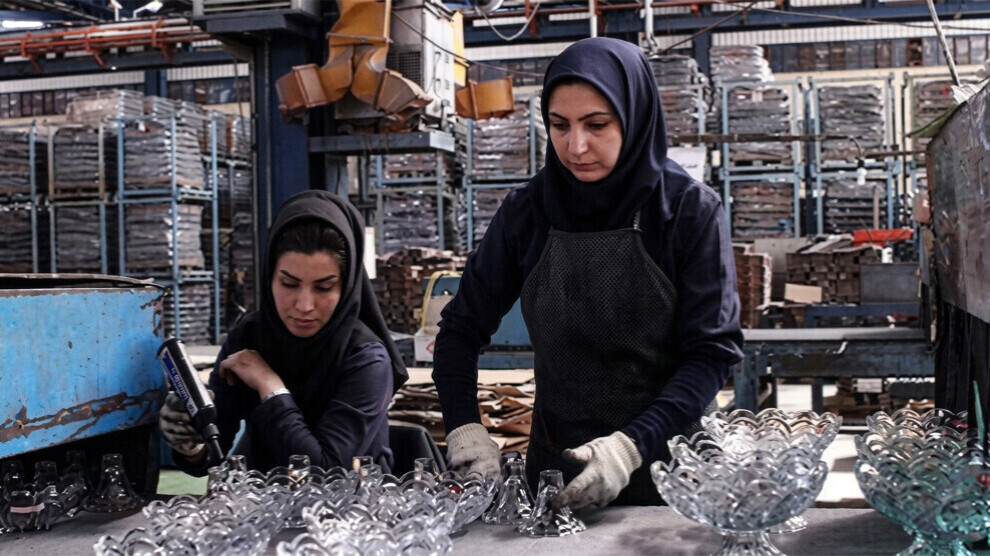
On the other hand, the war dealt a harsh blow to the economy. Many factories, workshops, and small businesses were completely closed or forced to sharply reduce their activity, leading to worker layoffs. Among different professional groups, women workers were the most affected. In factories and production units, women's names were the first to appear on workforce reduction lists. They often work with temporary contracts, receive lower wages, and have weaker job security.
Many of them are the sole breadwinners for their families or bear the greatest burden of caring for children and the elderly. With the closure of workplaces or long delays in salary payments, economic and psychological pressures on them have multiplied. Alongside these challenges, women workers face other problems, such as increased working hours without additional compensation under the pretext of labor shortages, or the cutting of benefits and insurance.
In many cases, women workers who protested were threatened with dismissal if they objected, which further increased the pressures on them. In reality, the war and economic crisis have not only paralyzed productive structures but have also deepened the gender gap in the labor market. Women who were already on the margins of the labor market before the war are now being excluded at a faster pace, while the burden of supporting the family increasingly falls on them.
Delayed wages and discrimination in paying women's salaries
(N.Marjan), who has precise knowledge of labor laws, explains: "It can be said with confidence that a large part of Kermanshah's companies have not yet implemented any wage increase for workers. On the surface, the government approved raising the minimum wage, but despite entering the second month of the new year, no official decision to increase salaries has yet been circulated to companies. This administrative vacuum has allowed employers to exploit the war conditions, refrain from implementing the decision, and continue paying wages without any adjustment."
But this injustice is not limited to April only. With the outbreak of war in the first week of March, and because Kermanshah's industrial areas are close to military and defense centers, many factories and companies were closed. As a result, March salaries were not paid, nor were year‑end bonuses for a large number of male and female workers. Reports indicate that some employers, even in cases where payment was made, gave priority to men under the pretext that they are the "primary breadwinners," while women were effectively deprived of their salaries and bonuses.
This discriminatory approach has increased pressure on women. Many of them not only bear part of the family expenses but also face rising prices, lack of job security, and gradual exclusion from the labor market during war. In such an atmosphere, women become more vulnerable to marginalization, exploitation, and neglect, and the gender gap within work environments widens.
For many employers, the war has become a pretext to suspend their legal obligations, and women were the first victims of this undeclared violation. The absence of oversight, the delay in issuing official instructions, along with the dominant male mentality in administrative and industrial structures, have created a system of pressures that has pushed women workers' lives and livelihoods to the brink of collapse.
(B.Elham), a worker in one of the companies located in the industrial zone on the Sanandaj road in Kermanshah, recounts what happened to her: "They have brought us to the verge of death so that we accept the bare minimum. In the company where I work, most of the female workers on the production line were fired. Only I and one other woman remained, but our positions were reduced from production workers to cleaners in the factory. With the rising cost of living day by day, I am forced to accept any work, but I hope this work is not a form of forced labor. I have not yet received my March salary, nor has April's salary been paid. Several days of the new month have passed without any news about wages. We dare not object, because they tell us that these are the circumstances, and whoever doesn't like it can go elsewhere."
Silent layoffs... excluding women from the labor market without official registration
Many women, fearing they will not find new work, have been forced to continue in conditions similar to those of ( Elham B. ) – conditions closer to silent coercion than to real work. But this is only part of the story. Many women confirm that their dismissal was not even officially recorded, depriving them of their most basic legal rights, such as unemployment insurance. The employer did not issue any notice of termination, nor provide any official document, but simply said: "Do not come to work for now." This single sentence has thrown the lives of hundreds of women into complete uncertainty.
Women have not received salaries for the past two months and do not even know what will happen to them tomorrow. Many of them remain at home without any source of income. They have no ability to object, no hope of returning, no means to claim their rights legally due to the absence of any document proving their dismissal. If they decide to file a complaint, they find themselves trapped in a long bureaucratic spiral.
This situation represents a kind of "silent layoff" – a method by which the employer excludes the worker without official registration, without assuming any responsibility or accountability. On the surface, there is no dismissal, but women who worked for years are deprived of everything at once: wages, insurance, their professional records, and the minimum security that the law is supposed to guarantee.
In many cases, women confirm that this method is used deliberately to avoid paying any entitlements, whether severance pay, compensation, or even overdue wages. Some of them have been at home since the beginning of the war, waiting to return to work, but what they face daily is mounting debt, rising living costs, and constant anxiety that follows them like a shadow.
Under these circumstances, women not only lose their jobs but also their voices. Fear of unemployment, scarcity of job opportunities, and the stringent security environment within workplaces all make even speaking about lost rights a risk in itself. Many women say that simply objecting could lead to "defamation" and prevent them from finding future work. Thus, women are pushed into two harsh choices: unemployment without income, or working under exploitative conditions – both unjust.
The security environment in factories
( Marjan N. ) explained that economic problems, along with the pressures imposed by employers on women workers, are only part of this group's suffering. In recent months, the authorities' fear of the outbreak of labor protests has led to tight security control over industrial zones and factories – control aimed at preventing any gathering or protest, even preventing the raising of simple demands such as delayed salaries or unpaid dues.
But the reality is more complex. The security climate inside workplaces has placed workers, especially women, in a situation where even expressing daily problems is costly. Many female workers point to the increasing presence of security forces around factories. Furthermore, management, relying on the "sensitivity of the circumstances," now considers any objection or even inquiry about delayed salaries as a threat.
In such an atmosphere, women workers become the most vulnerable. They not only face structural discrimination and a male‑dominated mentality in the work environment but also bear the burden of fear of stigmatization, unofficial dismissal, or even interrogation.
( Marjan N. ) noted that many women do not even dare to ask about their delayed salaries for fear of being placed on lists of "protesters" and then permanently excluded from the labor market. This reality has created a kind of forced silence – a silence that allows employers to delay wages for months, deny women workers benefits, and even dismiss them without any explanation.
In contrast, women find themselves forced to choose between two harsh options: either endure inhumane working conditions, or face unemployment without any support. In some factories, even small meetings among a few workers to discuss their problems have been banned. Managers, under the pretext of "instructions from higher authorities," warn that any gathering – even just to coordinate work schedules – could be interpreted as a protest movement.
This level of control has effectively eliminated any possibility of labor solidarity. As a result, women workers are trapped in a crushing triangle: an economic crisis worsening day by day; pressure from employers exploiting the circumstances; and security pressure that suppresses any attempt to object. This overlap has pushed many women's lives to an edge where they feel invisible, unheard, and not even allowed to demand their most basic rights.
In general, it can be said that the recent war conditions have made women more vulnerable to pressure than ever before. In all stages of repression, discrimination, and the imposition of unjust decisions, they are the first to pay the price – from both employers and the state. Women find themselves stuck in a deep, exhausting swamp, fighting with everything they have just to survive and trying to avoid sliding completely into this harsh vortex.