
“Sleeping in the Courtyard” : Cntemporary Kurdish Voices in Diaspora
“Sleeping in the Courtyard” is more than a book about exile_ it is a space for reclaiming voice, memory, and language through poetry, stories, and art by Kurdish writers.
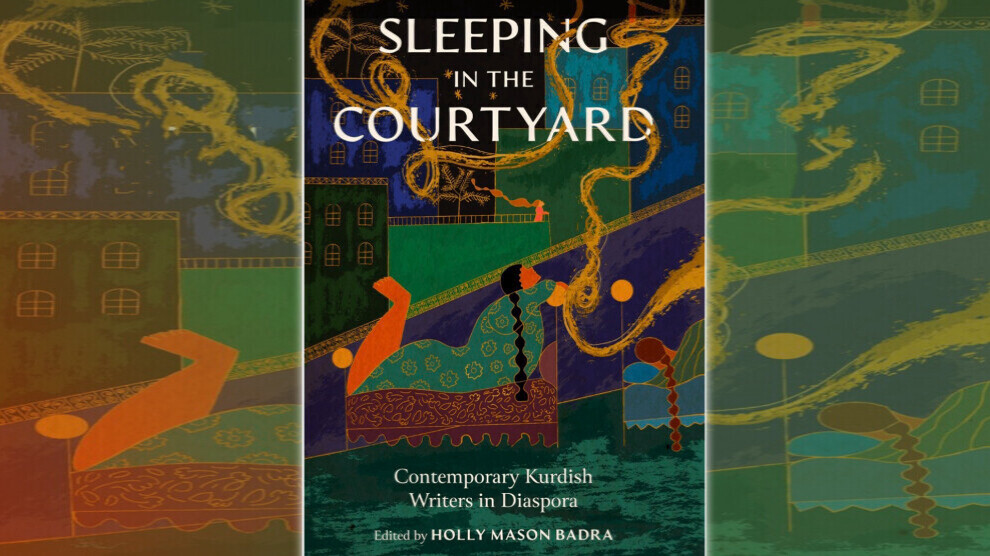
News Center_ The book”Sleeping in the Courtyard: Contemporary Kurdish Writers in Diaspora” was published in 2025 by the University of Arkansas Press. It is a literary and cultural anthology compiled and edited by Kurdish-American writer Holly Mason Badra.
The book features diverse literary and artistic works, including poems, stories, non-fiction prose texts, and graphic works, bringing together the voices of Kurdish writers living in Kurdistan and diaspora countries.
Voices Beyond Exile
Although the book is published in English, it is not limited to texts originally written in this language. Works have been translated from Kurdish, Arabic, Turkish, Persian, and Swedish, while some texts written in Kurdish dialects have been preserved alongside their English translations, in an attempt to maintain the presence of the original language and not separate the texts from their cultural roots.
This choice holds particular significance in the context of a long history of banning the Kurdish language and attempts to erase it. The book not only introduces Kurdish literature to English readers but also contributes to preserving voices and experiences that may be vulnerable to marginalization or oblivion. Among the names featured in the collection are Mirale Shimshek, Joman Hardi, Nazand Beikhani, Jila Hosseini, Narin Rostam, Heva Panahi, Pinar Banu Yashar, Mariam Rabia Ozumju, Roj Muhammad, and Hero Kurda.
Memory Defying Exile
"Sleeping in the Courtyard" is not merely a collection of literary texts; it appears as an attempt to reassemble voices scattered by migration, exile, war, genocide, and cultural erasure. The book's title in Kurdish, "Di hewşê de razan," carries deep symbolic resonance. The courtyard is not a home in the full sense, but it may become a space where the self reclaims its sense of homeland, preserves its memory, and restores its feeling of safety.
Through these texts, a clear meaning resonates: one may be far from their homeland, and borders and exile may impose great distances, but one cannot easily distance themselves from their language and memory. Here, literature becomes a space for reclaiming voices that wars and policies of exclusion and erasure have tried to silence, and a living archive preserving what was threatened with loss.
From War to Love and Life
The anthology does not confine the Kurdish experience to war, migration, loss, and the pain of history. Alongside these themes, the texts open space for love, friendship between women, family, desire, identity, dreams, and hope.
This diversity is one of the most distinctive features of the collection. Kurdish women writers do not appear here merely as "victims of history," but as active agents who look at history through their own voices, bodies, desires, and dreams. Therefore, their experience is not read solely as a political testimony of oppression, war, and exile, but as a complete human experience, carrying all that comes with love, desire, fear, hope, and daily life.
Holly Mason Badra explains that the anthology project began in 2019. Following media attention and military operations in Rojava, the Kurdish issue gained greater presence in North American public opinion, and many began asking where they could read Kurdish literature translated into English.
However, Holly Mason Badra noticed that the sources available to English readers to learn about Kurdish literature were limited, which drove her to begin gathering these voices and presenting them within a single literary project.
She summarizes her vision for the book by saying: "Kurdish women do not only write about their pain; they write about life. They fall in love, desire, speak, cry, dream, and build another world in their own language."
In this sense, "Sleeping in the Courtyard" does not come merely to document pain, but to affirm that literature can restore to the exile their voice, to memory its presence, and to language its place. It is a collection that makes writing a means of resisting erasure, and literature a space where scattered Kurdish voices meet to tell not only what happened to them, but how they chose to live, dream, love, and write despite it all.