
Kurdistan and Iran at the heart of the hidden war on global corridors Article by Sheilan Saqzi
Article by Sheilan Saqzi
What is happening today in Iran, the Middle East, and along the tense borders of Kurdistan is presented to people under familiar headlines: a confrontation between Iran and Israel, tension between Tehran and Washington, the Strait of Hormuz crisis, the nuclear file, a fragile ceasefire, and negotiations that reach no conclusion.
However, everything presented in official discourse is only the outer shell – a surface layer that preoccupies public opinion and prevents it from seeing the bigger picture. The world has entered a new phase of a silent but fateful struggle, a struggle not limited to missiles and uranium enrichment, but revolving around the transit routes of oil, gas, and goods – ports, railways, and corridors that control the movement of global trade.
What we see today in the Gulf, the Mediterranean, on the borders of Iraq and Syria, and even in the military highlands of Kurdistan, are in fact signs of a confrontation between two colossal global projects: the United States' project to maintain its dominance over energy and transport arteries, and China's project to build alternative routes and break the geo‑economic siege imposed by Washington.
In clearer terms, this war is not merely a war of states; it is a war of maps. A war over where the arteries of global wealth will pass in the coming decades, and which power will hold the control valve. For this reason, Iran and Kurdistan are no longer just troubled political geographies; they have become sensitive hinges in this global confrontation, where every explosion, every military threat, every sanction, and every security operation is essentially a message about controlling or disrupting the paths of the global future.
But maps are not always drawn on paper; the great maps of the world are often drawn on people's bodies. Every pipeline planned in think tanks appears on the ground as a military village, a mined border, a closed workshop, or an empty table. Every global corridor has at its bottom unknown victims who do not appear in any diplomatic report: a worker dismissed with each new round of sanctions, a fuel carrier whose livelihood is cut off when crossings are closed, and the goods porter at the border who carries the weight of global trade on his shoulders while his share of it is nothing more than bullets and the abyss.
From now on, it is no longer possible to explain what is happening only in the language of "regional tension"; because what is unfolding is deeper than a circumstantial confrontation. It is a war on corridors, on energy, and on the new map of the world.
It is no longer just about centrifuges, missiles, and diplomatic statements. The issue is: in the post‑Ukraine world order, who will hold the arteries of oil, gas, and goods transport? The United States with its naval control network and regional allies, or China with its project to connect East to West by land and sea? In simpler terms, the sirens and explosions heard in Iran's skies are the echo of the war on corridors.
This war on corridors began when the competition between China and the United States moved beyond the level of tariffs and technology to the level of "controlling the vital arteries of the global economy." China is no longer just the world's factory; China wants to own the world's routes as well. The billions of dollars poured into railways, ports, pipelines, free zones, and dry ports from Central Asia to the Gulf and the Mediterranean mean only one thing: Beijing wants to remove the monopoly of the US Navy over energy and goods routes.
In response, the United States is well aware that the decline of powers does not begin with military defeat, but with losing control over transit arteries. Washington for decades has held the pulse of global trade through straits and seas, marine insurance companies, the dollar, and military bases. If China succeeds in connecting Gulf oil and the European market by land via alternative corridors, America will not only lose a part of trade; the backbone of its hegemony will crack.
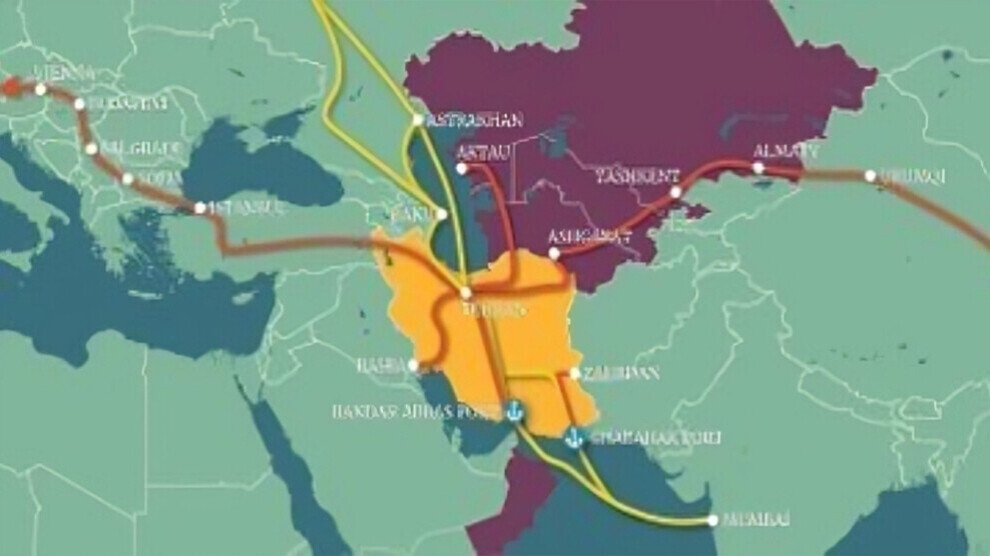
From this, two competing maps are born. The first map is China's project to connect East Asia to Central Asia, Iran, Iraq, Turkey, and then Europe. The second map is the United States' project to build a parallel route extending from India to the Gulf, Saudi Arabia, the UAE, Israel, and the Mediterranean, bypassing Iran and encircling China. For this reason, the Middle East today is no longer just an arena of proxy wars; it is a battlefield for corridor engineers.
The United States seeks to arrange transit routes so that every vital artery is either under the shadow of its allies or within the range of its military and missile pressure. Meanwhile, China wants to reclaim these arteries overland through investment and railway connections. This means that every port, every railway line, every pipeline, and every strait has become a security issue.
In this context, Israel's role is no longer just that of a security player or a traditional adversary of the Islamic Republic; it has become the military‑logistical arm of the American project. The India‑Middle East‑Europe corridor cannot be completed without Israel's Mediterranean ports, nor without regional security normalization. Thus, Tel Aviv is not only worried about Iran's nuclear program; it is worried about any regional system that makes Iran a link between East and West. A stable Iran transformed into a transit state would mean weakening part of the Western geo‑economic project, while a besieged and pressured Iran means maintaining the superiority of alternative routes. And at the heart of these two maps stands Iran.
Iran is not just a crisis‑ridden country in the Middle East; it is one of the most sensitive nodes in the world's political geography – a country overlooking the Gulf and the Strait of Hormuz, connected to Central Asia and the Caucasus, and capable of being the land bridge linking East Asia to West Asia and Europe. This location is what turns Iran from a regional player into a "global strategic node": a node that, if stabilized within the orbit of China and Russia, would upset part of the US containment equation; and if kept in a state of chronic instability, would become a permanent barrier to the security of eastern routes.
At the heart of this great node lies an even more sensitive geography: Kurdistan. It stretches across the land‑connection belts between the Gulf, Anatolia, the Caucasus, the Mediterranean, and Central Asia. It is not merely a land with an unresolved national cause; it is a region situated above pipelines, potential railway routes, transit lines, and military arteries. In other words, without passing through the Kurdistan environment, Iran's land connection to the Mediterranean cannot be completed, nor Iraq's connection to Turkey, nor Syria's connection to the depths of West Asia, nor even some energy routes from the Caucasus to the south. That is, Kurdistan is not a political margin for four states; it is a geopolitical joint for four states.
For this very reason, throughout the last century, Kurdistan has been a military, security zone divided among states; because regional and international powers are well aware that any form of genuine self‑government, popular stability, or formation of an independent will in this geography can change the equations of the corridors. Kurdistan was not besieged only because of the national and identity issue; it was also because of its strategic location that makes it a decisive point in the struggle of corridors.
From the oil pipelines in the Kurdistan Region to the communication routes in Rojava, from the border crossings in North Kurdistan to the transit links of East Kurdistan with the depths of Iran and Iraq, it becomes clear that this geography lies at the heart of the corridor war. Even the continued Turkish military presence in northern Iraq, Iran's pressures on the borders of East Kurdistan, and the persistent sensitivity of the US and Russia towards Rojava cannot be explained only by internal security considerations; these are all forms of armed protection for future corridors.
For this reason, in this struggle, Iran is not the "final target" but a "pressure‑adjustment field," and Kurdistan is one of the valves of that pressure. Every time the Strait of Hormuz trembles, oil markets shudder; and every time Kurdistan is militarized, the first to pay the price is that porter at the border who falls in the snow before the generals draw their maps, that Kurdish woman who stares into a road from which her husband will not return, and that worker who, with the closure of his factory, understands how the world war silently sneaks into his livelihood.
Therefore, this war cannot be viewed merely as an ideological or security conflict. It is an attempt to determine the position of Iran and its surroundings – especially Kurdistan – on the geo‑economic chessboard of the world: will these geographies become safe and profitable routes connecting East to West, or will they remain high‑risk areas, besieged by sanctions, repelling investment and trade?
Here a bitter truth emerges: the United States does not necessarily seek to completely destroy the Islamic Republic. A collapsed state at the mouth of Hormuz would pose a great risk to the global energy market. What Washington wants is an exhausted, monitored, perpetually pressured Iran – an Iran not stable enough to become a reliable pillar of China's and Russia's connection, and not collapsed enough to threaten the global oil system. This is the modern version of containment policy: keeping the state alive in a state of suffocation – a state that must breathe, but must not walk freely.
China, for its part, is also not ready to pay the price of a direct war for Iran. For Beijing, Iran is not an ideal ally but a necessary route – an essential piece in the energy puzzle. And Kurdistan, in turn, is a transit and control belt within that puzzle. China does not speak in this struggle with the language of missiles, but with the language of contracts, railways, dry ports, and investments. Yet the language of capital, though silent, can be equally cruel, because for capital, a human being has no value unless he stands in the way of transit.
In the harsh language of global politics, both powers want this geography to serve their maps, and here the role of the Islamic Republic becomes more tragic than ever. The regime that for four decades raised the slogan of independence and "neither East nor West" has today brought the country to a position where it enjoys neither the trust of the West nor an equal partnership with the East. Iran has not become a strategic partner for China, nor a negotiable player with the West; it has turned into a scorched land that each power tries to exploit for its own benefit. In this context, Kurdistan, like other national margins, has turned from a transit opportunity into a security belt and a field of repression.
This tragedy has not remained only at the level of diplomacy; it has seeped into daily life. When foreign policy is emptied of people's interests, its effects appear in bread queues, scarce medicine, closed factories, dilapidated schools, and on the face of that porter at the border who carries on his shoulders a burden that is actually the burden of the failure of all these states. The "kolber" (cross‑border porter) is not just a border worker; he is the condensed image of this global system – a human being who bears geography on his shoulders.
The Islamic Republic could have turned this exceptional geographical location into a historic opportunity for development, transit, investment, and making Iran a regional hub. But instead, it turned it into a field of ideological attrition. Instead of building railways, ports, and trade, it built a network of crises. Instead of building international trust, it raised the wall of sanctions. Instead of turning Iran and Kurdistan into a crossroads of transit, it made them a crossroads of threats. When geography substitutes bread with barracks, the first victims are always those with limited income.
In all these equations, there is no place for the peoples of Iran and Kurdistan – not in the think tanks of Washington, nor in the economic calculations of Beijing, nor in the closed meetings of negotiations. For the United States, this geography is pressure points. For China, it is energy and communication routes. For the governments of the region, it is security control belts. But for the people, this land is their home – a home that has been burning for years on the maps of others.