
The Arab Maghreb… Five Homelands and One Crisis, and Women Pay the Price(3)
Women’s economic vulnerability begins before lost income,formed by restrictions from labor market entry through unemploment, wages, working conditions, social protection, to financing difficulties and sustaining work.
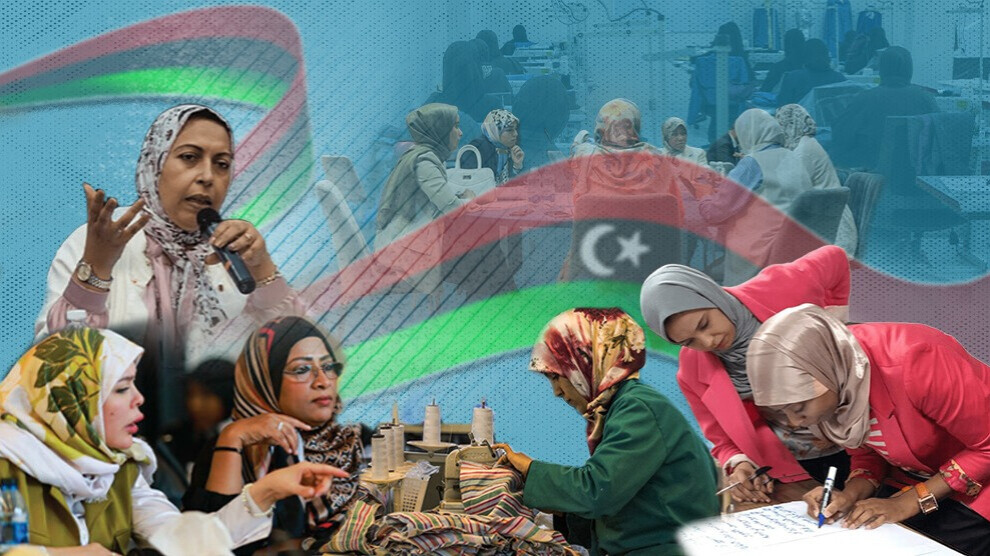
Libyan Women in the Economy of Vulnerability... Work Does Not Always Mean Security
MONA TUKA
Libya – In Libya, a woman may work for years and still remain far from economic security. A young woman may search for a job without finding one, or start a small project and then close it in the face of rising costs, or leave a stable job because care responsibilities find no one to share them with her.
Labor market figures reveal the size of the gap early: in 2025, unemployment among Libyan women aged 15 to 24 reached about 69.2%, compared to 41.7% among young men, according to International Labour Organization estimates published through the World Bank. But unemployment does not tell the full story, as a woman who does not work and is not searching for a job is not counted among the unemployed in the first place.
Behind these indicators, forms of vulnerability multiply: a worker who fears losing her job if she demands her rights, a project owner who does not possess enough to face rising costs, and a woman pushed by care responsibilities to leave the labor market. Among all these cases, the broader question remains: Is it enough for a woman to obtain work in order to become economically independent?
A Gap That Begins Before Unemployment
International Labour Organization data show that women's participation in the Libyan labor force is lower than men's, which means that part of the gap does not appear in unemployment figures themselves. A woman who does not work and is not searching for a job is not registered as unemployed, and she may be outside the labor market due to family responsibilities, limited opportunities, or her lack of expectation of finding suitable work.
Thus vulnerability is distributed among a woman who does not enter the labor market at all, another who searches for a job and does not find it, and a third who works in an unstable job or in an activity that does not provide social protection.
For young women, the problem begins at an early stage of professional life. The high unemployment among the 15 to 24 age group means that a large number of new entrants to the labor market face a long period before obtaining their first job, which delays building independent income, savings, and professional experience.
When a Job Does Not Mean Security
Even reaching a job does not necessarily take a woman out of the circle of vulnerability. In some private sector institutions, female workers face difficult conditions such as low wages, additional working hours, unclear employment terms, limited social protection, and fear of dismissal when objecting.
Facing these conditions becomes more difficult when a woman does not possess an alternative source of income or another job opportunity. Then the salary is not merely a compensation for work, but a reason to accept conditions she may not be satisfied with.
19 Years of Work... and Stability Did Not Come
Najma Shahaa has been working in the field of nursing for 19 years, spent between private health institutions and different departments, but she says that years of experience have not turned into job security or income proportionate to the nature of the work.
She recalls that her salary at the beginning of her work was 150 dinars per month for eight hours a day, before it later rose to 300 and then 350 dinars after she moved to the emergency department. She says that the highest salary she received during her career did not exceed 400 dinars.
She says that working hours on some days extended from eight in the morning until four or five in the afternoon, without counting additional hours or paying for them. She recalls one clinic that counted overtime, while that was absent in other experiences.
She also points out that some jobs were not linked to written contracts clearly defining working conditions, and that she was subjected to threats of dismissal and deduction when she demanded her rights.
According to her account, the pressures once reached the point of asking her to provide service to a person she says assaulted her, and when she refused, her manager threatened her with dismissal. She later chose to resign.
Najma Shahaa's experience does not mean that these practices represent all private sector institutions, but it shows how the fear of losing income can limit a worker's ability to object or leave work.
The Law Exists... But Accessing It Is Another Matter
Human rights activist Jamila Moussa, president of the "Hikmat Nisaa" Association, says that women's economic vulnerability cannot be reduced to unemployment or low income, because the problem extends to a woman's ability to access work, continue in it, and benefit from the protection provided by law.
She explains that the existence of a legal text does not necessarily mean a worker's ability to use it, especially when she fears that filing a complaint will lead to losing her job or source of income.
She believes that the problem appears clearly in the private sector, when a woman accepts a low wage, additional working hours, or unclear conditions because she does not possess an economic alternative. She adds that economic empowerment is not limited to training or providing a small project, but includes decent work, fair wages, social protection, and effective complaint mechanisms.
She points out that a woman who does not possess independent income also has narrower options when she is subjected to violence within the family, because the ability to secure housing, daily expenses, and leave a harmful relationship is linked in part to financial capability.
Unstable Work... When the Home Becomes a Place of Work
Not all women enter the labor market through formal employment. Some work from home in sewing, preparing food, and selling products and services through social media, or in small and craft projects.
These activities provide income for some women, but they do not necessarily guarantee stable income, insurance, or social protection, as they are also affected by the costs of materials, transport, marketing, and purchasing power. Here a woman may be economically active without her experience appearing in the form of traditional employment.
Vulnerability increases when the activity depends on daily or seasonal income, or when the project owner is unable to bear a period of declining sales.
The Small Project... An Opportunity That Is Not Always Enough
Even when a woman tries to establish her own project, the obstacle of financing appears. The project owner needs capital for equipment, materials, and operation, while guarantees, proof of income, and asset ownership may limit her ability to obtain financing.
The problem appears more clearly when a woman has started a project with limited resources; any rise in the cost of materials or decline in sales may lead to the activity stopping before it turns into a stable source of income.
Therefore, it is not enough to measure the number of women who started projects, but also their ability to continue and access additional financing when needed.
A Project That Did Not Survive
Iman Mohamed is responsible for supporting her daughter alongside her work. To secure additional income, she launched a small project in making pastries and selling them to shops and clients on occasions, but she was forced to close it after the rise in the costs of materials and goods and the decline in sales.
She returned to relying on her salary to support her family, after the project did not survive the operating costs and limited purchasing power.
Her experience shows another aspect of the vulnerability of self-employment: the project may be a means of increasing a woman's income, but it does not become a stable source merely by being launched, especially when capital is limited and there is no ability to bear losses.
When Household Responsibilities Become a Reason for Losing a Job
Khadeeja Saad, a dentist, was forced to leave her work for a period due to her responsibilities within the home and caring for her children. She says that the absence of her husband's participation in household work, due to a belief common among some men that a man's help at home diminishes his manhood, made most care responsibilities fall on her.
Khadeeja Saad later returned to work and was earning a good salary, but she found herself forced to be absent on more than one occasion due to her children's illness and emergency family circumstances. With repeated absence, she lost her job.
The problem for Khadeeja Saad was not in her unwillingness to work, but in the difficulty of combining a paid job with household responsibilities that find no one to share them with her. The experience ended with her losing a source of income she had relied on, to find herself before the same paradox: she needs to work to secure her income, but she also needs time to care for her family, while care responsibilities are not borne equally within the home.
Economic Independence Is Part of Protection
It cannot be said that rising prices automatically lead to rising domestic violence, just as violence against women cannot be reduced to the economic factor.
But the absence of independent income may limit a woman's options when she is subjected to violence. A woman who cannot secure housing, food, or her children's needs on her own may find greater difficulty in leaving a violent relationship.
This is why economic independence intersects with protection from violence: not because poverty automatically causes violence, but because financial dependency may limit a woman's ability to make a decision about her life.
Small Initiatives... Limited Treatment
Local and international initiatives target women with training, support for small projects, vocational qualification, and financing, especially in conflict-affected areas.
These programs provide opportunities for some women, but they alone do not address the problems of the Libyan labor market, from weak economic diversification and heavy reliance on the public sector to the limited number of stable jobs.
A small project may help a woman overcome a financial crisis, but it alone does not solve the problem of women's weak participation in the labor market or weak protection within some jobs.
An Economy That Does Not Measure All Work
The cases and figures reveal that women's economic vulnerability in Libya cannot be reduced to unemployment. There is the young woman searching for her first job, the woman working in an informal activity, the worker who accepts unstable conditions for fear of dismissal, the project owner who cannot bear loss, the woman who has become the breadwinner, and another who leaves work due to care responsibilities.
Therefore, measuring women's economic situation needs more than the question: How many women work? The broader question is: What kind of work do women get? How much do they earn? Do they have a contract and social protection? What happens if they fall ill or lose their job? And can they object to working conditions without losing their source of income?
In Libya, the problem lies not only in women's access to the labor market, but in their ability to remain in it under conditions that provide stable income and economic protection.