
Mauritania... When Economic Growth Does Not Mean Independence for Women(5)
Despite improved economic indicators in Mauritania, women still face labor market, economic independence, and social protection challenges, as the crisis affects their decision-making ability and access to legal protection.
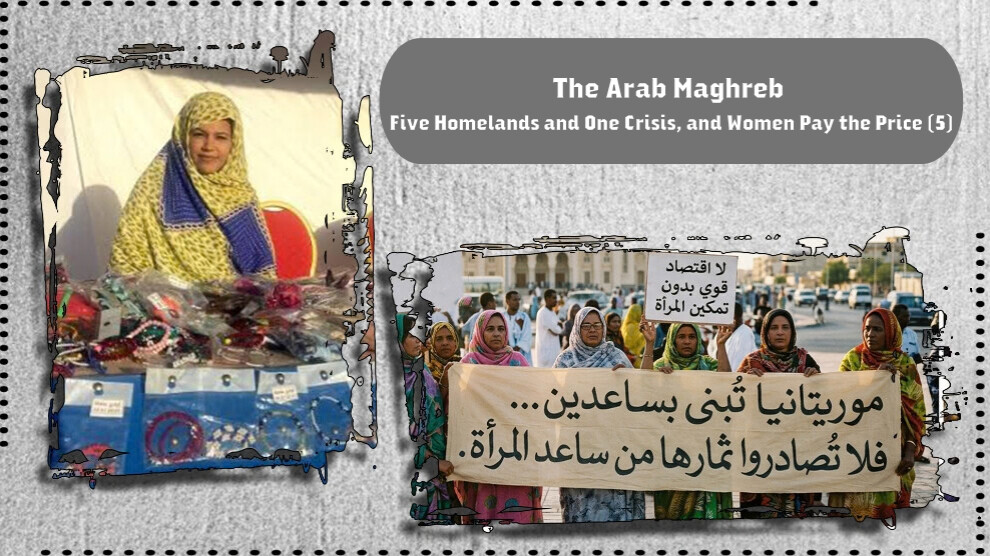
GHADER AL-ABBAS
News Center – Social norms and perceptions of family roles affect Mauritanian women's opportunities to participate in the labor market, by increasing unpaid care responsibilities, influencing the type of socially acceptable work, and limiting the ability to move or work outside the home. These factors interact with economic, legal, and institutional restrictions.
Mauritanian women, like women in the rest of the regions, face a set of restrictions that affect their entry into and continuation in the labor market, including family responsibilities, limited access to financing, and weak training and employment opportunities in low-wage or informal sectors.
The weakness of Mauritanian women's participation in the labor market cannot be understood through economic factors alone, as culture, social norms, and perceptions of family roles play an important role in determining the nature of women's participation in economic activity. Describing culture as "preventing women from working" in absolute terms does not reflect reality, as Mauritanian women occupy an important position in agriculture, livestock raising, trade, food industries, administrative work, and services. The problem lies in the fact that some social norms determine the type of socially acceptable work, its place, its hours, and the extent of a woman's ability to continue in it.
The situation of Mauritanian women in the labor market is not far from the situation of their counterparts in Arab countries. In Mauritania, 2025 was not a year of economic collapse, but it was not a year of equal gains either. The economy grew by about 4.2% during the year, the inflation rate declined to 1.5%, and the poverty rate decreased from 27% in 2024 to 25.2% in 2025, according to the latest World Bank data. However, labor market indicators reveal another face of the economy: unemployment among women reached about 14.7% in 2025, compared to 8.1% among men.
These figures reveal a paradox that is difficult to ignore: macroeconomic stability does not necessarily mean economic stability for women. The more fragile the job, the more costly its loss; and the less stable a woman's income, the weaker her ability to confront high prices or protect herself and her family.
These indicators measure three different problems: weak participation means that a limited proportion of women enter the labor market in the first place; high unemployment means that part of those who enter it do not find work; while the rise in vulnerable employment reveals a third problem related to the quality and stability of jobs.
In a country where women's participation in the labor force does not exceed about 27%, according to the World Bank report on "Women, Business and the Law 2026," the issue of women's employment and economic independence becomes part of a broader question related to poverty, social protection, violence, and the family.
Women Facing Economic and Social Deterioration
Economic and social deterioration was not merely a reflection of figures and economic indicators, but left its direct effects on the daily lives of Mauritanian families. Women were at the forefront of the groups that bore the cost of this crisis. With the decline in job opportunities and the rise in living costs, many women found themselves before specific choices: losing their source of income, returning to economic dependency, or trying to search for alternatives in a more fragile labor market.
The crisis was not only economic, but gradually turned into a social and rights crisis, reproducing old forms of inequality and widening the space of vulnerability that women suffer from, especially breadwinners for families and households in the least stable sectors.
The problem for women is not only in the number of available jobs, but in the quality of jobs and the extent of their ability to provide stable income and social protection. World Bank data based on International Labour Organization estimates show that 71.1% of working women in Mauritania were in vulnerable jobs during 2025, compared to 45.1% of men. This gap, which is close to 26 percentage points, means that working women are more exposed to unstable work or work lacking adequate protection.
Thus the crisis becomes deeper than just "unemployment." A woman may be counted among the employed, but she works in a limited-income or unstable activity, and may not possess savings or guarantees enabling her to confront a stoppage of activity. Therefore, the high proportion of vulnerable employment makes any economic slowdown more impactful on women.
At the aggregate level, the latest indicators showed a decline in the unemployment rate during the first quarter of 2026 to 11.97%, compared to 12.77% in the same period of 2025, while the number of job seekers reached about 180,000 people.
Losing Work Turns into Losing Independence
The labor market was one of the most prominent areas where the repercussions of the crisis appeared. While job creation was concentrated in paid work, which increased by 249,000 job opportunities, unpaid work declined by 55,000. These transformations were not necessarily reflected equally on women and men.
Women remain more exposed to vulnerable and unstable work, and their presence in sectors such as textiles, agriculture, and services makes them more affected by any economic decline or workforce reduction operations.
In the textile, agriculture, and services sectors, losing a job may mean for some women not just stopping work, but losing the only source of income on which the family depends. A woman who used to return at the end of the day with an amount sufficient to secure food or pay children's expenses suddenly found herself without income and without social protection shielding her from falling into poverty.
Here the paradox appears: the woman who entered the labor market seeking a degree of economic independence may find that this increases the likelihood of her depending again on her husband or family members.
High Prices Threaten Women's Economic Independence
Losing work was not the only factor in deepening women's vulnerability. The rise in prices of basic materials and living costs reduced the actual value of income and made it more difficult for families to meet their daily needs.
For women, the impact of high prices was double: on the one hand, their ability to secure their own needs declined; on the other hand, they bore the largest share of the burdens of managing the family budget and childcare.
With shrinking resources, a woman faces a difficult equation: less income, higher prices, and family responsibilities that do not recede. In some cases, economic pressure can turn into a source of tension within the family, increasing the risks of disputes and domestic violence.
Therefore, the relationship between the economic crisis and violence should not be understood as a direct or inevitable relationship, but rather that economic pressures may exacerbate factors of vulnerability and tension within some families, especially when accompanied by weak social protection and support mechanisms.
Rural Women and Agriculture... The Paradox of Working Without a Job
Mauritanian women play an important role in various stages of agricultural and food activity, but women's contribution to agriculture does not necessarily mean their ownership of the means of production. Access to land represents one of the most prominent restrictions. Available evidence indicates that women face difficulties in land ownership and in making decisions related to its use.
A large part of women's agricultural work is also carried out outside the framework of formal paid work, and therefore may not appear fully in economic statistics. The Food and Agriculture Organization (FAO) confirms that women in agricultural and food systems are more concentrated in seasonal, informal, and low-wage jobs, with continuing gaps in land ownership and access to financing, training, and agricultural services.
The paradox appears clearly in the agricultural sector: a rural woman may be directly participating in agricultural production, animal husbandry, food processing, and selling products, but she does not necessarily receive an independent wage, own the land, or control the income generated by the activity.
An International Labour Organization analysis indicated that only 6% of women in Mauritania own land according to the data on which the organization relied, and the percentage drops to 4.2% among women in rural areas. It also indicated the high concentration of women in the informal and vulnerable economy.
This means that the weakness of the official indicator of women's participation in the labor market should not be interpreted as women's absence from economic activity, but the quality of work, women's position within the family, ownership of the means of production, and the extent to which they obtain independent income must also be considered.
The Law Exists But the Gap Remains Wide
Women's vulnerability does not stop at the economy. The problem extends to the legal framework and the ability of institutions to transform rights into actual protection.
The World Bank report "Women, Business and the Law 2026" shows a clear gap between the legal framework and implementation in Mauritania. The country scored 33.5 points out of 100 in legal frameworks, 31.45 in supportive frameworks, and 36.48 in indicators of enforcing women's economic rights.
In the field of work specifically, the legal framework scored 25 out of 100, while supportive frameworks scored zero according to the report's methodology, while the indicator of perceptions regarding enforcement reached 31.25 out of 100.
The indicators point to gaps between the legal framework and supportive frameworks and enforcement mechanisms. For example, the report indicates that Mauritanian law prohibits discrimination in work on the basis of sex, based on the Labor Code and the law criminalizing discrimination, but it monitors in return the limited evidence of the existence of specialized mechanisms to receive complaints of discrimination in work or a clear and specific national strategy to increase women's access to the labor market.
Violence Against Women... Figures Revealing the Scale of Silence
The rights crisis takes a more dangerous dimension when talking about violence against women. In a report published by the Office of the United Nations High Commissioner for Human Rights in 2025, based on survey data, estimates indicated that 10% of women between 15 and 49 years old have been subjected to physical violence since the age of fifteen, while 6% have been subjected to sexual violence. More significantly, 65% of those who were subjected to violence did not seek help.
This last percentage raises a very important question: Why do women remain silent? Several factors may overlap, from fear and social stigma to economic dependency and difficulty accessing legal and psychological services.
Therefore, addressing violence does not begin and end at the law, but needs a system that a woman can access when she decides to seek help.
Listening Centers... Between Psychological Support and Legal Assistance
In this void between need and protection, the importance of listening centers, associations, and organizations working in the field of women's rights stands out.
The World Bank report indicates the existence of legal, health, and psychological assistance services and livelihood support through the center for women affected by violence, but it indicates at the same time the unavailability of sufficient evidence of the existence of specialized shelters for women affected by violence, and the limited specialized justice mechanisms in this field.
These institutions do not only address the effects of violence, but sometimes receive the results of broader problems: unemployment, economic dependency, family disputes, or lack of knowledge of rights. Hence, listening centers become part of a social safety net, not just a space for receiving complaints.
The Economic Crisis Is Not Neutral
In conclusion, the economic crisis does not affect all members of society in the same way. Women, due to the fragility of their positions in the labor market, their multiple responsibilities, and their weak economic independence, may pay a greater price when crises occur.
Therefore, addressing the crisis cannot be limited to creating general job opportunities, but needs policies that directly target women: protecting workers in fragile sectors, providing decent and stable job opportunities, supporting women who support families, strengthening protection mechanisms from violence, and expanding psychological and legal support services.
Bridging the gap between law and implementation also remains necessary so that women's protection does not remain mere texts, but turns into an actual right that she can access when she needs it.
In the end, the question is not only about the number of jobs women have lost or their unemployment rate, but about what losing those jobs means in their daily lives. Was the woman able to maintain her independence? Was she able to support her children? Did she find an institution that listens to her when she needed help?
Behind these questions lies the story of an economic and social crisis that transcends figures, and reveals that protecting and empowering women is not a marginal issue, but an essential part of any attempt to build a society more capable of confronting crises.