
From the Baath to the Jihadist Authority… The History of Demographic Change and its Repercussions in Syria
Demographic change is Syria reflected a deep crisis of population engineering: systematic practices across eras have erased local identities, fragmented indigenous components, and replaced stability with settlement and impoverishment.
SILVA IBRAHIM
News Centre — Demographic change in Syria constitutes an extension of a historical population engineering that began under the Baath regime and was deepened by the Turkish occupation through policies of Turkification and forced displacement in the north of the country to erase its historical identity. Today, this approach continues under the interim government led by Ahmed al‑Shara (al‑Jolani) through "silent displacement" and tools of impoverishment and property confiscation, inheriting a torn societal map that serves the interests of the new authority.
The term "demographic change" has emerged as one of the most prominent repercussions of the Syrian crisis, following systematic practices targeting the displacement and uprooting of indigenous populations from their lands. However, this policy does not constitute a product of the current crisis alone; rather, it represents an extension of a population engineering strategy pursued by the Baath regime since its rise to power.
This conduct is classified as a crime against humanity. According to the Rome Statute of the International Criminal Court, "deportation or forcible transfer of population" constitutes a crime against humanity if committed as part of a widespread or systematic attack directed against civilians. Moreover, Article 49 of the Fourth Geneva Convention of 1949 completely prohibits forced transfer, whether collective or individual, or the deportation of persons from their areas of residence to other territories.
Syria's population is estimated at approximately 23 million. Syrian society is characterised by a diverse demographic fabric, including Sunni Arabs alongside other Islamic sects such as Alawites, Ismailis, and Shiites. This diversity also includes Druze, a multi‑denominational and multi‑ethnic Christian community (including Syriacs, Assyrians, and Armenians), and major ethnic and religious components such as Kurds, Turkmens, Circassians, and Yazidis.
The roots of demographic change in Syria are intertwined with the colonial era. During the division of the Middle East after the First World War, international powers deliberately created geographical entities that did not correspond to their population extensions. To secure their control, France pursued a "divide and rule" policy by fuelling societal contradictions, adopting specific minorities, and granting them political and military privileges. This was clearly manifested during the French Mandate in the project of "sectarian mini‑states" and the establishment of the "Special Troops of the Levant," whose structure relied on attracting certain components over others to tighten control, thereby isolating social components and weakening the unifying national identity.
Population Engineering in the Assad Era
After the Baath Party seized power in Syria in 1963 and Hafez al‑Assad assumed the presidency in 1970, an approach similar to the previous French policy based on granting privileges to certain components while marginalising others deepened. Over 53 years of rule, the Baath regime focused on strengthening the influence of the Assad family and their close associates. This orientation was translated through systematic "demographic engineering" targeting major cities such as Damascus and Homs, where extensive living and administrative facilities were provided to encourage the settlement of Alawite families close to the regime in these cities, legally relocating them by transferring their civil records to the registries of old neighbourhoods, in an attempt to create a new population reality and integrate them into their historical fabric.
The Arab Belt
The Arab Belt is an Arabisation and demographic change project approved by the Syrian government in 1965 and began its actual implementation in 1974. The project stipulated the creation of a border strip 275 km long and between 10 to 15 km deep along the Turkish border, extending from the city of Derik in the east to the city of Sere Kaniye (Ras al‑Ain) in the west, through the confiscation of Kurdish farmers' lands and the settlement of Arab tribes brought from neighbouring areas. This was carried out by seizing fertile lands and distributing them to Arab families brought from the cities of Raqqa and Aleppo.
This policy aimed to cut the geographical and human extension of the Kurds along the border, replacing it with a population belt loyal to the regime to undermine any historical cross‑border connection imposed by the Sykes‑Picot Agreement. This systematic measure sought to create a demographic imbalance in the population structure of the border strip, transforming the Kurdish component from an absolute majority into a fragmented minority.
In the same context, development projects were employed to serve demographic fragmentation. With the construction of the Tishrin Dam on the Euphrates River in 1999 and the flooding of Kurdish villages along the river west of Kobani city, the Baath authorities dispersed the population by granting the displaced alternative lands in the depths of the eastern Aleppo countryside, which has a majority Arab population, instead of compensating them within their geographical surroundings.
From Political Planning to the Repercussions of the Crisis
The previous demographic policies were but a prelude to the birth of an entirely new population map shaped by the years of conflict and revolution since 2011. Over the past 14 years, Syria has witnessed an unprecedented radical transformation in its societal structure and geographical distribution, culminating in the fall of the Baath regime in late 2024. Military operations, forced displacement, and the shift of forces controlling the ground resulted in a sharp decline in the resident population inside the country, from about 21 million in 2011 to approximately 16 million currently. More than 13.4 million displaced Syrians are distributed between external refuge, including over 6.7 million refugees concentrated in neighbouring countries (Turkey, Lebanon, Jordan) and Europe, and internal displacement affecting about 6.5 million people, according to United Nations reports.
This violent population movement emptied the areas that had been incubators of protests of their human density, while concentrating loyalist families in the areas of control of the former regime, accompanied by large‑scale emigration of the youth category. Ultimately, new geopolitical boundaries have been drawn through which actors sought to establish a demographic reality serving their areas of influence.
Demographic Change in the ISIS Era
This manipulation of population identity was not limited to the traditional parties to the conflict. ISIS entered the fray as a major actor whose field violations intersected with those geopolitical objectives. ISIS deliberately targeted local components on the peripheries of its areas of influence, using forced displacement and property confiscation for political and ethnic motives, particularly against the Kurdish component. This policy was translated on the ground through systematic displacement operations, beginning in 2013 with the expulsion of residents of several Kurdish villages in Girê Spî (Tel Abyad), such as Susek, Yarqouy, and Qizli, and reaching its peak in the countryside of Kobani city in 2014 through the seizure, looting, and burning of Kurdish homes.
In 2015, these campaigns expanded to include the displacement of residents of Tel Brak village in Al‑Hasakah city, followed by an official decision from ISIS in June of the same year to expel Kurds from the centre of Raqqa city, culminating in July 2015 when ISIS launched a widespread campaign of arrests and confiscations targeting hundreds in the villages of the Al‑Bab countryside and the eastern Aleppo countryside, forcing thousands of residents into forced displacement towards safer areas such as Afrin, Al‑Hasakah, Qamishli, and Kobani.
Erasure of Historical Identity and Turkish Settlement Engineering
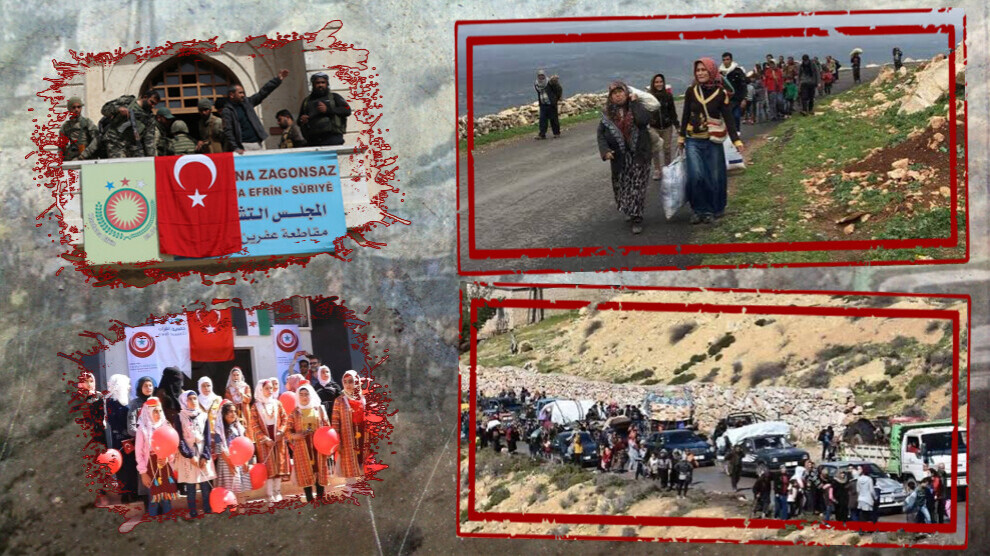
The military attacks launched by the Turkish occupation and its mercenaries on Afrin in 2018, and on the cities of Sere Kaniye and Girê Spî in 2019, deepened this policy, resulting in large‑scale demographic change and forced displacement of hundreds of thousands of indigenous inhabitants, including Kurds, Yazidis, and Christians.
According to documented reports, including those published by the Syrian Observatory for Human Rights at the time, in Afrin, the attack displaced more than 300,000 civilians, and the Kurdish presence there sharply declined as a result of preventing the displaced from returning and seizing their property. In Sere Kaniye and Girê Spî, displacement affected more than 85% of their original inhabitants. The Kurdish presence in Sere Kaniye shrank from about 70,000 to just a few dozen, and the historical presence of Armenians, Syriacs, and Yazidis diminished to isolated individuals.
These acute population shifts were accompanied by systematic Turkification policies that were not limited to imposing the Turkish language and currency, administratively linking the areas to Turkish provinces, and changing the names of squares; they extended to the destruction of archaeological and historical landmarks and the erasure of local cultural manifestations, to be replaced by thousands of new settlers from the families of Turkish‑affiliated mercenaries.
The New Face of Population Engineering
With the change of the governing facade, it became clear that the fall of the Assad regime on December 8, 2024, did not change the essence of Syria's crisis‑ridden reality, but rather opened the door to a new authority led by the jihadists of Hay'at Tahrir al‑Sham (HTS), which came with a soft and systematic strategy to complete the process of demographic engineering. Instead of crude military displacement, the interim government relied on tools of impoverishment and pressure.
In the coastal and central regions, the original components faced what the Syrian Observatory for Human Rights described as a "starvation massacre" and economic pressures that forced local residents to sell their lands under duress and seek refuge for emigration, in addition to the monitoring of systematic projects for demographic change in the Syrian coast. These projects rely on injecting huge sums of money to purchase properties of the economically exploited Alawite community in favour of Sunni factions loyal to the interim government and regionally backed groups.
Despite the documentation by the UN International Commission of Inquiry of previous acts of violence and sweeping operations targeting villages in the countryside of Latakia, Tartus, and Hama by HTS jihadists, the current approach has replaced them with "silent displacement." This was evident in the countryside of Hama and Homs through raids and liquidation campaigns, followed by forced seizure of homes and farms under the heading of "punitive confiscations."
According to a 2025 report by the New European Institute, this developmental exclusion was accompanied by social discrimination imposing laws and educational curricula with a specific religious character and the destruction of non‑Sunni places of worship, accelerating the emigration drain of minorities. In contrast, Idlib has been transformed into a polarised political hub for intensive demographic settlement of the Sunni component and HTS fighters and their families. Thus, al‑Jolani, with his soft approach, has inherited the same torn societal map left by the defunct regime.
Regarding the file of the displaced from Afrin, Sere Kaniye, and Girê Spî, despite an agreement reached on January 29 of this year between the Syrian Democratic Forces and the interim government stipulating the return of the displaced to their homes, the results on the ground have been disappointing. The returning percentage of Afrin's displaced were shocked by a bitter reality: the families of the Turkish occupation‑affiliated mercenaries refused to evacuate the homes they had seized. Meanwhile, the file of the return of the displaced from Sere Kaniye and Girê Spî remains stalled without a solution, leaving the people of those areas entering their seventh year of ongoing suffering under displacement tents.
The recent population transformations in Syria prove that the demise of one authority and the beginning of another does not necessarily mean the end of the tragedy, but may only change its tools, as the approach has shifted from crude military violence to economic pressure and punitive confiscations. This ongoing population engineering places Syria's future before a bitter reality that threatens to erase its historical identity and establish a torn societal map that will be difficult to repair in the near future, making the demographic change file the deepest and most intractable wound in the Syrian body.