
The Hidden and Distorted Faces... Women's Share of Murals in Kermanshah
City walls reveal the forces deciding who appears in public space; in Kermanshah, women's visual presence is restricted by patriarchal culture dominating representation and expression.
SARAH POUKHZARI
KERMANSHAH– Streets can be a mirror reflecting the prevailing ideas and beliefs in society, as the roots of societal culture and its values are manifested in the symbols and artistic elements that express collective beliefs.
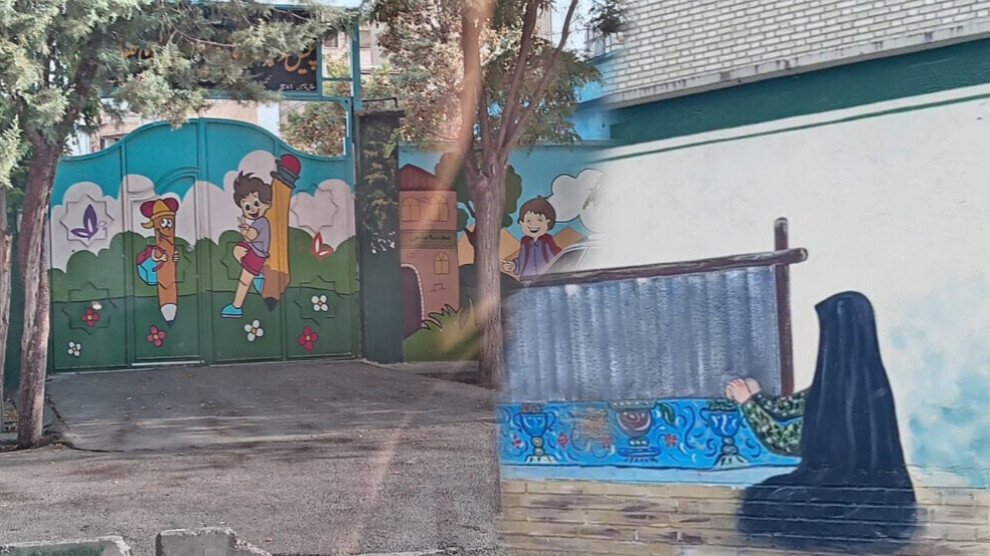
When walking through the streets of Kermanshah city in eastern Kurdistan, it becomes clear that memorial monuments, statues of legendary figures, murals, and other landmarks that embody successful and worthy figures are mostly limited to images and statues of men. As if women were not part of the city's history and identity, or were not worthy of presence and representation in its public space.
In this context, Fariba. S., an activist in the field of women's rights, says: "In a society dominated by patriarchal structure, public spaces and their facilities become monopolized by men.
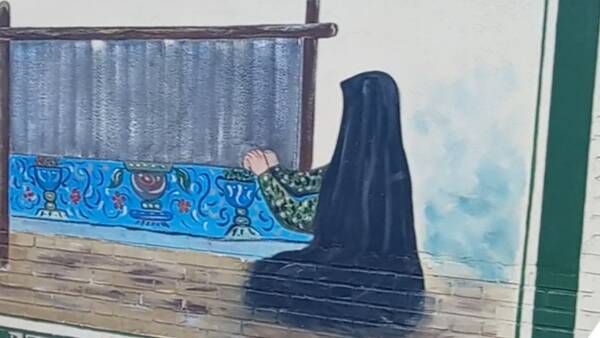
We hardly find a trace of women in the symbols and landmarks that embody heroism; their independent appearance in the public sphere is made a source of threat in the eyes of the dominant system, and the absence of their real presence necessarily leads to the marginalization of their image and representation in murals as well."
She notes that images of men remain present and dominant on the walls of schools, pools, sports complexes, and other public facilities, while images of women appear, in rare cases, in a stereotypical manner lacking details and individual features, as if there is an insistence on obscuring their true identity and erasing their visual presence. "Even when a woman's image appears, even in a limited way, on the city's walls, its depiction remains confined to the stereotypes entrenched by the patriarchal system; she is presented either as the sacrificing mother or the woman absorbed in household work, which reproduces her traditional roles and entrenches her subordinate position."
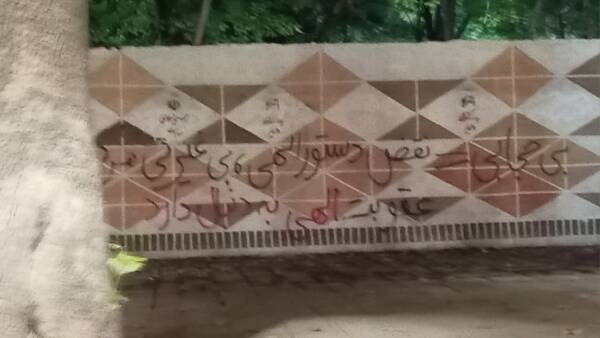
She explained that in contrast to this systematic exclusion, the walls of Kermanshah city face a disturbing phenomenon represented in the spread of slogans and writings targeting women's existence, dignity, and independence; they include explicit threats to women who criticize the imposition of compulsory hijab, reaching the point of incitement to practice violence against them.
Banning the Drawing of Women with Realistic Features
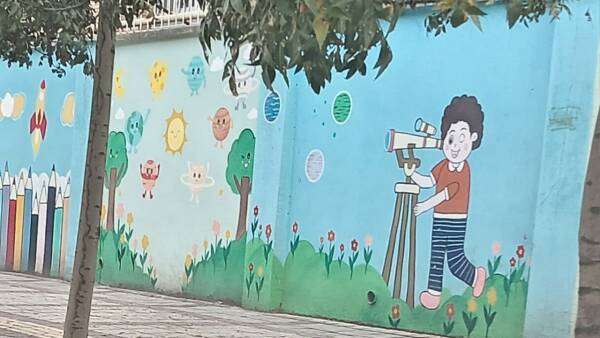
Sara. J., a visual artist from Kermanshah city, recounts an aspect of her repeated experiences working with the municipality, shedding light on the strict restrictions imposed on depicting women in public space. She explains that drawing realistic images of women in the city's streets is completely prohibited, and only simplified, primitive drawings of a childish character are allowed, provided they are executed inside closed places exclusively designated for women.
She cites an incident that occurred about six years ago, when she was commissioned to execute a mural depicting a group of children walking hand in hand. "I prepared a design featuring three girls and three boys standing side by side, but the municipality rejected the design and demanded reducing the number of girls and preventing the children from holding hands. Objections and modifications continued until the matter ended with the deletion of all the girls from the painting, leaving only four male children on the wall."
These evidences reveal that erasing women's image from public space is not a passing practice, but a systematic exclusionary policy that goes beyond preventing their appearance to distorting their images and obliterating their features, whether on city walls, gravestones, or billboards.
Regardless of the different contexts, these practices reflect a common patriarchal logic seeking to control women's presence and impose guardianship over their visual representation, which is clearly evident in Afghanistan under Taliban rule, where the ban extended to removing women's images from shop facades and beauty salons. Hence, obscuring women's image is not related to the image alone, but represents an attempt to deprive them of their right to appear, be represented, and exist as an independent and active entity in the public space.