
From Destroying Civilization to Misogynistic Statements... Where Is Afghanistan Heading?
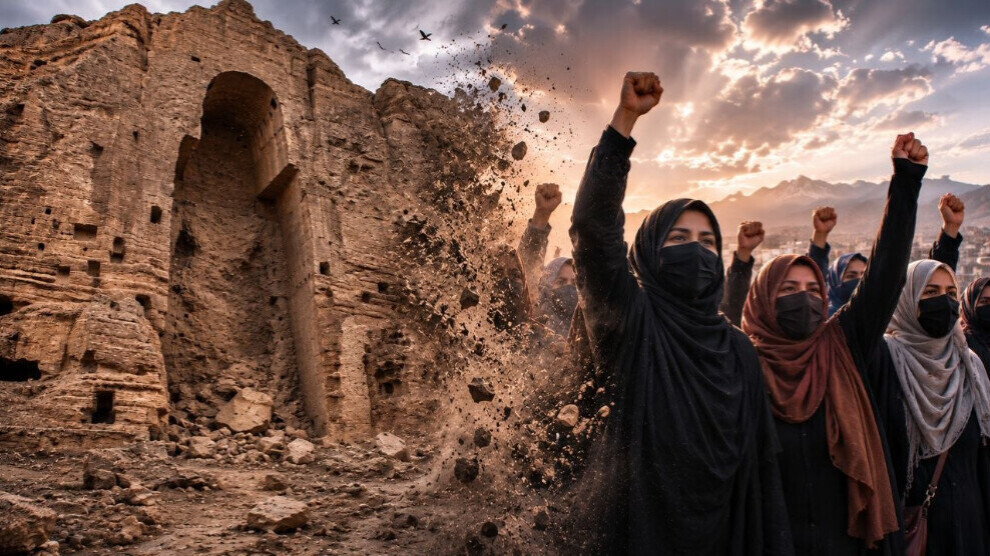
The statements of Abdullah Sarhadi, the former Taliban governor of Bamiyan province, once again open the door to discussions about the destruction of the Buddha statues in Bamiyan, and about the movement's view of cultural heritage and women.
BAHARAN LAHIB
Afghanistan — Five years after the Taliban's return to power in Afghanistan in 2021, statements by Abdullah Sarhadi, the former Taliban governor of Bamiyan province, have once again brought part of the Taliban's past and their view of the country's history and culture back into public debate. In an interview with the BBC, he spoke about his role in destroying the historic Buddha statues in Bamiyan, asserting that he does not regret the act.
The Buddha statues of Bamiyan were not merely two large stone figures; they were part of Afghanistan's historical and cultural heritage, remnants of past civilizations in the country. Their destruction in 2001 provoked widespread global reaction and became one of the symbols of the Taliban's treatment of Afghanistan's cultural heritage.
Abdullah Sarhadi's admission of his role in destroying these monuments comes at a notable time, as after the Taliban's return to power, he resumed holding government positions within the movement. He first served as governor of Bamiyan before being appointed governor of Jawzjan. This raises a number of questions about the extent of change in the Taliban's vision and policy toward Afghanistan's past and cultural heritage, as well as the place this heritage holds in Afghanistan today.
At the same time, he described women as "deficient in intellect" and stated that allowing them to attend schools could lead to "luring them into prostitution." These remarks provoked widespread reactions, particularly among women, who expressed their rejection and raised their voices in protest.
Yalda Ahmad, a psychologist and women's rights activist, rejected Abdullah Sarhadi's statements, saying: "In recent days, the BBC aired a documentary about the Taliban Emirate. In this documentary, various Taliban figures presented their medieval ideas. But Sarhadi's remarks reveal the depth of the movement's hatred of women and ignorance. He says women are 'deficient in intellect' and should not be allowed to go to school, and that when they go to religious school, their eyes are 'torn' and they say things that leave one bewildered about them."
Yalda Ahmad explained the term "torn eyes," commonly used among ordinary people, stating that in Afghanistan it is used to mean "lack of modesty, immorality, and, more broadly, sexual misconduct."
She added: "What he said is not new. Since the Taliban first came to power until today, they have practically shown, through their ignorant, despotic, and misogynistic laws and decrees, the nature of their policies. They have closed the doors of schools and universities, do not allow women to go to offices and work, have closed parks and recreational places in their faces, and prevented them from going to beauty salons—everything that could give women even a little comfort. They only say that women must remain imprisoned within the four walls of their homes and are not allowed to go out without a mahram (male guardian)."
She pointed to the heroic role women have played in confronting various forms of fundamentalism, from jihadist groups to the Taliban and ISIS: "If we look at history, in this same recent decade, we see that in Afghanistan and various countries, women have always been subjected to violence by despotic and misogynist forces and groups. But on the other hand, if we remember the women of Kurdistan, ISIS subjected them to violence and committed countless oppression against them—but it was women themselves who fought them with courage and valor, like the heroism of the women of Kobani."
She added: "ISIS told its fighters, 'Whoever is killed by a woman is not a martyr'—meaning no funeral prayer is held for their body. But these heroic women in Kobani and in various parts of Kurdistan were the ones who made ISIS's graveyard."
Women, she said, have a proud history of struggle in many regions: "If we look at the history of Latin American countries, Palestine, or various other countries, we see that the heroic women of these countries stood with all courage and steadfastness against ignorant and misogynist religious and non‑religious forces and struggled against them."
She also noted "the resilience and struggle of conscious and militant women in Iran, who for decades have stood against one of the most ignorant, brutal, and bloodthirsty Islamic regimes in the world, resisting and fighting, dyeing prisons and gallows with their blood. Similarly, we see that the women of our country have not been prevented by these laws, decrees, and statements from the Taliban from standing firm and resisting. On the contrary, they realized that the remedy for all pain is struggle. For this reason, in any way possible, and by any means they could, they stood courageously and heroically against the Taliban, protested, raised their voices, took to the streets, and even endured the brutal torture practiced by the movement."
In concluding her remarks, Yalda Ahmad said: "We believe that a day will come when all the women of the world unite, show solidarity with one another, and stand in a single row against every individual, group, or entity that is hostile to women, and against every tyrant who practices oppression and discrimination against them. Then, the inexhaustible power of peoples—foremost among them the power of women—will manifest, enabling them to overthrow tyrants and end injustice and despotism."