
Yadkar Qarman Employs Colors in the Service of Kurdish Women’s Struggle and Identity
Kurdish artist Yadkar Qarman dedicates her artistic talent to documenting the struggle of her people and shedding light on the issues of Kurdish women, through paintings that evoke memory, history, and identity.
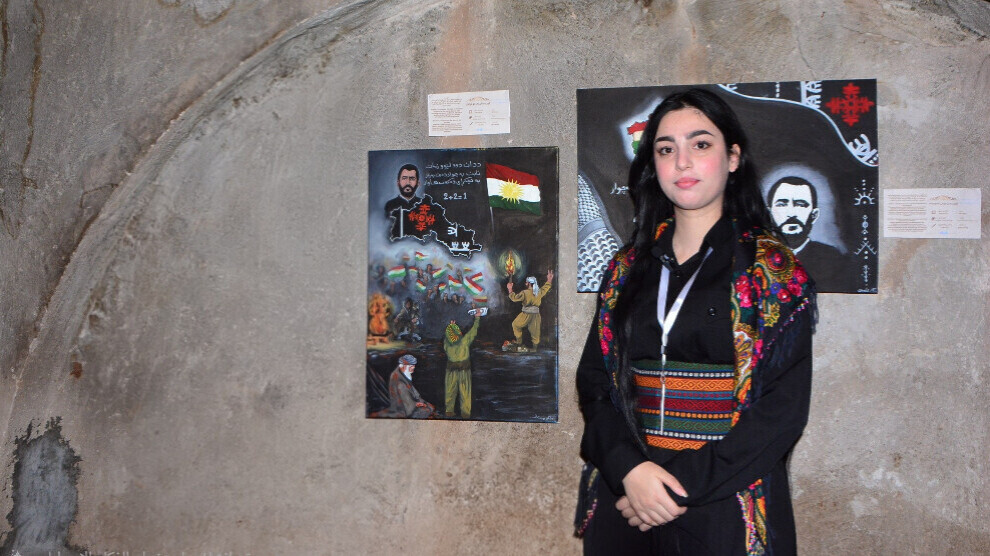
SHLER KOYI
KOYA– Kurdish artist Yadkar Qarman, known as Yadkar Broshan, employs the art of painting to express the struggle of Kurdish women, their identity, and the causes of their people. For about 11 years, she has devoted her artistic talent to embodying pain, resistance, and Kurdish history through paintings rich in symbols and connotations.
Artist Yadkar Qarman says that her works are inspired by national and social events, and by what the Kurds have faced in the four parts of Kurdistan, and she seeks through them to convey the suffering and resilience of her people to audiences inside and outside Kurdistan.
Regarding the connotations of her paintings, she explained: "I have been painting for about 11 years. My interest in fine arts began when I was in the ninth grade, in Koya city, and since then I have continued working in this field. My style relies more on sequential art, and I have drawn inspiration for my works from the issues and wars facing the Kurdish people in eastern Kurdistan and Rojava. I have dedicated my art to serving the Kurdish people."
"The Iranian State Is More Hostile to Women"
She noted that in one of her paintings, "I painted the map of Kurdistan in the form of a cloud, because the revolution initially launched from the areas of Ilam and Kermanshah, where the hijab is more commonly used. I also painted the image of Qazi Muhammad, the leader of the Republic of Kurdistan, and the author of the famous phrase '2+2=1,' which symbolizes unity, because we consider him a symbol of the Kurdish people and see ourselves as an extension of his legacy."
"I Drew My Ideas from Resistance and Revolutions"
Yadkar Qarman noted that she "used these symbols to express my belief that the Iranian regime will one day fall at the hands of women, especially since the Jina Amini revolution had a wide resonance, and I have drawn a large part of my ideas from it."
She addressed other works inspired by revolutions and resistance, noting that she painted a portrait of the female fighter in the ranks of the Women's Protection Units whose braid was cut and who was martyred by jihadists of Hay'at Tahrir al-Sham. She said: "It is very important that an artist is able to serve their people through their art. We can, even without words, show what the Kurds have been subjected to, and how they remained strong despite all they have gone through. Therefore, I am keen to address these issues in my paintings, so that Kurds and others can learn about them."
She noted that she completed two other paintings, one about Shah Maran, which she described as an ancient Kurdish legend, confirming her desire to highlight its connection to Kurdish heritage.
She explained that Shah Maran represents an exceptional woman in beauty and wisdom. "I wanted to redraw her to confirm the connection of this legend to Kurdish culture. My love for Kurdistan cannot be described in words, and I will continue to express it through my paintings."
At the end of her interview, Yadkar Qarman confirmed that the four parts of Kurdistan are equal in status to her. "North, south, west, and east are nothing but geographical directions, but Kurdistan is one. And I wish from the depths of my heart that we can all return to our land and rejoice in our homeland again."