
The Passion for Piano Turns into an Opportunity to Teach Women in Iraq
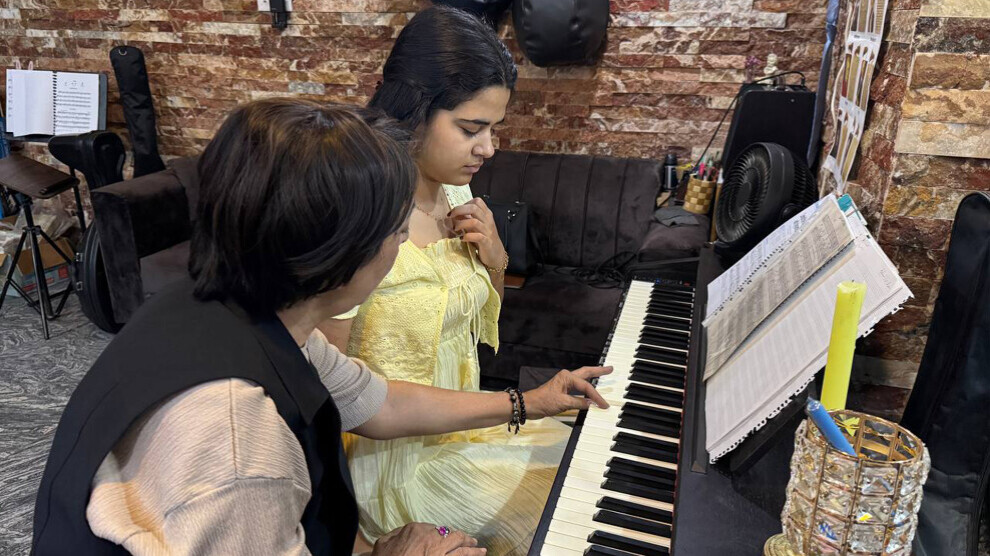
Shaima sumaisem trains women in Iraq on the piano and seeks to expand the horizons of learning music before them, in a society where women’s participation in the artistic field is still governed by social retrictions.
RAJAA HAMID RASHID
BAGHDAD– In the journey of learning music, the matter is not limited to acquiring the skill of playing, but extends to building self-confidence and providing an environment that encourages experimentation and continuity. The experience of the trainees with piano instructor Shaima Sumaisem highlights an aspect of this journey.
What makes the number of trainees in the piano lesson limited? A question that reflects the social challenges facing women in Iraq, and limiting their opportunities to learn music and engage in the artistic field.
In an endeavor to expand opportunities for learning music, Shaima Sumaisem, a piano instructor at Majeed Institute for Music, works on training women and girls and developing their musical skills, based on a personal experience during which her dream of learning to play the piano was delayed.
From the Piano Dream to the Profession of Training
Shaima Sumaisem began learning to play the piano at the age of twenty, and studied under the late Iraqi pianist Saad Hikmat, who she noted was used by Iraqi radio and television as a professional player. She then continued her musical studies under Maestro Salem Abdul Karim, who was at the time the director of the Institute of Melodic Studies.
In 1988, she worked with him as a music trainer, simultaneously with her studies under him, in an experience she describes as a challenge, as she combined the role of teacher and student.
Another station in her career came through her cooperation with Kifah Majeed, which gave her the opportunity to work as a piano trainer at Majeed Institute for Music. Shaima Sumaisem believes that studying under a woman may be more acceptable to some girls in Iraqi society, helping them overcome social embarrassment and engage in learning.
Shaima Sumaisem has been working at the institute for seven years. She says that she has been practicing piano training for about 15 years. The institute, alongside the piano, includes lessons in other musical instruments, including the violin, oud, guitar, santur, and qanun.
In her training, she relies on combining the theoretical and practical aspects, as trainees learn to read musical notation and the correct techniques for using fingers, alongside practicing pieces they choose in consultation with her. She deals with different age groups, from children who have not reached school age to people in their fifties and sixties.
Music Between Hobby and Professionalism
Shaima Sumaisem notes that technology and social media platforms have provided additional opportunities to learn about and learn music, and have contributed to highlighting women's experiences in playing and teaching. She cites santur player Jumana Al-Bayati, and Arab women who offer lessons in singing and playing musical instruments, as models of growing women's presence through digital media.
On the other hand, Shaima Sumaisem talks about the challenges she faces in her work, foremost among them balancing her family responsibilities and her endeavor to develop her knowledge. She explains that reconciling these obligations is not easy, especially as she is keen to expand her culture in multiple fields, including philosophy, psychology, sociology, and economics, alongside music.
She also participated for two years in the Child Library initiative sponsored by the Swedish Olof Palme organization, and has offered lessons in Iraqi schools during the past three years. Among her dreams is composing songs for children, whether from songs included in school curricula or outside them, carrying values such as friendship, love of nature, care for animals, and tolerance.
She believes that children's songs play an important role in developing their personalities, expressing her hope that this aspect will receive greater attention in Iraq, allowing children broader opportunities to learn about music and interact with it from an early age.
The Trainees... An Experience That Goes Beyond Playing
The trainees' experiences show how learning music can become a space for acquiring skills and enhancing self-confidence. Among these experiences is that of Mai Salam, a student in one of the schools for outstanding students, who describes her relationship with her instructor Shaima Sumaisem as based on friendliness and flexibility, noting that repeating training and re-practicing allows her to learn according to her own pace.
Her experience reflects the nature of the relationship between the instructor and the trainee, as the lesson is not limited to acquiring technical skills, but extends to providing a supportive environment that encourages continuing to learn and develop.
For Shaima Sumaisem, teaching playing does not represent merely mechanical training in finger movement, but an experience that can reflect on the learner's personality and the way they deal with life. She highlights that teaching a person to play any instrument contributes, from her point of view, to rearranging their thoughts and personality, and enhancing balance, tenderness in feelings, and humanity.