
Anahita... The Legacy of the Water Goddess Between Temple Ruins and the Memory of Folk Heritage
Despite Kangavar's Anahita Temple collapse, vow rituals and beliefs in Kermanshah springs' healing powers remain evidence of the ancient water goddess's continued presence in local folk heritage.
SARA POUKHZARI
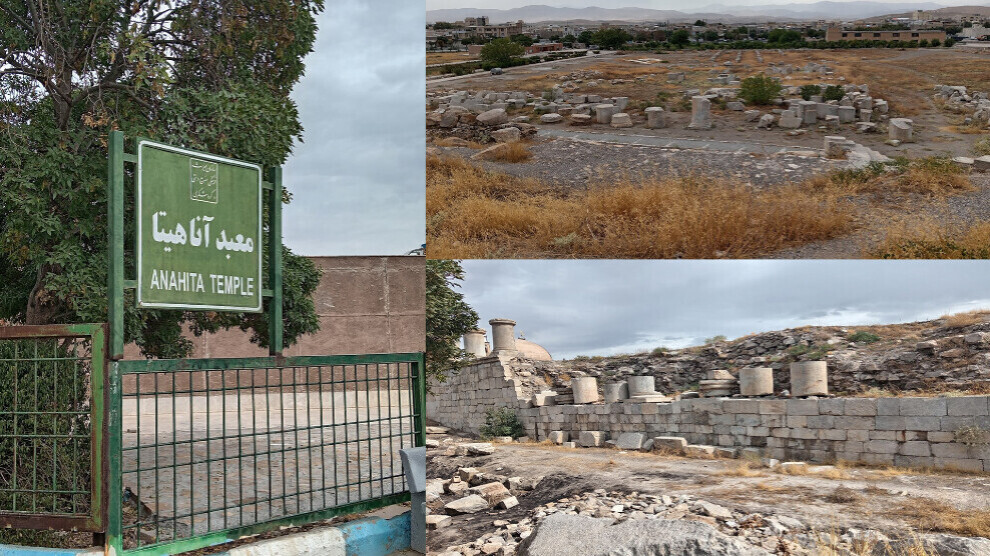
KERMANSHAH – The cracked columns, the collapsed walls, and the silent structure of the temple, of which only a few traces and faded stone inscriptions remain today amid a land enveloped in silence, all form a scene suggesting a forgotten memory from an ancient era. An era in which this building, when it was towering, was perhaps a witness to rituals, beliefs, and an ancient civilization, of which nothing remains today but scattered fragments in ancient texts and oral heritages passed down by generations over the centuries.
Today, many pass by this landmark without turning to its name — that name that was once a symbol of greatness and majesty, before its status receded in memory with the passage of time, leaving nothing of it but letters engraved on a rusty metal sign: "Anahita Temple."
Traces of the Goddess of Purity in History
Anahita is known as the goddess of water; a pure and powerful goddess, and the protector of all the waters of the world. Her roots go back to eras deeply rooted in antiquity, when every element of nature had its own god or goddess, and humans believed in the existence of a sacred power behind every element of life.
In Kermanshah, many historical and cultural evidences of this goddess's presence are manifested, foremost among them the Anahita Temple in Kangavar. The history of this temple goes back to between two thousand and two thousand five hundred years, and it is considered the second-largest stone building in Iran after Persepolis; which reflects its greatness and vastness, and indicates the high status that Anahita occupied in the past.
Her name was even mentioned in the Avesta (the holy book of followers of the Zoroastrian religion), specifically in "Aban Yasht," which dates back more than three thousand five hundred years, and is considered one of the oldest hymns of glorification associated with water and purity.
In addition, her image appears on silver and gold vessels dating back to different eras, especially the Sassanian era, accompanied by symbols such as water, the lotus flower, fish, and pomegranate. In Taq-e Bostan in Kermanshah, she was depicted alongside a Sassanian king, which is clear evidence of this goddess's prominent presence in the culture of the ancients.
The evidences of Anahita's veneration are not limited to Kermanshah, as respect for water and the belief in its sanctity are still present in the customs of the region's inhabitants, as an echo of ancient beliefs deeply rooted in the collective unconscious across generations.
When Ancient Rituals Remain Alive in the Springs
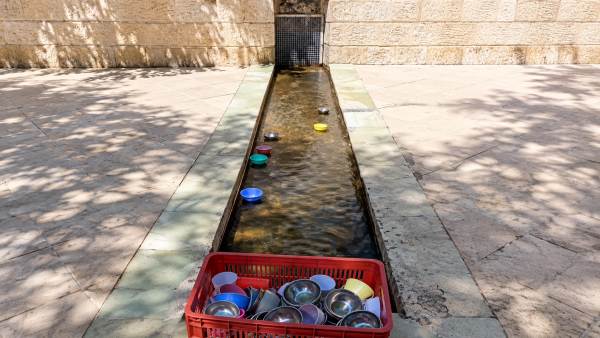
There are many springs throughout Kermanshah, and the inhabitants of each area believe that they have various therapeutic properties. They also offer different vows to them, in their belief that their waters are capable of healing physical, and even psychological, diseases.
For example, in the Dalahu area, there are springs known as Ghaslan and Kani Shifa, and many believe that their waters possess healing properties, and therefore a large number of people head to them. Among the vows that are offered, the pomegranate occupies a special place. It is worth noting that the pomegranate is mentioned in historical sources as the symbolic fruit of the goddess Anahita; a fruit associated with fertility, purity, and the power of life.
There is also in Kermanshah the Rizeh spring in Javanroud, which many believe its waters are effective in treating kidney stones, as well as the Koli spring in Sonqor, where residents believe that bathing in its waters helps lower fever and heal from diseases.
These examples represent only part of the springs believed to possess therapeutic properties throughout Kermanshah; springs that a large number of people believe in their therapeutic capabilities and sacred power. This respect and veneration can be viewed as a form of honoring and revering water, that element that has occupied a spiritual place in various cultures since antiquity.

The similarity of the name of the "Hanita" spring in Kermanshah with the local name of the water goddess "Anahita" may indicate the possibility of the continuation of ancient beliefs associated with the sanctity of water. Despite the absence of documented historical evidence for this derivation, the oral circulation of the name and the spring's association with seeking healing may reflect remnants of ancient religious heritage.