
A craftswoman from Kasserine revives Tunisian heritage with the sparkle of crystal
Wahida Ben Said has succeeded in using crystal to revive the traditional Tunisian dress and preserve heritage in a style that combines creativity and identity.
Ikhlas Hamrouni
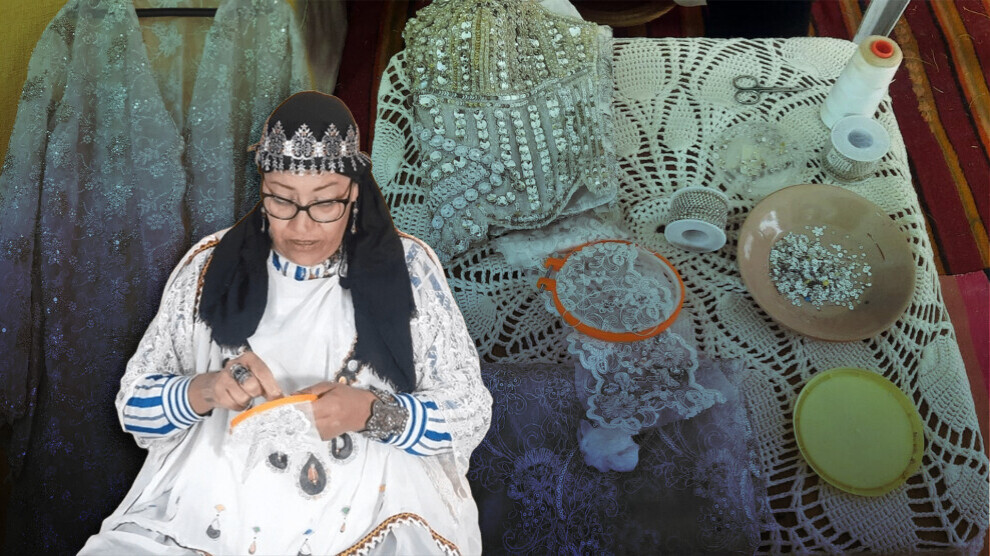
Tunis – In the city of Kasserine, where the scent of heritage meets the spirit of creativity, craftswoman Wahida Ben Said continues to preserve traditional crafts through the art of crystal embroidery – a meticulous work that gives Tunisian attire a special sparkle. Since childhood, she has managed to turn her passion into a profession and an identity, through which she seeks to protect this legacy and transmit it to broader horizons.
Wahida Ben Said explains that crystal is known for its facets that give striking beauty to traditional dress. She says that the craft of crystal embroidery is among the refined works that give attire such as the caftan and the Tunisian "kiswa" a distinctive character, noting that crystal is available in different sizes, most of its shapes are imported from abroad, and it is distinguished by its brilliant shine and sold in markets by the meter.
Regarding why she chose this profession, she mentioned that she loved this craft since childhood because her mother worked in embroidery, crochet, weaving, and handicrafts. She indicated that she had her first experience at the age of eight, when her mother gave her a small piece to learn on; she embroidered her first motif and learned the basics of the craft.
She added that she continued her studies until the third year of secondary school, then enrolled in a training course in Tunis, where she studied at the "Al‑Fatah" center for three years and six months. She explained that she obtained a diploma in hand, machine, and traditional embroidery, which includes traditional dress, lentil, sesame, and crystal embroidery, in addition to the "jebba," "burnous," and caftan.
She said: "I began gradually to develop my skills and research in this field until I became passionate about it. I delved into traditional dress and Berber identity, especially the black 'melhfa,' introducing embroidery and warm colors. I embroider it by hand with needle and thread, and produce many different products and decorations from it." She added that she creates different crystal shapes such as roses and decorations, and uses multiple embroidery techniques, noting that she sometimes works on cotton to highlight the beauty of the piece.
Wahida Ben Said explained that embroidery, crochet, and handicrafts in general help reduce psychological stress and provide mental relaxation, adding that working with colors brings joy and pleasure.
She pointed to her insistence on the continuity of this craft: "Traditional crafts must not disappear. For that reason, I have trained a number of girls and helped them learn this craft." She added that this field can provide a source of income for women, despite differences in capabilities among artisans. "Many girls have become working independently and earning an income from this craft."
Challenges of the craft and ambition for global reach
Wahida Ben Said faced several challenges during her career, most notably the high prices of raw materials, especially crystal, which is expensive and relatively recent in the embroidery field. She explained that some pieces, such as the crystal‑encrusted caftan, can cost high amounts due to this high cost.
To ensure the quality of her product and ease of marketing, she sometimes adopts light and not excessive work to make it comfortable and practical, affirming that crystal embroidery requires high precision and harmony among all units, and that she is among the few in her region who work with crystal and silver.
Speaking of her successes, she expressed her pride in participating in a high‑level craft show with the "Golden Five," considering it an important milestone in her artistic path. She concluded by affirming her ambition to take the "Kasserine melhfa" global despite difficulties and lack of support.