
Political imprisonment in the feminine form… A Symposium reopense the question of protection and cross-border solidarity
A digital symposium by NAFID highlighted the very harsh reality of women’s political imprisonment in the regiion via testimonies from Morocco, Palestine, and Tunisia, revealing political, psychological, and social dimensions extending beyond the prison w
Hanan Hart
Morocco — The participants in the symposium unanimously agreed that the political imprisonment of women is a cross-border issue, intersecting political, social, and psychological dimensions, and that confronting it requires organized international solidarity and stronger legal protection for human rights defenders.
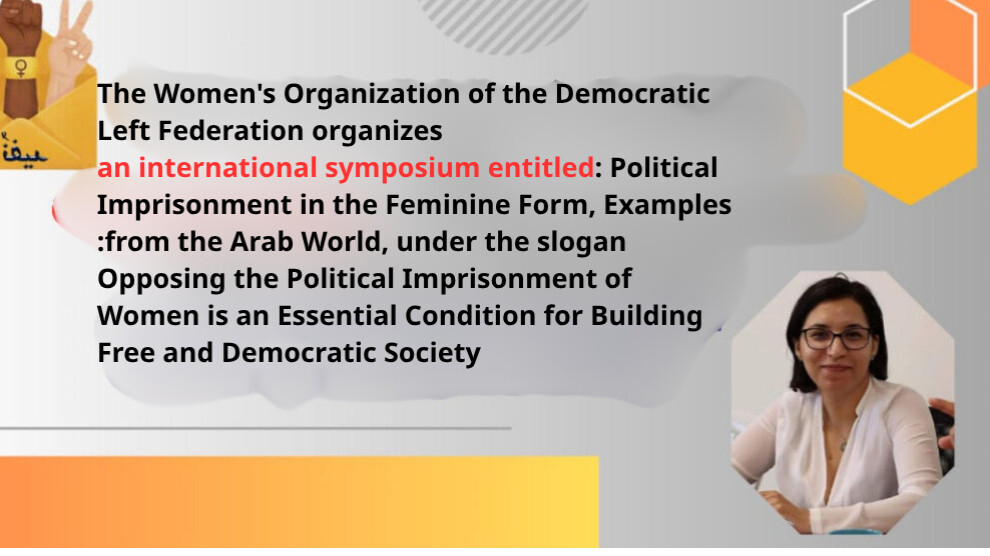
In an international context marked by escalating tensions and the decline of freedoms in several regions, an international digital symposium organized by the "Women of the Federation of the Democratic Left – NAFID" (a Moroccan women's organization) yesterday, Thursday, April 16, highlighted the reality of the political imprisonment of women as one of the most prominent manifestations of restricting rights and freedoms, along with its extended effects beyond prison walls.
The symposium, held remotely under the title "Political Imprisonment in the Feminine Form: Examples from the Arab World," presented readings and testimonies from Morocco, Palestine, and Tunisia, revealing the intertwining of political dimensions with social and psychological dimensions in the experience of imprisonment, especially for women.
"Women's issues cannot be separated"
Sanaa Faouzi, Secretary-General of the "NAFID" organization, affirmed that choosing the topic of political imprisonment in the feminine form reflects an awareness of its urgency and an extension of the organization's commitment to defending women's rights as part of a broader struggle for democracy and social justice. Women's issues cannot be separated from political, economic, and social contexts. She considered that the struggle for equality is directly linked to the struggle for dignity and freedom.
She pointed out that political imprisonment remains one of the most prominent manifestations of restricting freedoms in the region, amid the growing forms of prosecutions related to opinion or protest, with ongoing challenges to fair trial guarantees.
Palestine: Imprisonment that transcends the body
From Palestine, the testimonies of participants presented a harsher picture of the experience of imprisonment. Political and human rights activist and member of the General Union of Palestinian Women, Maysar Attiyani, spoke about what she described as "double violence" that women are subjected to inside prisons, including minors and pregnant women, under difficult detention conditions and lack of healthcare.
She pointed to "cases of childbirth inside prisons under harsh conditions," considering that these facts reflect a compounded suffering affecting both women and children. "Documenting these experiences is in itself a form of resistance." She stressed that targeting women and children in conflict contexts is linked to a broader structure of control, because women's freedom is inseparable from the freedom of society.
"Targeting women is broader than violence"
For her part, Maryam Abu Daqa, a leader in the Palestine Liberation Front, evoked the impact of prolonged imprisonment, saying, "We left the prisons, but the prisons did not leave us," referring to the continuing psychological impact after release. "The experience of imprisonment remains present in memory and body, especially in light of what she described as the escalation of violations in the Palestinian context." She considered that targeting women comes within a broader system of conflict-related violence.
Morocco: Memory and the social extension of imprisonment
In the Moroccan context, human rights activist Latifa El Jababdi, a former detainee during the so-called "Years of Lead," recalled a period that extended from the 1960s to the late 1990s, which witnessed serious human rights violations before they were recognized within the framework of transitional justice, particularly through the Equity and Reconciliation Commission. She noted that the conditions of women inside detention centers at that time did not meet humanitarian standards, including pregnant and breastfeeding women.
She also pointed out that the effects of imprisonment do not end with release but extend to social life, where some women face forms of social stigma that may lead to family breakdown. She added that some cases of imprisonment during that period occurred on the basis of kinship relations, without direct political involvement.
"Not limited to a single national context"
For her part, lawyer Souad El Barahma, President of the Moroccan Association of Human Rights, considered that patterns of imprisonment have undergone transformations in recent years, no longer linked only to traditional political positions but now include freedom of expression and participation in social protests. She affirmed that this phenomenon is not limited to a single national context but reflects broader transformations related to political and social structures in the region. She called for strengthening legal protection for women human rights defenders and expanding cross-border solidarity mechanisms.
Tunisia: The body as a space for control
From Tunisia, human rights activist Fidaa El Atmani, a member of the Tunisian League for Human Rights, highlighted the reality of imprisonment among women activists, considering that political imprisonment does not target only the individual but extends to their memory and struggle experience. "The female body inside prison becomes a field for multiple forms of control and violation, making the experience of imprisonment have complex psychological and physical dimensions."
She said she speaks from the position of a "witness" who directly experienced imprisonment, pointing out that the effects of that experience from the era of Zine El Abidine Ben Ali still continue on psychological and physical levels. "I was part of a collective struggle path, and I was imprisoned because of this involvement, which makes my testimony part of a continuous memory of resistance."
She stressed that solidarity with women prisoners must not remain circumstantial or emotional but should be based on collective awareness and organized cross-border action, rejecting all forms of violations. She sent a salute to a number of Tunisian women currently languishing in prisons, considering that their imprisonment reflects a message of intimidation that goes beyond individual cases and extends to women generally in Tunisia and beyond.
Towards cross-border solidarity
At the conclusion of the symposium, the participants called for building an international front against the political imprisonment of women, strengthening legal frameworks to protect women human rights defenders, and expanding women's political representation as an essential entry point for achieving justice and equality.
The speakers affirmed that despite differing contexts, political imprisonment shares similarities in its manifestations and effects, and confronting it requires cross-border solidarity that goes beyond condemnation to action and organization.