
From Educational Restrictions to Creating Hope wit a Small Project in Afghanistan
Farima Amir, a young woman from a remote area in Daikundi, moved to Bamyan to carve her path toward the future by opening a small shop.
BAHARAN LAHIB
AFGHANISTAN_After the Taliban’s return to power in Afghanistan in 2021, and the restriction of women’s and girls’ access to education and social activities, many of them resorted to small projects and artistic activities, seeking to continue their lives and preserve their independence.
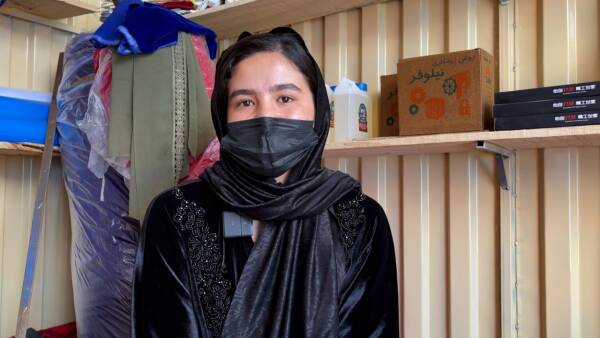
In the handicrafts market in Bamyan city, women display traditional clothes and jewelry in their stalls. Among them is Farima Amir, a young woman from Daikundi province, who recently opened her own small shop, where she practices embroidery and sewing and sells her products.
She adds: "In Daikundi there are no educational courses or schools. Even religious schools do not exist in some areas, and home courses are not organized either. In general, the education sector is completely halted. Women cannot do any work outside the home, and they do not participate in any activity."
According to Farima Amir, many girls in Daikundi remained in their homes, preoccupied with sewing and household work. Being deprived of education and the absence of opportunities for social participation caused them great psychological pressure, which pushed some of them into early marriage.
From Lost Opportunities to Seeking to Continue Education
Farima Amir was also deprived of continuing her education after the Taliban took control of power. She says that Daikundi was gradually moving toward progress, despite its geographical remoteness and lack of resources, as girls used to study in schools and enroll in courses to learn English and prepare for the university entrance exam. But after the closure of educational institutions, many of them were forced to remain in their homes.
When she was unable to continue her studies, she resorted to religious schools, but she faced difficulties, according to her account, because of the age issue. This was negatively reflected on her psychological state, as she felt that she had been deprived of her right to education and its opportunity.
Through opening a small shop, Farima Amir seeks to develop her skills and achieve her own income.
Lack of Basic Services
Daikundi's problems are not limited to the restrictions imposed on education and women's social life. Farima Amir says that the mountainous nature of the province and the lack of adequate roads make the population's access to public services difficult.
As for the health sector, despite the existence of medical centers in the province, the available capabilities in remote districts are limited. She explains that some health centers lack advanced equipment and experienced doctors, forcing women to head to the province center for childbirth or to obtain appropriate medical care.
Farima Amir notes that many women in remote areas used to work in agricultural lands simultaneously with continuing their education, before the current restrictions were imposed. She sees in these women models of seeking to change life's conditions, a pursuit she believes has come to face obstacles due to the closure of educational institutions and the restriction of women's participation in social life.
Despite the difficult conditions, Farima Amir believes that women's insistence on continuing to work and learn is evidence of their refusal to surrender. She directs a message to the women of Afghanistan, especially the girls of Daikundi, in which she calls on them to hold on to hope. "Let them always preserve their strength and continue the journey. The women of Afghanistan find a way for themselves behind every closed door. It is a source of pride that they continue striving and persevering under these circumstances."