Armenian Teachers: Learning in Our Mother Tongue is Our Right
Armenian language teachers stressed the importance of recognizing the mother tongue, saying, “It is not merely a tool for communication, but an integral part of the Armenian community’s identity history, and culture.
RONIDA HAJI
Al-Hasakah — In the aftermath of the massacres and forced displacement that the Armenian people have endured throughout history, preserving the language, culture, and identity of successive generations—whether in the diaspora or within Syria—has become a fundamental issue in recent years. With the outbreak of the Rojava Revolution and the establishment of social and educational systems under the umbrella of the Autonomous Administration, the opportunity arose for the Armenian community to organize itself and learn in its own language and culture.
Since 2022, the Armenian Language Foundation in the city of Hasakah has continued its efforts to preserve the Armenian language, with teachers demanding recognition of their language and protection of their right to education in their mother tongue. In this context, Armenian language teachers affirmed that language is not merely a tool for communication, but an integral part of the Armenian community's identity, history, consciousness, and culture.
In the city of Hasakah, there are 39 teachers working in the field of teaching the Armenian language, and the number of students receiving education in this language exceeds 600. Armenian teachers seek to continue this education to ensure that new generations receive their education in their mother tongue.
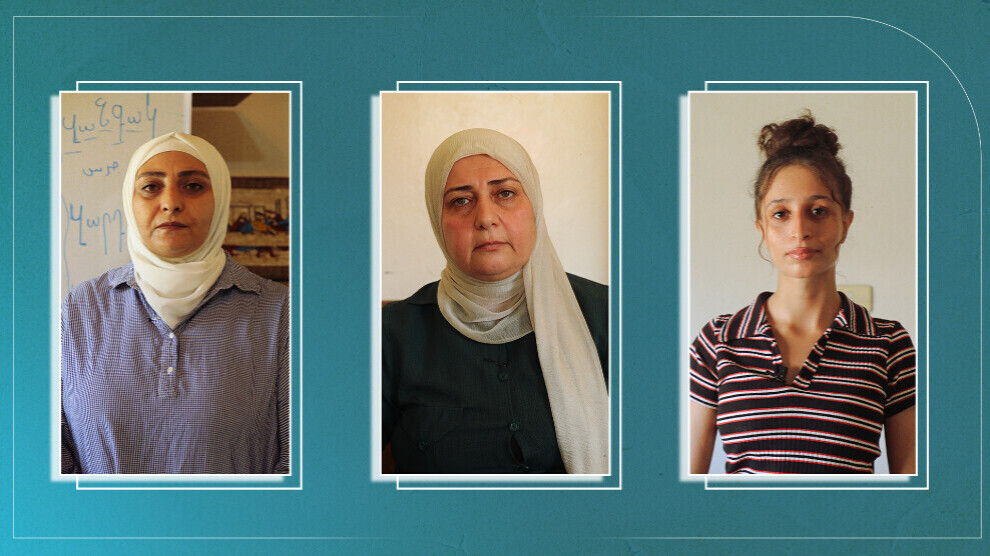
Armenian language teacher Nisreen Issa, who has been working in this field since 2019 and currently teaches at the Armenian Language Foundation, says that their goal is to pass the mother tongue on to future generations and raise awareness in society about the existence of the Armenian people and their culture. She says that "alongside Arabic, Kurdish, and Syriac, the Armenian language also exists in Syria and must be preserved," calling on the new Syrian government to recognize it.
"The Mother Tongue Is the Key to History and Culture"
Hana Hamada, also a teacher at the Armenian Language Foundation, affirmed that the mother tongue is not merely a tool for communication, but an integral part of identity and consciousness, and a means of preserving history and culture. "Learning the mother tongue is a way to preserve identity, and through it, one can express oneself, one's feelings, and one's thoughts."
Teacher Firooz Abdullah explained that the former regime did not recognize linguistic and cultural diversity in Syria. "But now we defend our language, identity, and culture, and we want to teach them to future generations," she affirmed, stressing that the new Syria must be built on the basis of recognizing all its languages and cultures, rather than imposing a single language on the various segments of society.