
“Protecting civil peace in Hasakah is a collective responsibility and diversity is the foundation of partnership”
Syriac Democratic Party co-president Madeline Khamis affirmed Hasakah is a shared home, not a conflict arena, stressing dialogue, partnership, and protecting national, cultural, and religious diversity while guaranteeing all rights.
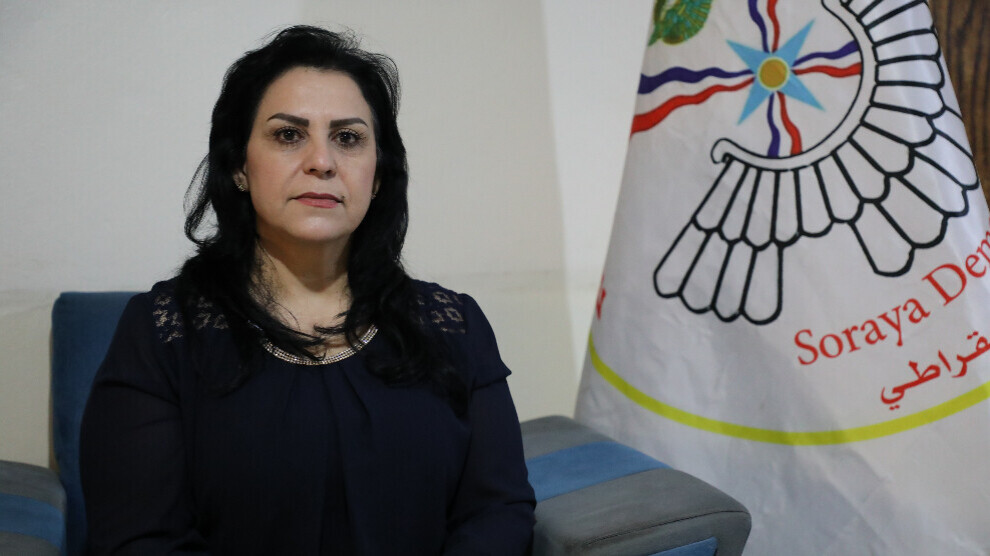
AL-HASAKAH— Amid the escalating tensions witnessed in the Jazira region, especially the city of Hasakah, and the growing inflammatory rhetoric that threatens social relations and puts civil peace before dangerous tests, the need emerges for a responsible discourse that restores consideration for dialogue and fortifies society from sliding toward division and clash.
In this context, the co-president of the Syriac Democratic Party, Madeline Khamis, affirmed that what the region is witnessing cannot be reduced to passing political differences or divergences in viewpoints, but is a reflection of political, administrative, security, and social accumulations that have worsened due to weak dialogue and declining trust between the parties, and have come to warn of dangerous repercussions for the social fabric that was formed over decades of coexistence and partnership among the region's components.
She explained that Hasakah and the Jazira region are distinguished by national, cultural, and religious pluralism that constitutes the essence of their historical and civilizational identity, affirming that this diversity was never a burden on the region or a reason for its weakness, but has always represented a source of richness and strength, and that turning it into a tool for conflict, accusations of betrayal, and hostility serves only to entrench divisions and strike at the foundations of coexistence.
Inflammatory rhetoric and declining trust
In discussing the causes of the current tension, Madeline Khamis explained that what the region is witnessing is the result of an accumulation of political, administrative, security, and social crises that have worsened due to weak dialogue and declining trust between some parties.
She pointed out that the rise of inflammatory rhetoric, especially through social media platforms, contributes to fueling tension and feeding divisions, by spreading accusations and targeting identities and affiliations. She warned of the danger of holding any component responsible for the actions of individuals or groups, or directing accusations without evidence and documented facts.
She indicated that there are parties investing in the state of division and chaos to weaken society and obstruct political solutions, affirming the need to separate political differences and divergences in positions on the one hand, and relations between the components of society on the other, and not to turn national and religious identities into tools for exclusion or discrimination.
She warned that the continuation of these practices threatens civil peace and the future of the region, and undermines opportunities for building a democratic project based on pluralism, partnership, and mutual recognition of rights. "We must not allow political differences to become a reason for destroying the social and human relations between the peoples of the region, for these relations are deeper than partisan differences and narrow interests, and protecting them is everyone's responsibility."
Dialogue is a fundamental entry point for protecting civil peace
Madeline Khamis stressed the need to move from diagnosing the crisis to taking practical steps to address it, affirming that national and political responsibilities should be a bridge for dialogue and understanding, not a tool for deepening divisions. She announced her readiness for dialogue and coordination with all political and societal forces that believe in partnership, justice, and reject violence and exclusion, pointing out that overcoming the crisis requires prioritizing the region's interest over partisan and narrow calculations.
She said: "We want to be part of making the solution, not a party to increasing tension, for what is required today is to bear responsibility and work together to protect society and preserve its stability."
In this context, she called for launching a comprehensive political and societal dialogue that includes various parties, political forces, representatives of components, and civil institutions, in addition to forming joint committees to document cases of incitement, threats, and violations and follow them up through the competent legal institutions.
She also stressed the importance of launching societal initiatives, especially among youth, to enhance the culture of dialogue, acceptance of difference, and confronting hate speech, in parallel with demanding that security, administrative, and judicial authorities bear their responsibilities in protecting citizens without discrimination, investigating violations, and holding those responsible accountable in accordance with the law.
She stressed the need to protect educational institutions and students, preserve freedom of expression and peaceful protest, and prevent any armed practices that would threaten the security and safety of civilians.
Recognition of the rights of all components
Madeline Khamis affirmed that achieving stability and coexistence is inseparable from recognizing the rights of all components of the region and ensuring their real and equal participation in political, administrative, and cultural life, pointing out that Syriacs, Assyrians, Chaldeans, Arabs, Kurds, Armenians, and other components constitute an authentic part of the region's history, identity, and civilizational and social formation.
She stressed the need to translate the recognition of diversity into constitutional and legal guarantees that ensure each component preserves its language, culture, traditions, and privacy, and guarantees its effective participation in decision-making, away from marginalization, exclusion, and discrimination.
She added: "Recognition of national, cultural, and linguistic pluralism does not conflict with Syria's unity, but rather constitutes a foundation for building a democratic state based on equal citizenship, justice, and partnership, in which everyone's rights are protected by law, away from domination and balances of power."
"Hasakah is bigger than partisan differences and narrow interests"
In a message directed to youth, Madeline Khamis called for awareness and responsibility, and not to turn social media platforms into arenas for incitement and the spread of hatred and misleading news, affirming the importance of verifying information and avoiding discourses that fuel divisions between the components of society.
She stressed the need for youth to be part of protecting civil peace and enhancing the culture of coexistence and pluralism, and for the public interest to take precedence over narrow calculations, affirming that the responsibility for maintaining stability is a shared responsibility that includes political forces, institutions, civil society, and all citizens.
At the conclusion of her talk, she affirmed that Hasakah is bigger than partisan differences and narrow political interests, and that all its components are partners in land, history, and destiny, and that a safe and stable future cannot be built for any component in isolation from others, stressing that protecting this shared home requires adhering to dialogue, partnership, and mutual recognition of rights.