
Mezkin Khalil: The Historical Truth of the Middle East Requires a Democratic System
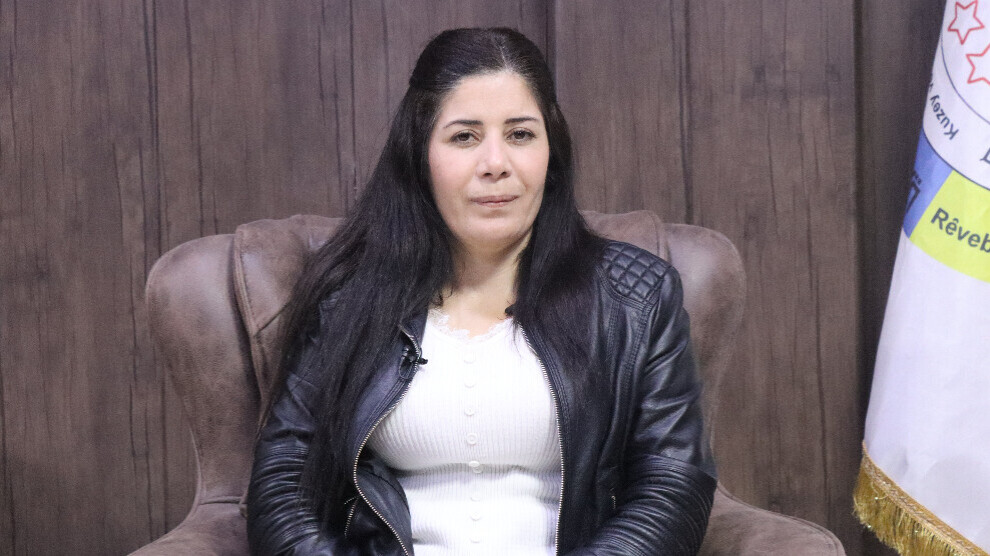
Mazkin Khalil,Co-president of kobani’s Executive Council,said the Middle East was historically a place of unity and a source of civilization. The Democratic Nation Project seeks to restore that reality of dicersity and unity.
Norshan Abdi
Kobani – The Autonomous Administration system in Rojava, inspired by the ideas of leader Abdullah Öcalan on "Democratic Nation," has been subjected to multiple forms of attack. It began with media mobilization, threats, and warnings, later escalating to military assaults during which war crimes were committed, the effects of which remain to this day.
Mezkin Khalil, co‑president of the Executive Council of the Autonomous Administration in Kobani, Rojava, speaks about the historical realities of the peoples of the Middle East: "If we reflect on the foundations of the Democratic Nation and the necessity of its implementation, we find many historical truths. For centuries, peoples of different sects, ethnicities, and beliefs lived together in the Middle East without division. For this reason, the Middle East was historically a place of unity among peoples and became a source for the development of civilization, science, culture, and humanity."
As she explains, the reality of Middle Eastern society became "distorted" with the entrenchment and development of dominant systems and mentalities. "The fabric of the peoples of the Middle East underwent negative changes. For years, the dominant ruling systems swallowed this truth, and the Middle East is losing its reality."
"We Revived Our Historical Roots in North and East Syria"
Mezkin Khalil pointed out that leader Abdullah Öcalan presented his "Democratic Nation" project to correct history. "Leader Öcalan, who analyzed and researched the sociology of all societies and peoples, recognized the need to revive the history of these peoples. Therefore, he articulated our need for a democratic national system and presented this system as an alternative to ruling systems—one that allows peoples to live together without conflict and to build a common life despite their differences."
In North and East Syria, the Autonomous Administration project has continued for 14 years. The democratic national system encompasses all the peoples of the region with their identity, language, culture, and existence, along with their active participation in administering the region.
"Dominant Forces United Against Democratic Forces"
However, the project in North and East Syria has not been spared attempts to undermine it. Attacks occurred early this year by the Syrian Interim Government in the Sheikh Maqsoud and Ashrafiya neighborhoods of Aleppo, extending to areas of North and East Syria. Mezkin Khalil said of these attacks: "They targeted the Autonomous Administration system. The opponents of our project have been working for many years to undermine it. Numerous conspiracies have been hatched to eliminate it because it poses a threat to the interests of hostile forces."
She described the Autonomous Administration project, saying, "It has become a model to be emulated by all freedom‑loving peoples, but the dominant forces have shown fierce hostility toward it and have sought to reimpose control over the will of these peoples. Therefore, a wide‑scale attack occurred, and ethnic conflicts erupted."
"Our Experience is a Rich Legacy for the Future"
Mezkin Khalil believes that the Autonomous Administration project is the optimal alternative, based on the historical realities of this region. As she affirms, "It protects the rights of every nation, especially women's rights, and corrects the distorted history." She added, "For this reason, our 14‑year experience constitutes a rich legacy through which we can expand and strengthen our system. There is no problem between the components of Syria; on the contrary, each component is a great asset for Syria."
"Syria's Wealth Can Endure Through the Unity of Its Peoples"
Mezkin Khalil, co‑president of the Executive Council of Kobani city in Rojava, insists on the Democratic Nation project for Syria's future. She affirms that "Syria's ethnic and cultural wealth represents a great opportunity upon which to organize our project and system. As I see it, the best system for the life of these peoples is a democratic, ecological, and free system. For this reason, we confront the challenges and conflicts that have arisen in Syria by insisting on our project. We can once again strengthen our unity in Syria and protect our rich mosaic from all authorities."
She concluded by affirming that the Democratic Nation system is the solution to all conflicts. "The current crises are based on power. In confronting them, we need democratic societies, structures, and systems."