
The co-chair system corrects a long history of unilateral decision-making
The co-chair system constitutes a progressive governance model that enhances women’s participation in decision-making, challenges entrenched patriarchal norms, and lays the foundation for balanced partnership in North and East Syria.
Asma Mohammed
Qamishlo – The co-chair system has brought about a profound societal transformation that reinforces women’s participation, undermines patriarchal mentalities, and paves the way for building fair governance and balanced partnership between men and women in the Autonomous Administration of North and East Syria.
The co-chair system in the region represents a unique experience at both regional and international levels. It brings men and women together in administration and decision-making, opening broad horizons for genuine female participation in all aspects of life. This model has not been limited to administrative affairs; rather, it has extended to politics, diplomacy, and society, affirming women’s ability to bring about change and exert influence, thereby breaking with the traditional patriarchal mindset that sought to marginalize their role for decades.
A Fundamental Pillar
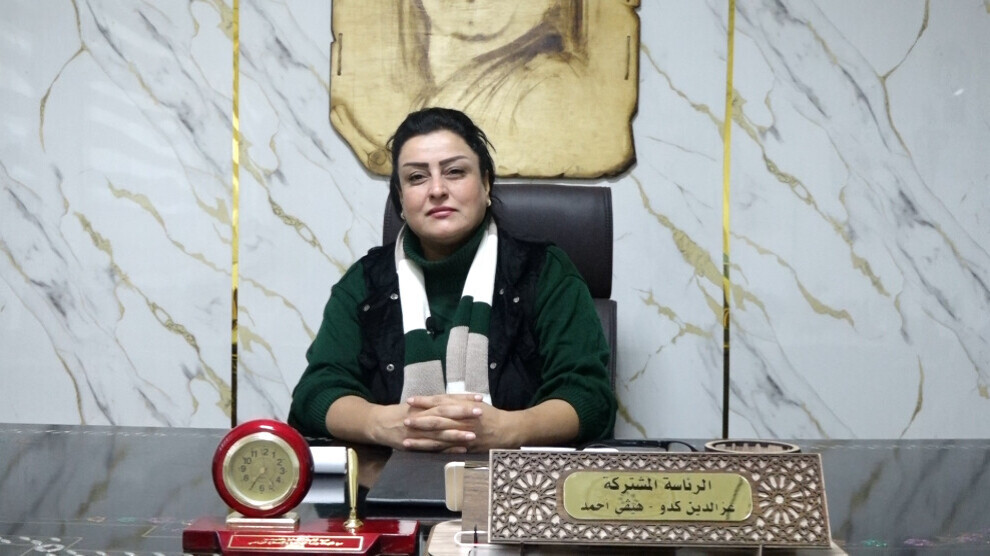
In this regard, the co-chair of the Qamishlo Subdistrict Council, Hêvî Ahmed, stated that the co-chair system is not merely an administrative framework, but a comprehensive strategic vision aimed at empowering women and enhancing their participation in decision-making and community building. She emphasized that women in North and East Syria have proven to be a fundamental component and a solid pillar in building the homeland. They are capable of carrying out both public and private responsibilities, developing their talents, and addressing issues concerning them independently, without interference from any other party.
She views the concept of co-chairmanship as one of the core pillars of the Autonomous Administration system, stressing that it is “not merely an organizational mechanism or an administrative procedure, but a comprehensive and unique model on a global level that brings men and women together in managing work and making decisions. It is based on the principle of genuine partnership and full consensus across all political, social, executive, diplomatic, and military fields, ensuring balanced participation at every step of the decision-making process.”
She further noted that this model reflects an advanced vision for integrating women into all aspects of public life, enabling them to perform their natural role alongside men. This, in turn, guarantees the achievement of justice and gender equality and contributes to eliminating the traditional mentality that has long marginalized women and excluded them from positions of responsibility. “Co-chairmanship does not simply mean holding a dual position,” she added, “but rather embodies a new culture founded on cooperation, mutual understanding, and the fair distribution of responsibilities—an experience that has proven effective in institutional management, strengthening stability, and building a more harmonious and balanced society.
Correcting the Course
Hêvî Ahmed explained that this model was introduced to correct a long historical trajectory of unilateral decision-making, which often led to negative outcomes, marginalized women’s capacities, and excluded them from positions of influence and decision-making. “In the past, women were confined to roles within the family and the private sphere, while society failed to recognize their real capabilities and diverse talents. This resulted in the loss of immense human potential and expertise that could have contributed to societal development had women been given the opportunity.”
She further clarified that implementing the co-chair system was not merely a symbolic measure, but a fundamental step toward rebuilding the concept of participation and entrenching the principle of genuine partnership between men and women. “It provided women with the opportunity to prove themselves as effective actors capable of making significant decisions at both administrative and societal levels. Their role became evident in shaping public policies, managing complex files, and contributing to the promotion of justice and balance within institutions. Consequently, women’s participation is no longer symbolic or limited, but has become an integral part of modern governance structures and social transformation toward a more inclusive and dynamic society.”
Playing Decisive Roles
She pointed out that women in North and East Syria have demonstrated a strong and prominent presence across all spheres of life. Their role has not been limited to civil or administrative work within local institutions, but has extended to battlefronts, political and diplomatic arenas, as well as fields of training, organization, and community coordination. “Women have been able to play decisive roles even under the most difficult circumstances. They fought heroic battles in Kobani, Ras al-Ayn, and across other regions of North and East Syria, making great and courageous sacrifices that established them as one of the main pillars in confronting terrorist organizations. They became the most effective deterrent force in halting the expansion of these groups and achieving security and stability.”
She emphasized that this rich and multidimensional experience has proven to the world that women are not secondary or complementary actors in society, as previously portrayed, but true partners in shaping change. Women are capable of influencing the course of events and shaping the future of the region with strong will and clear vision. This has strengthened their status and reinforced a new image of women as leadership forces who act, defend, and contribute to building a more aware and progressive society.
According to Hêvî Ahmed, women within the Autonomous Administration system shoulder dual and unique responsibilities. “Their general responsibilities include administrative and organizational work, overseeing institutions, and ensuring the functioning of councils. Their specific responsibilities involve organizing women, raising their awareness, developing their skills, enhancing their intellectual and social capacities, addressing their issues, and directly following up on matters that concern them. This is carried out within a framework of mutual trust between women, without interference from any third party, granting women genuine independence and making them the primary decision-makers in both their private and public affairs.”
She affirmed that women’s ability to manage multiple tasks simultaneously and handle complex responsibilities without losing balance or precision makes them indispensable to the success of any institution or society. “Women possess the flexibility and wisdom that qualify them to bear burdens and make appropriate decisions during critical moments.”
Eliminating Patriarchal Mentality
The importance of implementing the co-chair system stems from its role in eliminating the traditional patriarchal mentality that has, for decades, sought to exclude women, deprive them of their natural rights, and confine them to the private sphere while preventing their participation in positions of public responsibility. “Women have always been, and remain, the cornerstone of society. They give birth to half of it and raise the other half, and by nature possess the innate ability to perform multiple tasks simultaneously. This makes them a vital element that cannot be ignored or underestimated in managing societies and making critical decisions. Empowering women is not a luxury or a secondary demand; it is a societal necessity to ensure the construction of a balanced and just future.”
Hêvî Ahmed addressed a message to all women, stressing the importance of knowing their true selves, discovering their latent abilities, enhancing their awareness, developing their skills, and building self-confidence without hesitation or fear. “Women must be free in their thinking, strong in will, firm in stance, capable of making the right decisions at the right time and place, and persistent in striving for equality across political, social, cultural, and economic fields.”
A Nation Is Built by Its Women
She believes that the co-chair system represents a key gateway to raising public awareness, spreading a culture of justice and equality, and enabling every individual to play their true role in building their homeland. It is an advanced model at both regional and international levels, proving that balanced partnership between men and women is not merely a theoretical concept or slogan, but a successful practical experience capable of producing a cohesive and developed society that values individual capacities and acknowledges each person’s role.
In concluding her remarks, the co-chair of the Qamishlo Subdistrict Council, Hêvî Ahmed, described women as the spring that nourishes society with strength and life, and the foundation upon which the nation is built in all its components and layers. “Women are not merely supportive elements; they are a natural force capable of achieving the impossible when granted full freedom and when they grant themselves trust and belief in their ability to choose and make the right decision at the right moment. Through their awareness, willpower, and courage in confronting challenges, women are the true makers of change and the most influential force in any society. They are capable of reshaping reality in all its details, transforming challenges into opportunities, and building a brighter, more just, and more stable future—far beyond expectations—because true progress is incomplete unless women recognize themselves as an indispensable force in the journey of human and national development.”