
Women's rights between constitutional texts and the absence of a state... how will they be applied in times of war?
Following the PNA's release of the 2026 draft constitution for public review, women are following these laws to ensure they contribute to their empowerment and rights.
Rafif Asleem
Gaza – The draft Palestinian Constitution came into effect in mid‑April, with women's rights distributed across several main provisions, including the chapter on "Public Rights and Freedoms" covered by Article (27), which stipulates that Palestinians are equal before the law without discrimination, while Article (41) states that assuming public jobs and positions is a right based on equal opportunity – meaning women have the right to hold them.
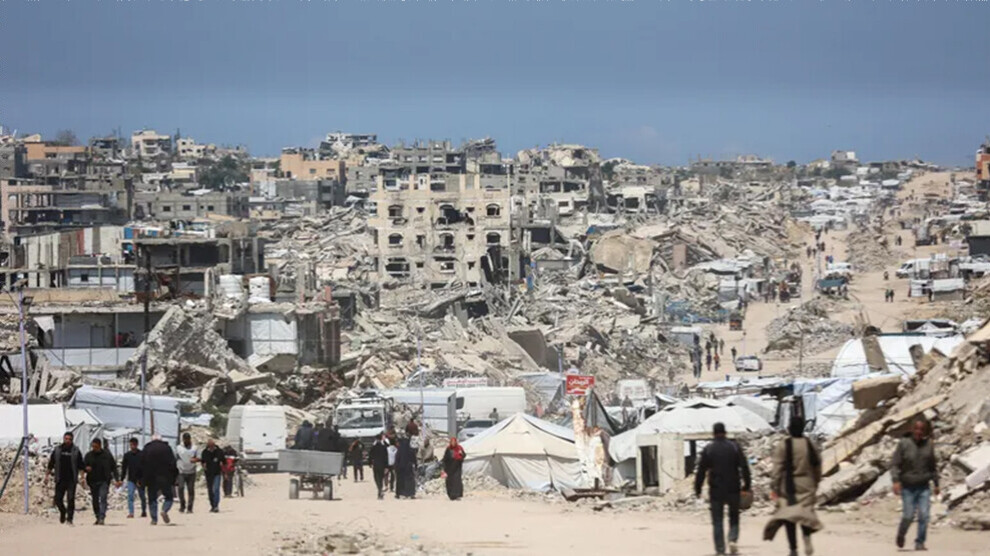
The problem of implementing the draft constitution lies in the ability to apply it in the absence of an actual state with full sovereignty and stable institutions. The political and security scene, especially in the Gaza Strip, which has been living through an extended war for two years, makes the implementation of many constitutional articles a practical challenge. A constitution by nature requires a stable environment, institutions capable of enforcing laws, guaranteeing rights, and holding violators accountable. Given the political division, the damaged institutional structure, and the disruption of many basic services, the application of this draft remains closer to a theoretical framework expressing future aspirations than a fully implementable system at present.
Nevertheless, a number of activists believe that the existence of a constitutional draft represents an important foundational step, because it outlines the contours of the future legal system and prevents legislative vacuum, until conditions allow for the application of a permanent and binding constitution.
Problems of women's representation in the draft Palestinian Constitution
Human rights activist Lubna Al‑Deeb says that discussing a provisional Palestinian draft constitution for 2026 is "extremely important because we have moved from a Palestinian Basic Law to a constitutional authority and from there to a provisional Palestinian constitution, which means that Palestinians now have a framework for all laws and principles guaranteed within constitutional texts for the protection of the most vulnerable groups in society."
She adds: "The existence of a Palestinian constitution for a state under occupation is confirmation of Palestinian presence in the international arena and that they, as individuals, are capable of managing the country's internal affairs, especially women, who have seen a historical emergence after the Nakba." She notes that in 1965 the first women's cell emerged, and their serious participation in political work was proven during 1967, when they participated in struggle, and since then they have continued to offer diverse roles in political and struggle fields.
According to this role, Lubna Al‑Deeb criticizes how women's laws came in the texts of Palestinian legislation, where rights were addressed in general legal phrasing – the term "Palestinians" was unfair and did not explicitly guarantee women within its texts, leaving room for evasion. She notes that Palestine's accession to many international conventions concerning women, such as CEDAW and others, obliges it to formulate provisions for women based on those laws, which have formed periodic reports of commitment.
Protecting women requires the constitutional legislator to speak in a clearer manner about them; it is not enough to speak of parity and equality in all fields by using the general masculine plural. Lubna Al‑Deeb points out that Arab societies in general tend to isolate women from political and social work. When a text gives women a 50% quota, failing to empower them becomes a violation of a clear constitutional legal text that requires punishment.
She adds: "Women's rights appeared in the new draft within the second chapter on general principles, where one article mentioned the family, protection of mothers, custody, and violence, but custody was not detailed with more precision, nor was violence against minors or women mentioned – it came as protection of the family from violence. The same applies to education and health."
Lubna Al‑Deeb disapproves of the new legal provision that stipulates women's legal capacity to sign only marriage contracts before the age of 15, not other contracts, despite international law stipulating that both sexes have the capacity to sign contracts after age 18, i.e., after childhood ends. She asks: is marriage more important than other contracts in social life that the legislator gave her capacity only for it?
She adds that the quota did not do justice to women in the new draft constitution – it only came to 30%. She notes that during a transitional period "we do not demand 100% empowerment for women, but since Palestine is facing a new experience and an important and sensitive stage, women should have received a 50% quota."
"The draft is a successful means for countries under colonialism"
Activist Shaha Al‑Sharafa says that women are not half of society, but the foundation of its establishment and advancement, especially when speaking of women in Gaza who have always proven their presence on all occasions, but that participation has sometimes been contradicted by the difficult conditions the city has experienced, as they had to rearrange their priorities anew.
Regarding the provisional Palestinian draft constitution, Shaha Al‑Sharafa explains that the State of Palestine is in an exceptional situation, subjected to great pressures whether in the Gaza Strip or the West Bank. The Palestinian Authority saw fit to issue a non‑final initial document containing proposals for constitutional articles drafted by a specialized committee, which have been open for public discussion, amendment, or referendum over the past two months before being adopted as a permanent and binding constitution.
She adds: "This draft is a successful means for all countries under colonialism or suffering from instability; it is a transitional phase only, lasting from 4 to 5 years until the official constitution of the country is approved."
Shaha Al‑Sharafa explains that the interim constitutional drafting committee, in cooperation with the Ministry of Women's Affairs and civil society institutions, worked to review these provisions several times to ensure the inclusion of women's issues in more detail, and to preserve the rights of women and girls and ensure full justice for them within the exceptional circumstances the country has experienced.
She concludes by saying that the law is "good and takes into account the rights and protection of women," but these laws remain dependent on circumstances that may afflict the country, especially when speaking of the Gaza Strip and a war that has lasted two years, which has limited the application of laws and regulations, as well as women's suffering as they still try to win their rights.
Thus, there are two different views on the draft Palestinian constitution, despite agreement on the importance of having a constitutional framework at this stage. Lubna Al‑Deeb focuses on the legal gaps she sees in the formulation of women's rights, considering that the draft did not do justice to women enough, whether in the language of the texts, representation quotas, or protection of the most vulnerable groups. Shaha Al‑Sharafa, on the other hand, views the draft as a necessary transitional step under the exceptional circumstances Palestine is going through, and sees it as a tool to build upon later, especially given the efforts made to ensure the inclusion of women's issues. Between these two testimonies, a clear debate emerges between those who demand stricter and clearer texts from now on, and those who see the priority as having a foundational document that can be developed when political and security conditions allow.