
The Middle East on a Hot Plate…..Wars Ignite.
The Middle East witnesses an unprecedented regional explosion: wars intertwine with state crises fronts entangle from Iran to Lebanon, Gaza, and Yemen_no longer mere military conflict but the collapse of an entire political model.
Malfa Muhammad
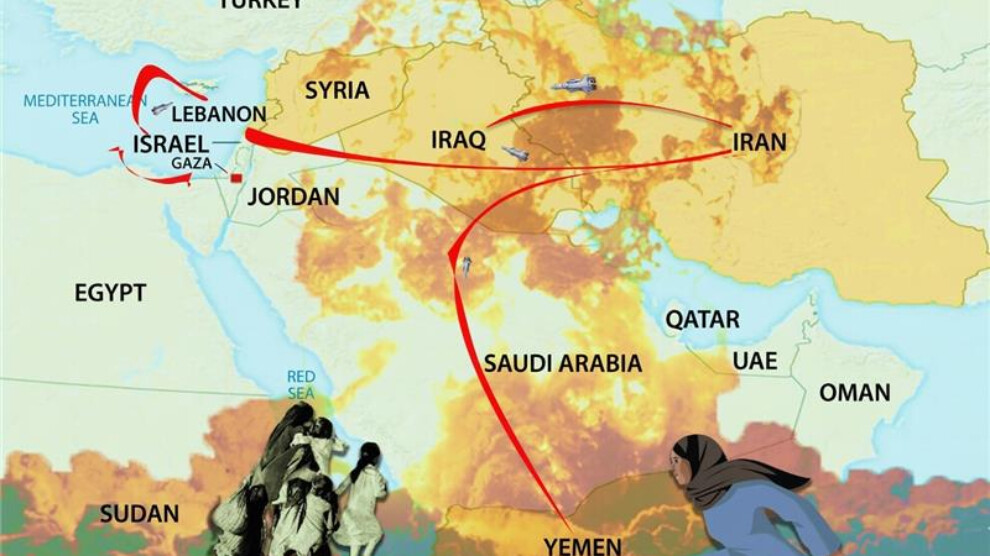
News Center — The world is entering an unprecedented phase of tension, as the confrontation between the United States and Israel on one side and Iran on the other has shifted from "limited skirmishes" to a full-scale war that is redrawing maps of influence in the Middle East. The scene is no longer merely an exchange of strikes, but a complete slide into open conflict that spans fronts from Iran to Lebanon, Gaza, Yemen, and Iraq, igniting vital maritime corridors, while international powers race to cement their positions in a rapidly changing regional equation.
To understand this regional explosion, it is not enough to view it as a conflict between axes; rather, it is a direct product of a patriarchal political model shaped a century ago. This model—built on the centralized nation-state and men's monopoly over decision-making and violence—is the thread connecting all fronts. The war is not merely a confrontation between states, but a reproduction of a single authoritarian system that excludes society, especially women, from participation.
From a feminist political perspective, this scene exposes the limits of the patriarchal nation-state; it is a state that has reproduced a closed, authoritarian center and an elite that controls decision-making. As the war expands, the fragility of this model is laid bare—a model that treats society as a silent mass, men as fuel for the frontlines, and women as a social incubator for war rather than as actors with the right to hold power accountable.
Behind the military noise, a much deeper crisis emerges: "a crisis of an entire political model" built on the centralized nation-state, on the monopoly of power and wealth, and on the marginalization of women and peoples. Leader Abdullah Öcalan was among the first to warn against this path, considering that what we are experiencing is not just a regional conflict, but one manifestation of the "crisis of capitalist modernity," which he described as the true face of the Third World War. In response to this collapse, he proposed an alternative vision based on "grassroots democracy and women's liberation" as the only entry point to ending the system of violence and building a more just society.
This ideological analysis reveals the intertwining of three major systems: rigid nationalism, ideological religion, and neoliberal capitalism. Despite their different slogans, they agree on keeping women in a subordinate position, turning the current war into a means of reproducing the same patriarchal-class system and modernizing its security tools.
Open Regional Conflict
For weeks, the Middle East has been witnessing one of the most dangerous moments of military explosion, as the US-Israeli confrontation with Iran has slipped from the framework of limited strikes into an "open regional war" extending from the Gulf to the Mediterranean. Aerial and missile strikes are now hitting the depths of both Iran and Israel, while operations expand to include Gulf states—a clear indicator of the collapse of the deterrence system that governed relations between the parties for decades.
This escalation is not an isolated event, but a new chapter in a series of accumulated conflicts rooted in major transformations that reshaped the region. The 1979 Islamic Revolution in Iran created an almost complete rupture with Israel, after years of security and economic cooperation between the two sides. Tehran adopted a discourse considering Israel an "illegitimate entity," and made supporting anti-Israel movements part of its ideological and political structure.
In the 1980s and 1990s, Iran adopted a strategy of "forward defense" by supporting regional allies in Lebanon, Palestine, Yemen, and Iraq. In response, Israel adopted a "campaign between wars" policy, using precise strikes to prevent the consolidation of Iranian presence in Syria and cut supply lines to its allies.
From Iran to Lebanon... An Inevitable Transition to an Active Front
As the confrontation between Iran and the US-Israel expands, other conflict arenas can no longer remain on the sidelines. Fronts linked to Tehran have begun to react automatically to the escalation, foremost among them the Lebanese arena, which has always been a strategic extension of the regional equation.
Lebanon can no longer remain outside the scene. Since March 2, 2026, the southern border has turned into an "active front" after Hezbollah entered the confrontation directly, in what its leaders described as a "strategic commitment" to Tehran and a response to the strikes it is facing. This involvement was not surprising; Lebanon has always been part of the regional deterrence equation, but the scale of participation this time has moved the country from the "brink of engagement" to a "wide-scale war" interconnected with the Iranian front.
Israel responded with an unprecedented intensification of its aerial and missile strikes on southern Lebanon and the suburbs of Beirut, before launching ground operations on March 16 in an attempt to impose a de facto "security zone" and push Hezbollah away from the border. This escalation came within an Israeli vision that neutralizing the Lebanese front is a prerequisite for the success of its operations against Iran, making Lebanon an organic part of the regional war theater, not merely a secondary arena.
As in every conflict governed by a patriarchal structure, women's voices are completely absent from decision-making, even though they bear the heaviest burden of displacement and social collapse—revealing the contradiction between the discourse of resistance and the reality of patriarchal authority that controls the destiny of society.
From Lebanon to Gaza... Another Face of the Equation
If Lebanon entered the war through its connection to a regional axis, Gaza represents the other face of this equation, having transformed over the past two decades from a local Palestinian arena into a central node within Iran's network of influence.
Since the 2023 war, the Gaza Strip has been under constant siege and destruction. But behind the harsh humanitarian image, a more complex political equation is revealed: Hamas, which began as a popular resistance movement, has become a parallel authority imposing the decision of war and peace without the participation of society or its institutions. As its regional ties expanded, its ability to make a fully independent decision diminished, because its position within the axis makes it part of calculations that go beyond Gaza's borders.
The war is managed through a closed patriarchal decision-making structure, while women are reduced to images of victims or mothers, without being part of shaping the decision or determining the course of the conflict.
Iraq... The Duality of State and Factions
What applies to Gaza in terms of the intertwining of local and regional dynamics appears even more clearly in Iraq, where a weak state intersects with armed factions directly linked to Iran, making the Iraqi arena an integral part of the broader war scene.
Iraq represents a telling example of the crisis of the state in the Middle East, where an official institutional structure intersects with a system of armed factions possessing social, political, and military legitimacy. The Popular Mobilization Forces (PMF) are the most prominent of these actors, having emerged in the context of confronting ISIS, but quickly transformed into a supra-state force with influence beyond the state's capacity for control and containment.
Although the PMF was established as an emergency force, a significant part of its factions is organizationally and ideologically linked to Iran's Revolutionary Guard. This connection has made the PMF part of Iran's regional influence network, which operates according to a logic of "multiple arenas" in confronting the US and Israel. Thus, the PMF is no longer merely a local force, but a regional actor moving within calculations that transcend the borders of the Iraqi state.
From Iraq to Yemen... Another Extension of the Axis
While the conflict in Iraq takes on an institutional-factional character, Yemen presents another model of the influence of regional axes, as the Houthis represent one of the most important extensions of Iranian influence in the region. With the expansion of the US-Israeli war against Iran, on Saturday, March 28, Israeli forces recorded for the first time a missile launch from Yemen, before the Houthis claimed responsibility. This development came after a series of threats from the group that it would intervene if the escalation against Tehran and the "axis of resistance" continued.
Looking back, the Houthis have been linked to Iran since the early 2000s, when Tehran began supporting groups adopting anti-US and anti-Saudi discourse. With the outbreak of the Yemeni war in 2015, this connection deepened significantly, as Iran provided weapons, expertise, and training through the Revolutionary Guard and Hezbollah. The Houthis also adopted the discourse of the "axis of resistance" and raised its slogans, while maintaining relative independence in decision-making.
In Yemen, as elsewhere, the war is managed with a patriarchal logic that makes society merely a reservoir for mobilization and keeps women outside any political role, even though they bear the consequences of war—loss of security, food, and care. Despite the differences in conflict arenas from Lebanon to Gaza, Iraq, and Yemen, what unites them is the reproduction of the same patriarchal system—a system that makes the nation-state and armed movements two faces of a single authority that monopolizes decision-making and violence and excludes society, especially women, from participation.
Maritime Corridors as Pressure Cards... The "Breaking Bone" Scenario
As the conflict moves from land to sea, the Strait of Hormuz has emerged as one of the most important pressure cards in Iran's hand. The strait is not just a narrow waterway between land and ocean; it is a global energy artery. As war escalates, this artery has returned to the forefront—not only as a trade route, but as a tool that can change the balance of power in an instant.
In recent days, Iran sent a message to the International Maritime Organization stating that the strait would remain open to "non-hostile vessels." It seemed like a quiet announcement, but it carries a dual tone: one hand reassuring markets, the other hinting at the possibility of pressure, closure, or selective targeting.
From a feminist perspective, these conflicts over maritime corridors appear as an extension of the patriarchal mindset of control that treats geography and resources as tools of power, not as living spaces for societies dependent on economic and security stability.
Everyone knows that the current situation is not the end. If the war reaches the "breaking bone" stage, the rules of the game could change entirely. Then, Iran might not be content with signaling, but could use the strait as a direct weapon, whether by disrupting navigation or targeting energy infrastructure in the Gulf. This scenario, if it occurs, will not remain confined to the region, but will shake global markets from Asia to Europe.
Where Is the Scene Headed?
What is happening is no longer a series of separate crises, but an interconnected web of conflicts: a war on Iran, the Lebanese front, ongoing Gaza, tension in Yemen and the Red Sea, and pressure on the Strait of Hormuz. Any change on one front directly affects the others.
Tehran seeks to establish a new deterrence equation, but it is moving on the edge of an abyss; any miscalculation could open the door to a wider strike or internal collapse if the war is prolonged and sanctions intensify.
Despite the escalation, a window—albeit narrow—still exists for a settlement based on: a truce in Gaza, security arrangements in Lebanon, and mutual guarantees regarding maritime corridors and the missile program.
But the real alternative is not merely a ceasefire; it is reimagining societies through a participatory economy not based on plunder, and a grassroots political space where decisions are shaped from below. Women's liberation is not just about quotas; it is a structural condition for any genuine democratic experience. Either women are at the heart of any coming liberation project, or the world will remain trapped in the same loop: men declaring wars, and women paying the price in silence.