
Women workers in Morocco… permanent services amid suspended rights
In Morocco, women cleaners in public institutions face a stark paradox: while providing essential, continuous services, they endure a precarious reality lacking job stability due to widespread reliance on outsourcing companies.
By Hanane Hart
Morocco – Every year, May Day provides an opportunity to renew the debate on working conditions and the rights of workers, both men and women. However, some groups remain outside this public debate, despite their daily presence in several public facilities in Morocco. In these spaces, women cleaners begin their day in the early hours of dawn, before administrative staff arrive, preparing the premises to receive a new workday – in silence, and with contracts that do not reflect the continuity of their presence.
Work based on outsourcing
This group often works through outsourcing companies, in an employment model based on external contracting, where stability appears only superficial. Despite years of work inside the same institutions, the workers' situations remain tied to changing companies, with no real guarantees of continuity or recognition of professional seniority.
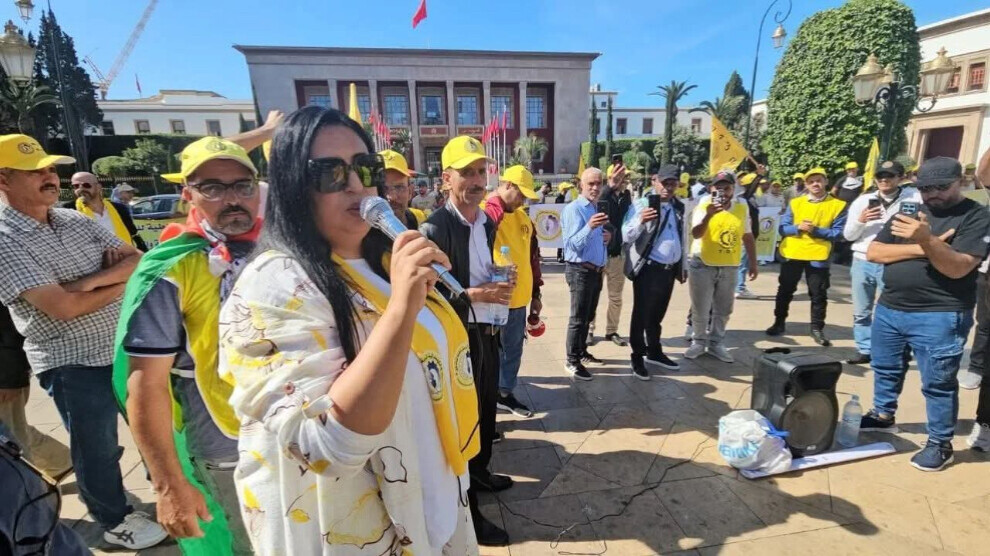
In this context, trade union activist Loubna Najib affirms that this file has been raised with the Ministry of Labor through official reports and study days, including clear demands related to improving working conditions, reducing working hours, and ensuring actual benefit from social protection. However, according to her, these demands have remained promises without actual implementation.
She points out that many women workers start work very early in the morning, sometimes as early as five o'clock, for low wages, despite the demanding nature of the tasks they perform daily. A large proportion of them come from fragile social backgrounds, including widows and divorced women, especially in rural and remote areas where living and working difficulties are compounded.
Double fragility
Challenges are not limited to the nature of the work but extend to transportation conditions. Women workers in distant areas face great difficulties in reaching their workplaces, in the absence of suitable means of transport, which increases daily fragility.
Despite some improvements achieved after years of union struggle, especially in terms of reducing working hours – which in some cases exceeded 12 hours per day – the general reality remains worrying.
Loubna Najib affirms that there is a clear weakness in monitoring within public institutions, whether by labor inspectorates or contracted administrations, which contributes to the continuation of a number of violations related to work through outsourcing companies.
In this context, although Moroccan law requires declaring women workers to the National Social Security Fund, union estimates indicate that some women workers are either not fully declared, or are declared at wages lower than their actual wages, which directly affects their access to health coverage and retirement.
Seniority without stability
Field monitoring also shows that a number of women workers have worked for more than 10 or 15 years inside the same institutions, without this being reflected in their professional status, due to the changing of companies entrusted with sector management, leading to the loss of seniority and the interruption of professional stability.
Loubna Najib criticizes the continued failure of a number of outsourcing companies to respect their obligations, focusing on reducing costs and achieving profits, in the absence of effective punitive mechanisms. She also points out that some administrations overlook these violations, which contributes to reproducing the same fragile conditions.
In the catering sector as well, union data reveal cases where women workers receive meager compensation that may not exceed 25 dirhams per day (about $2.7), calculated on the basis of meals rather than a fixed monthly wage, reflecting an additional problem of professional fragility.
In light of this reality, women workers find themselves between two contracting parties – administrations and companies – each referring responsibility to the other, leaving them without a clear address to protect or claim their rights.
In response, Loubna Najib stresses the need for responsible authorities to intervene decisively, by strengthening monitoring, activating the law, imposing penalties on violating companies, in addition to reviewing the model of delegated management, to ensure the protection and professional stability of women workers.
As this model continues, the question remains: How can permanent services inside public facilities continue in the absence of stability for the women workers who ensure them daily?